

Quick Answer
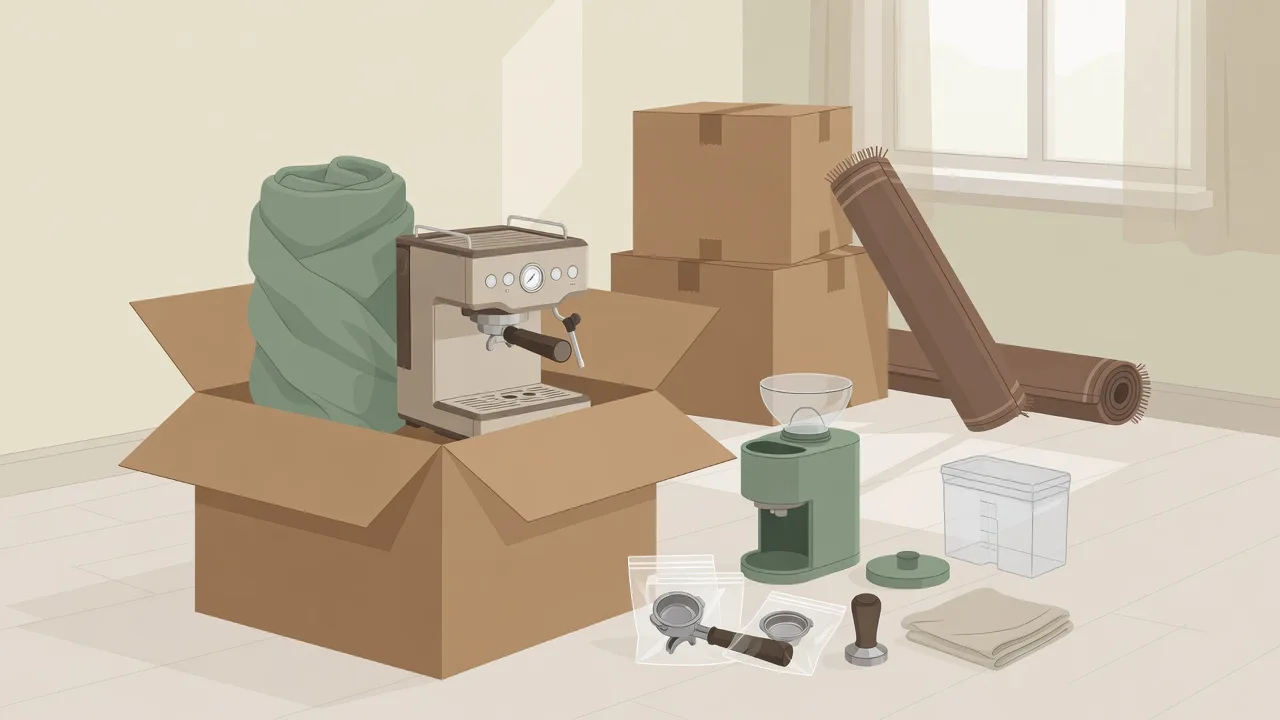
Clean the machine early, well before moving day, so it has time to dry. Empty the water tank and the drip tray, and let the machine cool before you handle it. Pack it upright with nothing on top, bag the portafilter, baskets and other small parts so they don't go missing, and empty the grinder's hopper before you pack it. If there's any chance the machine will sit somewhere freezing, keep it with you instead, for example in the heated car rather than an unheated truck.
Don't open the machine to drain it. Breville's compact-machine manuals tell you to empty the removable tank and drip tray before storing, and none of the compact-machine manuals we checked describes draining internal parts. The one exception we found is Breville's Dual Boiler, whose own manual asks you to drain its boilers before transport. That step is for that model only.
Evidence in this guide: Manufacturer-researched (Breville, De'Longhi, Baratza and KINGrinder instruction manuals, checked October 24, 2026) and forum discussion (Reddit r/espresso). Nothing here is Hands-on tested or a Measured mock-up. This is a packing guide, not a ranking.
Apartment Barista uses Amazon affiliate links. As an Amazon Associate, this site earns from qualifying purchases. Prices and availability can change at any time and should be checked on Amazon before buying.
Who This Guide Is For
- Renters moving with a compact espresso machine such as a Breville Bambino, Bambino Plus or Barista Express, or a De'Longhi Dedica or Stilosa.
- Anyone packing an electric grinder like the Baratza Encore ESP, or a hand grinder, along with the machine.
This guide stops when the boxes are open. For setting the machine up again in your new kitchen, see First Week With a New Espresso Machine in a Small Apartment: A Setup Checklist.
What Owners Ran Into (Forum Discussion)
On April 17, 2026, an Expobar owner was planning a cross-country move and asked the question this guide answers. They were "looking for advice on how to pack my espresso machine to keep it safe during the move." (Reddit, "Espresso Machine move [E61 Expobar]")
On July 10, 2025, another owner described what happened after a long drive: "We brought my espresso machine with us in the car, packed up, drained and cleaned." When they set it up at the new place, "I open the water reservoir and there’s TONS of ants, crawling out, saving their eggs because the machine is hot!!" (Reddit, "Ants in machine during move")
On August 29, 2024, a Bambino owner found a problem while packing: "I’m moving and while packing up I took off the drip tray and found a roach or something similar living in the drip tray" (Reddit, "Found a roach in my drip tray")
These are individual posts, not a survey. They do show the three things that tend to go wrong: not knowing how to pack the machine, something getting into the water tank on the way, and finding something in the drip tray at the last minute. We don't know how the ants got in. Even a cleaned and drained machine is worth checking again at both ends of the move.
Step 1: Clean It Well Before Moving Day
Do the last full clean early, not the night before. That gives the drip tray, water tank and any rinsed parts time to dry before they're wrapped. For the cleaning routine itself, see How to Clean an Espresso Machine in a Small Kitchen.
- Take out the drip tray and look at it. Breville's Bambino manual says the drip tray "should be removed, emptied and cleaned after each use or when the drip tray indicator rises through the drip tray grid." Before a move, pull it all the way out, empty it, wash it and let it dry. The roach in the post above turned up exactly there. For the day-to-day version of this routine, see Tiny Drip Tray Workflow for Compact Espresso Machines.
- Empty and dry the water tank. Leave its lid off for a while so the inside dries too.
- Wipe out coffee grounds. Clean the portafilter, baskets and the area around the group head so you aren't packing old coffee.
We didn't find any manufacturer guidance on insects in an espresso machine. So this guide sticks to cleaning, drying and checking the parts you can remove, and doesn't recommend sprays or treatments. Don't open the housing to look inside.
Step 2: Empty the Water You Can Reach, and Let It Cool
Breville's Bambino and Bambino Plus manuals give the same storage steps: "Before storing, turn the machine off, switch off and remove the power plug from the power outlet. Empty the water tank and drip tray and ensure the machine is cool, clean and dry. Store in an upright position. Do not place anything on top of machine." The Bambino safety section also says to "Allow the product to cool down before moving or cleaning any parts."
That's the whole draining job for most compact machines: the removable tank and the drip tray. The manuals we checked for the Bambino, Bambino Plus, Barista Express, Dedica and Stilosa don't describe draining internal water, and we didn't find a manufacturer procedure for it. Don't take panels off or tip the machine to force water out.
Carry the tank empty and on its own. De'Longhi's Stilosa (EC260) manual has a troubleshooting entry for "The water tank leaks when carried." The listed cause is "The valve at the bottom of the tank is dirty or defective," and the fix is "Clean the water tank." An empty, clean tank packed separately can't leak onto everything else in the box.
If you own a Breville Dual Boiler (BES920), its manual says: "We recommend draining both boilers completely before transporting the machine or storing for an extended period of time." Follow the draining steps in that manual. This is a requirement for that model, not a general rule for other machines.
Step 3: Keep It Out of the Cold
De'Longhi's Dedica (EC685) manual warns: "The appliance could be damaged if the water it contains freezes. Do not install the appliance in a room where the temperature could drop below freezing point." Breville's Dual Boiler manual describes its boiler draining as "also intended as an anti-freeze measure in the event the machine is exposed to extreme cold temperatures."
The Bambino, Bambino Plus, Barista Express and Stilosa manuals we checked don't mention freezing. None of these manufacturers gives a safe temperature range for moving or storing a machine, and we didn't find one, so we haven't given one here. In winter, the simple precaution is to keep the machine with you: the heated car instead of the back of a truck, and inside instead of a cold storage unit.
We also didn't find manufacturer guidance on how long a machine can safely sit packed in storage. If you're storing it for a long stretch rather than just moving it, follow your manual's storage section and contact the manufacturer if you need more than that.
Step 4: Pack It Upright With Nothing on Top
The Bambino, Bambino Plus and Barista Express manuals all say to store the machine upright with nothing on top of it. Pack it the same way:
- Use the original box and inserts if you kept them. If not, use a sturdy box a bit larger than the machine.
- Wrap the machine in a towel or blanket, then fill the gaps so it can't slide around.
- Mark the box so it stays upright, and make sure nothing heavy gets stacked on it in the truck.
- Unplug the cord and coil it loosely beside the machine so it isn't pinched.
These packing tips are general moving advice, not manufacturer instructions. The manuals don't say how to box a machine for a move.
Step 5: Bag the Small Parts
The portafilter, baskets, tamper, milk jug, steam tip cleaning tool and cleaning discs are the parts that tend to go missing. Breville's Barista Express (BES870) manual says to "Insert all accessories into the storage tray" before storing. If your machine has that tray, use it. If not, put the small parts in one labeled bag and pack it in the same box as the machine, so you can make coffee the first morning without hunting through boxes.
Keep the manual in the same bag. You'll want it for setup.
Step 6: Pack the Grinder
Baratza Encore ESP. The manual's steps for removing the hopper start with: "Remove all coffee beans from the hopper and grind any remaining beans through using either the On/Off switch or the pulse button. Unplug the grinder from the power outlet before removing the hopper." To lift the hopper off, it says to "Rotate the hopper completely counterclockwise so that the grind setting indicator is aligned with the triangle near grind setting 40." That changes your grind setting, so write down your current setting first.
The same manual says "When making grind adjustments, the grinder must either be running or completely empty of beans to prevent damage to the unit," so run it empty before turning the hopper. It also warns: "Do not immerse the grinder housing in water. Do NOT wash the burrs with water, or they will rust." If you're cleaning before the move, stick to dry cleaning; see How to Clean an Espresso Grinder in a Small Apartment Without Making a Mess. If you still have the original packaging, check it for the adjustment shims the manual mentions before you recycle it.
KINGrinder K6. The manual says "The entire grinder should not be washed with water. Please use the brush for cleaning." and "Please store in a dry environment." Note your click setting before you pack it in case it gets bumped. For more on this grinder, see KINGrinder K6 for Apartments.
Other grinders. Follow your own grinder's manual. Don't open up the burr assembly to secure it for the move.
Beans. Pack beans separately in an airtight bag or container rather than leaving them in the hopper. See How to Store Coffee Beans in a Small Kitchen.
Step 7: Moving Day
- Carry the machine and grinder yourself if you can, in the car with you rather than in the truck.
- Don't use the machine on the way. Breville's Bambino manual says "Do not use in moving vehicles or boats."
- Keep the box upright and wedged in place so it can't tip over or slide around.
After You Arrive
Before the first fill, take out the water tank and drip tray and look inside them. The ants in the post above were found in the water reservoir. Then follow First Week With a New Espresso Machine in a Small Apartment: A Setup Checklist for rinsing and first shots, and Espresso Machine Outlet and Cord Placement for Apartments for finding the right spot in the new kitchen.
Machines and Grinder Mentioned in This Guide
These are the machines and grinder whose manuals give the clearest packing and storage steps for this guide. This is not a ranking.
- The Breville Bambino manual gives the short storage checklist used above: empty the tank and drip tray, cool, clean and dry, upright, nothing on top. See Breville Bambino for Apartments.
- The Breville Bambino Plus manual gives the same storage steps. See Breville Bambino Plus for Apartments.
- The Baratza Encore ESP manual explains how to empty the grinder and take off the hopper. Write down your setting first. See Baratza Encore ESP for Apartments.
For the other machines in this guide, see De'Longhi Dedica for Apartments and De'Longhi Stilosa for Apartments.
FAQ
Do I need to drain the inside of my espresso machine before moving?
For the compact machines in this guide, the manuals we checked only ask you to empty the water tank and drip tray. We didn't find a manufacturer procedure for draining internal water on those models, so don't open the machine. Breville's Dual Boiler is the exception we found: its manual asks you to drain both boilers before transporting it.
What temperature is too cold for an espresso machine?
We didn't find a temperature from Breville or De'Longhi. De'Longhi's Dedica manual says the appliance could be damaged if water inside it freezes. The practical answer is to keep the machine anywhere it won't freeze, which usually means traveling with it instead of leaving it in a cold truck or storage unit.
Do I need the original box?
None of the manuals we checked says you must use it. If you kept it, use it. If not, a sturdy box, a towel or blanket, and enough padding to stop it from sliding will do the job. Keep the machine upright either way.
Will the warranty cover damage from a move?
We didn't find a statement from Breville, De'Longhi or Baratza on whether moving damage is covered. Check your warranty terms or contact the manufacturer before the move if this matters to you. For more on warranties and repairs, see How Long Does a Beginner Espresso Machine Last? Wear Parts, Care, and Repair vs Replace.
I found bugs in my machine while packing. What should I do?
Remove, empty, wash and dry the drip tray and water tank, and clean what you can reach without opening the machine. We didn't find manufacturer guidance on pests, so if you're worried about the inside of the machine, contact the manufacturer's support.
Sources
Checked October 24, 2026.
- Breville, Bambino BES450 US instruction book
- Breville, Bambino Plus BES500 US instruction book
- Breville, Barista Express BES870 US instruction book
- Breville, Dual Boiler BES920 instruction manual
- De'Longhi, Dedica EC685 instruction manual (De'Longhi manual hosted by a retailer)
- De'Longhi, EC260 US instruction manual
- Baratza, Encore ESP manual
- KINGrinder, K6 manual
- Reddit r/espresso posts dated April 17, 2026, July 10, 2025 and August 29, 2024, linked above
Bottom Line
Moving an espresso machine is mostly about doing the simple steps early. Clean it early, empty the tank and drip tray, let it cool and dry, and pack it upright with nothing on top. Bag the small parts, empty the grinder and write down its setting, and keep the machine out of the cold. Don't open it up to drain it unless your own manual tells you to. When you arrive, check the tank and drip tray before the first fill, then set it up like a new machine.
Apartment Barista uses Amazon affiliate links. As an Amazon Associate, this site earns from qualifying purchases. Prices and availability can change at any time and should be checked on Amazon before buying.