Quick Verdict
Three or more morning milk drinks do not automatically mean you need a larger espresso machine. First identify the repeated bottleneck. In a small apartment, the slow part may be weighing coffee, finding counter space for cups, steaming and pouring milk, or getting the shared sink clear again—not the machine's brew cycle alone.
Keep a compact sequential setup when the three-drink round is occasional, everyone can tolerate a calm order, and the counter still supports safe milk handling and cleanup. Start researching a higher-capacity machine type when three or more hot milk drinks are a normal, time-sensitive job and the same workflow failure happens most weekdays.
This is a buyer-fit guide based on public user discussions and manufacturer materials, not a lab test or a promise that any compact machine will serve a group at cafe speed.
The Three-Drink Decision Rule
| Your usual morning | Practical starting point | What to verify next |
|---|---|---|
| One or two drinks, with a third only sometimes | Keep the compact routine | Whether the third drink is truly frequent enough to change the kitchen permanently |
| Three drinks, spread across a relaxed morning | Test a calmer sequence first | Which step repeatedly makes the drinks late or messy |
| Three or more drinks needed in a short window most weekdays | Compare capacity as a whole system | Brewing-to-steaming changeover, grinder pace, milk handling, cleanup, and counter footprint |
| Four to six drinks, frequent guests, or regular hosting | Treat this as an upgrade-research signal | Machine type, household budget, service pace, and whether a larger station still fits the apartment |
Public espresso discussions consistently distinguish an ordinary one- or two-drink routine from repeated rounds of several milk drinks. That is a useful demand signal, but it is not a universal rule: machine design, drink size, beans, and personal workflow differ. Use your own routine and the manual for the exact machine before changing how you brew or steam.
Find the Real Bottleneck Before Buying More Machine
A compact machine may not be the slowest part
Time one ordinary weekday round from getting cups out to putting the milk pitcher and cloth away. Do not time a holiday breakfast. Mark the step that keeps repeating: grinding, switching from espresso to steam, making room for cups, pouring milk, or washing up.
If the problem is a crowded work zone, a physically larger machine can make the problem worse. Start with How Much Counter Space Do You Need for an Espresso Setup? before treating capacity as only a feature comparison.
The sequence matters more than an idealized shortcut
Some shared-boiler designs require espresso before selecting steam; De'Longhi documents that sequence for its relevant models. That does not make every compact machine the same. Follow the manual for the machine you own, especially for heat-up, steam, purge, water, and cleaning instructions.
For several drinks, avoid inventing a universal recipe such as one oversized milk pitcher or a fixed brew order. A milk amount that is hard for you to control can create more waste and more cleanup. A good weekday workflow is one you can repeat without rushing hot milk or blocking the only sink.
Guests are not always an upgrade requirement
An occasional four-drink weekend can be slower without proving that the weekday setup is wrong. Upgrade research becomes more useful when the same household makes several milk drinks in a short window often enough that the delay is predictable and frustrating.
Apartment Fit Checks for a Three-Drink Round
- Count hot milk drinks in one normal weekday window, then count how often that window happens.
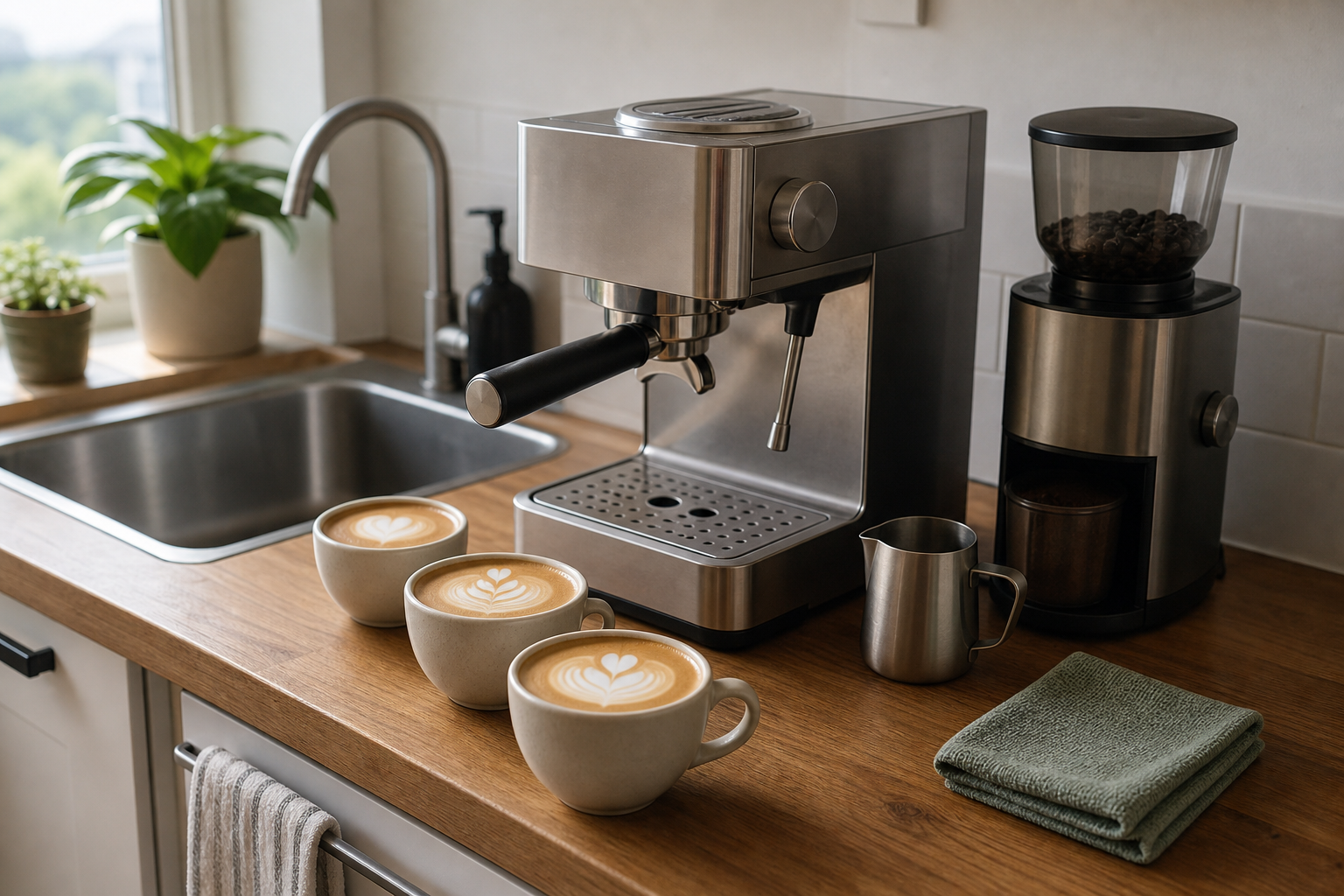
- Leave a landing spot for three cups, a milk pitcher, a dry cloth, and the portafilter handle—not just the machine body.
- Check where the water tank, bean hopper, and drip tray need clearance before assuming a larger model will fit.
- Notice whether a grinder, rather than the espresso machine, is holding up the round. See Best Burr Grinders for Beginner Espresso for the separate-grinder decision.
- Keep the sink route clear enough to rinse and put away the tools you normally use. Espresso Setup Near One Small Sink has a small-space layout check.
- Read your exact machine manual before changing its brew-to-steam or cleaning sequence.
- When considering an Amazon listing, confirm the current seller, exact model, dimensions, included accessories, return terms, price, and availability.
Compact Sequential Example: Breville Bambino
Best for: A household that normally makes one or two milk drinks, sometimes makes a third, and values a small semi-automatic station over a permanent capacity upgrade.
Why it fits:
Current manufacturer materials position the Bambino as a compact machine with a hands-on 54 mm portafilter and manual milk-texturing workflow. It is a useful example of the compact sequential path: preserve apartment counter space and make drinks in a deliberate order instead of expecting one appliance to remove every morning task.
Good fit if:
- a three-drink round is occasional or has flexible timing
- the counter has a clear place for cups, milk, and a wipe-down cloth
- the household accepts a hands-on routine and follows its machine manual
- a smaller machine leaves more usable room for the rest of the kitchen
Skip it if:
- three or more hot milk drinks are a rushed daily requirement
- simultaneous brewing and steaming is non-negotiable for the household
- the shared sink and counter are already the source of repeated friction
- you want a one-button drink routine rather than manual espresso preparation
Apartment tradeoff:
A compact footprint is valuable only if the surrounding process stays compact. The grinder, cups, milk, water access, and steam-wand cleanup still need real space. For the baseline two-drink scenario, read Can a Compact Espresso Machine Make Two Lattes Every Morning?. For the feature question, read Does Simultaneous Brewing and Steaming Matter for a Couple?.
Amazon check: Confirm the current seller, exact model, included accessories, dimensions, return terms, price, and availability before buying.
What I Would Do First
For a beginner apartment household, I would keep the current compact setup for one week and write down the actual point where the three-drink round breaks down. Fix the smallest proven issue first: create cup space, set up a clear cloth-and-sink routine, or reassess the grinder workflow.
If a calm, manual-compliant routine still fails on normal weekdays, compare higher-capacity machine types as one part of a system. Do not spend the entire upgrade budget on a bigger machine and then discover that the grinder, counter, outlet, or cleanup path is still the bottleneck.
What Beginners Can Skip for Now
- A larger machine bought only for rare guests.
- Extra puck-prep tools added before the base three-drink workflow is repeatable.
- A giant milk pitcher chosen only because several cups are involved.
- A permanent coffee-bar rebuild before measuring the real work zone.
The most helpful early upgrade may be an organized routine rather than another accessory. Espresso Accessories Beginners Can Skip can help keep that decision grounded.
FAQ
Can a compact espresso machine make three lattes?
Many compact machines can make several drinks in sequence, but that is different from being the best fit for a rushed three-drink routine. Check the exact machine manual, your available counter and sink space, and whether the delay repeats on normal weekdays.
Do I need a dual-boiler machine for three milk drinks?
Not automatically. A separate or higher-capacity heating approach can reduce certain workflow constraints, but it also changes cost, footprint, heat, cleaning, and counter needs. Upgrade only after you can name the repeated constraint in your actual routine.
Should I make all the espresso first and steam milk later?
There is no safe universal order for every machine or drink style. Follow the instructions for your exact machine and choose a sequence you can complete calmly. Avoid changing a machine's operating sequence based only on a general internet workflow.
What if the third drink is only needed on weekends?
Keep the compact setup unless the slower round is genuinely a recurring problem. It is usually better to accept a slower occasional round than to make an apartment kitchen permanently larger and harder to use every day.
Disclosure
Apartment Barista uses Amazon affiliate links. As an Amazon Associate, this site earns from qualifying purchases. Prices and availability can change at any time and should be checked on Amazon before buying.