

Quick Verdict
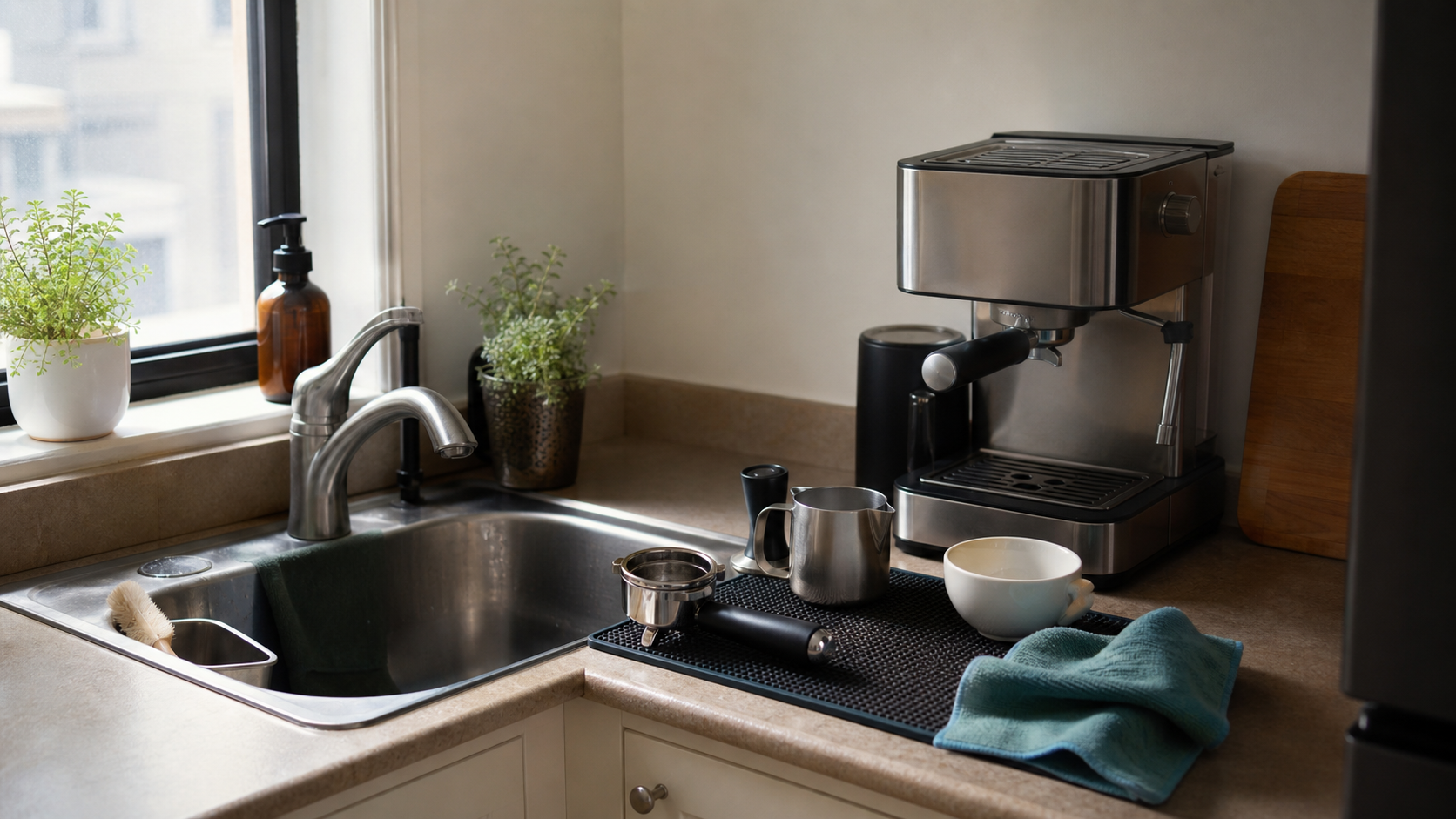
If your espresso setup shares one tiny apartment sink, put the wet workflow first. The best layout is usually not the prettiest coffee corner. It is the one that lets you empty the drip tray, rinse the milk pitcher, wipe the counter, and set washed parts somewhere safe without blocking the whole kitchen.
Start with this rule: keep the machine close enough to the sink that cleanup happens immediately, but do not let the sink become the landing zone for every tool. A small drying mat, dedicated cloths, and one drawer or bin for cleanup items can make a compact setup feel calmer than another decorative shelf.
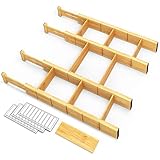
For this guide, the OXO Good Grips Large Silicone Drying Mat is the drying-zone pick to check first. Amazon Basics Microfiber Cleaning Cloths handle the daily wipe-down role. SpaceAid Bamboo Drawer Dividers are the storage pick if towels, filters, cleaning supplies, and small espresso tools keep spreading across the sink-side counter.
Apartment Barista uses Amazon affiliate links. As an Amazon Associate, this site earns from qualifying purchases. Prices, sellers, return terms, product details, and availability can change at any time, so check the current Amazon page before buying.
Read this with coffee station outside the kitchen, how to build a coffee bar in a small apartment, and best low-mess espresso setup for beginners.
Who This Guide Is For
This guide is for:
- apartment renters with one small kitchen sink
- compact-machine owners using a Bambino, Dedica, or similar countertop machine
- latte drinkers who need to rinse milk tools fast
- beginners whose sink area already competes with dishes, meal prep, and trash
- small-kitchen users planning the full cleanup route before buying more gear
This guide is not for:
- commercial coffee service
- plumbed-in espresso bars
- people with a large secondary prep sink
- readers looking for electrical or plumbing installation advice
- anyone trying to solve a messy routine only by buying more accessories
What Real Users Are Trying to Solve
Current public espresso discussions around sink distance and cleanup usually have the same hidden question:
"Where does everything wet go after the drink?"
People can make a coffee station work far from a sink, but the routine gets stricter. Drip trays need emptying. Milk pitchers and frother parts should be rinsed quickly. Steam-wand cloths need a place to dry. Used cups, catch cups, portafilters, baskets, and small tools all compete for the same tiny sink edge.
That means the real article topic is not just "where should the machine sit?" It is the wet path from shot to reset.
The One-Sink Setup Rule
Use a three-zone layout:
- Brew zone: machine, cup, scale, and portafilter.
- Rinse zone: sink path for drip tray water, milk pitcher, basket, and catch cup.
- Dry zone: mat or towel where clean wet parts can sit without blocking the sink.
If those three zones overlap completely, the setup will feel messy even if every product is compact.
Quick Picks
| Pick | Best for | Why it fits |
|---|---|---|
| OXO Good Grips Large Silicone Drying Mat | Drying mat for rinsed parts | Gives a defined landing zone for cups, pitcher, basket, and small tools after rinsing |
| Amazon Basics Microfiber Cleaning Cloths | Daily wipe-down cloth | Keeps counter, drip tray, pitcher, and steam-wand cleanup from borrowing random kitchen towels |
| SpaceAid Bamboo Drawer Dividers | Drawer organizer for sink-side tools | Moves cloths, cleaning supplies, filters, and small espresso tools off the counter |
Do not treat this as a fixed shopping cart. Confirm current Amazon seller, selected size, dimensions, care instructions, return policy, price, and availability before buying.
Small-Sink Fit Checks
Before adding anything, stand in your kitchen and walk through one drink.
Check these points:
- Can you remove and empty the drip tray without carrying it over clean dishes?
- Can the milk pitcher reach the sink before milk dries on the inside?
- Is there a dry spot for the portafilter basket, catch cup, and cloth?
- Does the drying area block the faucet, soap, dish rack, or food-prep space?
- Can used cloths dry before laundry, or do they sit wet in a pile?
- Is the trash or puck container close enough that grounds do not travel across the floor?
- Can a drawer or bin hold cleaning supplies away from beans and drink powders?
- Does the coffee station still leave room for normal cooking cleanup?
If the answer is no, fix the workflow before buying another espresso accessory.
Best Picks
OXO Good Grips Large Silicone Drying Mat
Best for: drying mat for rinsed coffee parts
Why it fits:
The OXO Good Grips Large Silicone Drying Mat is here because a tiny sink needs a controlled dry zone. Current OXO materials describe a ribbed silicone mat that elevates items for drying, can roll up or hang for storage, and is dishwasher safe. The current Amazon listing describes it as a large silicone drying mat with a flexible, easy-clean format.
Good fit if:
- you rinse a milk pitcher, catch cup, basket, or portafilter after most drinks
- your dish rack is already full
- you need a removable dry zone instead of another permanent counter item
- your coffee parts need to dry near the sink instead of beside beans or food
Skip it if:
- your counter has no spare flat space near the sink
- you already have a dish rack that comfortably handles coffee tools
- you want an absorbent mat rather than a rinse-clean silicone surface
- you will not wash or dry the mat regularly
Small-space notes:
Measure the open counter next to the sink. A drying mat only helps if it creates order. If it covers the only prep surface, it becomes another bottleneck.
Tradeoff:
Silicone is easy to rinse and store, but water can still sit on the surface if the mat is overloaded or ignored. It is a drying zone, not a cleanup shortcut.
Amazon check:
Check the current Amazon seller, exact OXO model, selected size or pack option, dimensions, care instructions, return policy, price, and availability before buying.
Amazon Basics Microfiber Cleaning Cloths
Best for: daily wipe-down cloth
Why it fits:
A one-sink espresso setup needs cloth discipline. One cloth can wipe the steam wand and splashes. Another can dry the counter or drip tray area. Without that system, wet paper towels, random dish towels, and milk residue start taking over the sink edge.
Good fit if:
- you make milk drinks and need a dedicated coffee cloth
- the sink area gets wet after every drink
- you want washable cloths instead of using paper towels every morning
- you can keep coffee cloths separate from food-prep towels
Skip it if:
- you already have a clean dedicated cloth routine
- you do not have a place for used cloths to dry before laundry
- you expect a cloth to replace machine-specific cleaning or descaling
Small-space notes:
Keep one clean cloth near the machine and one used-cloth spot away from food prep. In a small apartment, the used-cloth location matters as much as the clean drawer.
Tradeoff:
Reusable cloths reduce daily clutter, but they create laundry. If you cannot dry or wash them regularly, they become part of the mess.
Amazon check:
Check current Amazon seller, pack size, cloth dimensions, washing guidance, selected color, return policy, price, and availability before buying.
SpaceAid Bamboo Drawer Dividers
Best for: drawer organizer for sink-side tools
Why it fits:
Drawer dividers are not exciting, but they solve a common small-sink problem: everything that touches cleanup ends up on the counter. A divided drawer can hold spare cloths, cleaning tablets, a brush, filters, small tools, and backup accessories without mixing them into the brew zone.
Good fit if:
- your sink-side counter is crowded with small tools
- you have one drawer near the machine or sink
- cleaning supplies and prep tools keep mixing together
- you want a renter-friendly storage fix without drilling shelves
Skip it if:
- your drawers are too shallow or narrow
- you need a portable bin instead of drawer storage
- you have no nearby drawer and would need to cross the room for every item
Small-space notes:
Measure the drawer interior before buying. Leave one section for clean cloths, one for maintenance supplies, and one for small espresso tools. Do not store descaler or cleaning tablets loose beside beans or drink powders.
Tradeoff:
Drawer dividers free the counter, but they do not add space. If the drawer is already full, remove non-coffee clutter first instead of forcing more into it.
Amazon check:
Check drawer interior measurements, current Amazon seller, selected size, selected color, return policy, price, and availability before buying.
What I Would Do First
If I had one small sink and a compact espresso machine, I would not start by buying a bigger organizer. I would start with the reset routine.
- Put the machine as close to the sink as the outlet and counter allow.
- Choose one landing spot for rinsed coffee parts.
- Keep two dedicated cloths in rotation.
- Move backup accessories into a drawer or bin.
- Keep the drip tray and milk pitcher from sitting in the sink all morning.
That gives you a real routine before you decide whether you need more products.
Sink-Side Layout Examples
If the machine sits directly beside the sink
This is the easiest cleanup path. Put the machine on the stable side of the counter, keep the drying mat on the far side of the sink or behind the machine, and store cloths in the closest drawer.
Watch out for splashes. Do not let the scale, grinder, beans, or open filters live where sink water hits them.
If the machine is across from the sink
Use a small catch cup for flush water and move wet parts to the sink in one trip. Keep the drying mat near the sink, not across the kitchen, so rinsed parts do not travel back dripping.
This layout can work, but it needs discipline after milk drinks.
If the machine is outside the kitchen
Be stricter. Keep a clean refill carafe, empty the drip tray on a schedule, and rinse milk tools immediately at the kitchen sink. For most beginners, storage can move outside the kitchen before the wet espresso workflow does.
Common Mistakes
Letting the sink become the coffee storage area
The sink should handle rinsing, not long-term storage. If the portafilter, cup, pitcher, and cloth all sit there after the drink, normal kitchen cleanup gets harder.
Drying coffee parts beside beans
Keep wet items away from beans, grounds, filters, syrups, and drink powders. Coffee storage should stay dry.
Forgetting the used-cloth plan
A clean cloth is useful. A wet cloth with no drying or laundry plan is clutter.
Buying a mat that is too large for the counter
A drying mat should define a wet zone. If it covers the only prep space, use a smaller mat, a foldable towel routine, or a different station layout.
Rinsing grounds down the sink as a habit
Remove the puck and loose grounds first. A few stray grounds during rinsing are different from pushing pucks or heavy grounds into the drain every day.
What To Check Before Buying
- Current Amazon seller and return policy
- Exact dimensions and selected size
- Whether the mat fits your counter beside the sink
- Whether cloths have a drying and laundry route
- Whether drawer dividers fit your drawer interior
- Whether cleaning supplies can stay separate from food and beans
- Whether the setup leaves room for normal dishes and meal prep
- Product availability and current price on Amazon
FAQ
Should my espresso machine be next to the sink?
If possible, yes. Sink access makes milk cleanup, drip tray emptying, and quick rinsing easier. If the outlet, counter, or cabinet layout prevents that, keep the wet tools near the sink and use a catch cup or tray to reduce drips.
Do I need a drying mat for espresso tools?
Not always. You need a drying zone. That can be a silicone mat, a clean towel, or part of an existing dish rack. The key is that rinsed coffee parts should not block the faucet or sit beside beans.
Can I keep a coffee station far from the sink?
You can, but it works better for dry storage than for wet espresso prep. If you make milk drinks, the sink path becomes more important because milk residue is easier to rinse immediately than later.
What should stay in the drawer?
Clean cloths, spare filters, a brush, cleaning tablets, small espresso tools, and backup accessories can live in a divided drawer. Keep chemicals or cleaners separate from beans, cups, and drink ingredients.
What is the simplest one-sink setup?
Use a compact machine near the sink, one defined drying spot, one cloth routine, and one drawer or bin for cleanup tools. Add products only when they remove a real bottleneck in that routine.
Final Recommendation
For a tiny apartment sink, buy for the reset routine, not for the photo. The OXO drying mat is the first product to check if rinsed parts need a real landing zone. Amazon Basics microfiber cloths are useful if your wipe-down habit is inconsistent. SpaceAid dividers make sense if the sink-side counter is crowded with tools that should live in a drawer.
Keep the machine close to water when you can, keep wet items away from beans, and make every drink end with a quick reset before the sink fills up again.
Disclosure
Apartment Barista uses Amazon affiliate links. As an Amazon Associate, this site earns from qualifying purchases. Prices and availability can change at any time and should be checked on Amazon before buying.