

Quick Verdict
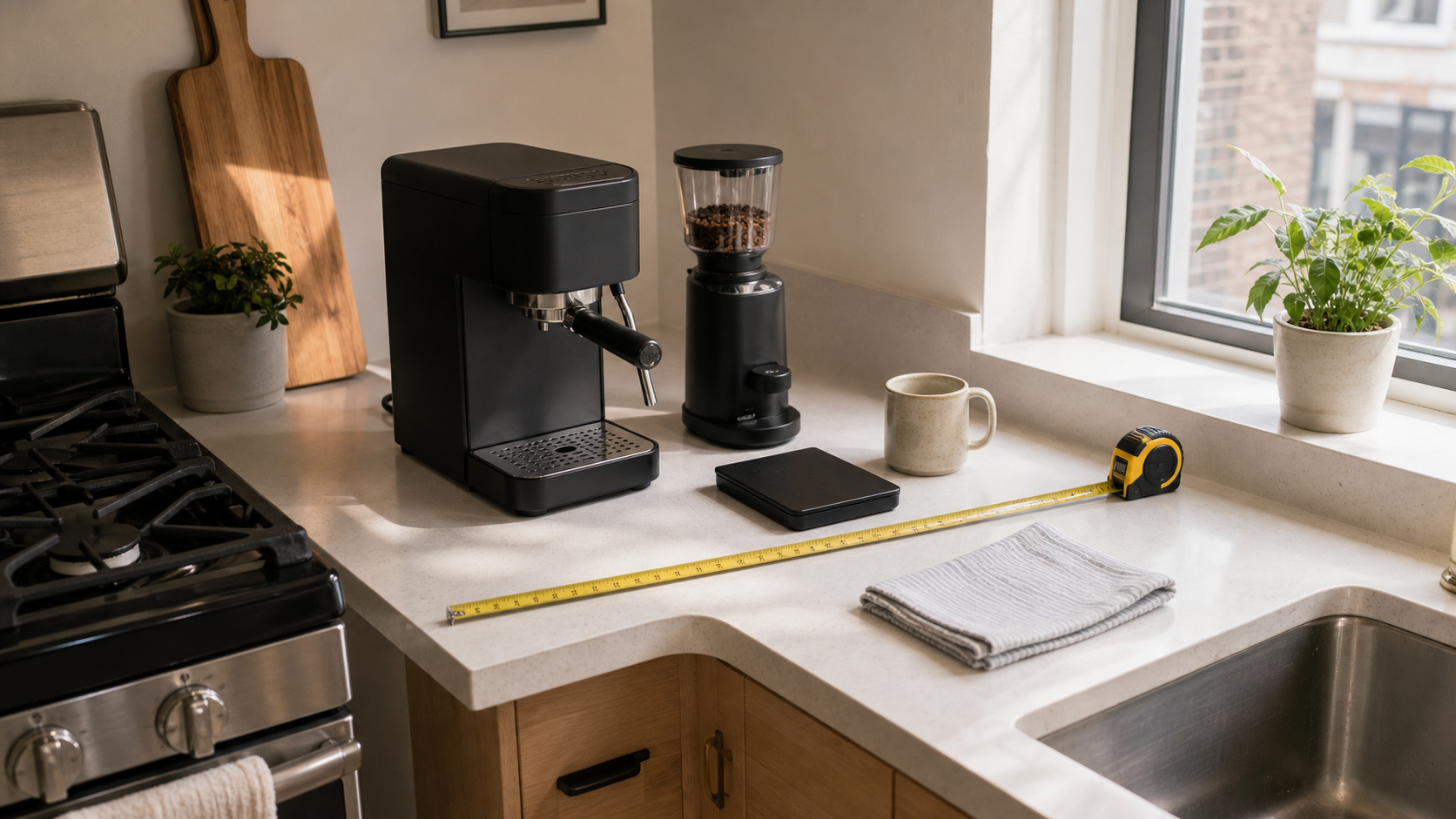
For a beginner apartment espresso setup, plan for more than the machine footprint.
A compact semi-automatic setup usually needs:
- a machine zone
- a grinder or coffee storage zone
- a cup and scale zone
- a tamping or prep zone
- a wet cleanup path
- one small dry landing spot for towels, baskets, and tools
If you only measure the machine body, the setup can technically fit and still feel frustrating every morning. Current public espresso discussions keep showing this same problem: people can fit an espresso machine on the counter, but then the grinder, scale, knock box, tamping mat, tools, and cleanup routine start taking over the kitchen.
The short rule:
- If you have a narrow strip of counter, start with a slim machine example like the De'Longhi Dedica Deluxe and store tools in a drawer.
- If you have a little more depth and want a stronger beginner upgrade path, measure around a compact machine example like the Breville Bambino.
- If you want grinder and machine in one appliance, use a larger all-in-one example like the Breville Barista Express only if you can give it a permanent station.
- If you choose a separate grinder, remember that the Baratza Encore ESP or any similar grinder needs its own footprint, outlet, grounds cleanup area, and height clearance.
Apartment Barista uses Amazon affiliate links. As an Amazon Associate, this site earns from qualifying purchases. Prices and availability can change at any time and should be checked on Amazon before buying.
Read this with the Espresso Machine Size Guide, Best Compact Espresso Machines for Small Kitchens, Best Burr Grinders for Beginner Espresso, and Best Coffee Station Layouts for Small Apartments.
Who This Guide Is For
This guide is for:
- apartment renters measuring a first espresso setup
- small-kitchen users with one usable strip of counter
- beginners deciding between a compact machine and an all-in-one machine
- latte drinkers who need space for milk, towels, and cleanup
- buyers who want a realistic measurement checklist before ordering
This guide is not for:
- commercial coffee bars
- built-in or plumbed espresso stations
- large kitchens with a dedicated coffee wall
- advanced buyers planning heavy dual-boiler machines
- anyone who wants a decorative setup more than a daily working station
The Real Space Problem
The espresso machine is only one piece of the footprint.
A beginner setup also needs room for:
- beans or pre-ground coffee
- grinder or dosing cup
- scale
- cup or shot glass
- tamper or included tamping tool
- milk pitcher if you make lattes
- towel near the steam wand
- knock box, trash, compost, or sink path
- cleaning tablets, descaler, brush, or cloth
- a dry place to set wet parts after rinsing
This is why a product page can be technically accurate and still leave you surprised. A machine might be only a few inches wide, but the portafilter handle, cup, scale, grinder, towel, and cleanup routine are what make it livable.
A Practical Counter-Space Formula
Use this simple formula before buying:
machine footprint
+ grinder or coffee storage footprint
+ cup and scale landing zone
+ tamping/prep zone
+ cleanup zone
+ hand clearance
= real espresso setup footprint
You do not need every item permanently on the counter. You do need a clear place where the routine can happen.
For a very small apartment, the safest plan is:
- keep the machine on the counter
- keep the grinder only if you will use it daily
- store tools in one drawer or small bin
- keep a towel within reach
- leave one open landing zone empty
That last empty zone matters. If every inch is filled with gear, espresso becomes harder to make and harder to clean.
Quick Picks
| Pick | Best for | Space lesson |
|---|---|---|
| De'Longhi Dedica Deluxe | Slim machine example | Narrow width helps tight counters, but depth, water access, and cup clearance still matter. |
| Breville Bambino | Compact machine example | A compact machine can work well if you still leave room for grinder, scale, and cleanup. |
| Breville Barista Express | All-in-one size caution | Built-in grinder reduces separate appliances, but the machine needs a larger permanent station. |
| Baratza Encore ESP | Grinder-height reminder | A separate grinder protects espresso quality, but it adds height, outlet needs, and grounds cleanup. |
These are measuring examples, not a fixed shopping cart. Check the current Amazon seller, exact model, dimensions, return policy, included accessories, price, and availability before buying.
Measure These Six Zones
1. Machine Width
Width decides whether the machine can sit beside a sink, stove, microwave, dish rack, or cabinet wall.
The De'Longhi Dedica Deluxe is the slim example because current Amazon listing information shows an ultra-slim body around 6 inches wide. That is useful when width is the main constraint.
But narrow width is not the same as easy workflow. Still check:
- whether the portafilter handle has room to turn
- whether the steam wand needs side space
- whether the machine moves when you lock in the portafilter
- whether your cup and scale fit under the spout
- whether you can remove the drip tray without moving other items
2. Counter Depth
Depth is the wall-to-front-edge measurement.
Depth is where many small kitchens fail. A machine may fit from wall to counter edge, but espresso also needs front working space.
Measure:
- wall or backsplash to counter edge
- machine body depth
- extra space for the portafilter handle
- cup and scale depth
- towel or tamping mat space
- room to slide out the drip tray
If the machine uses most of the depth, you may end up tamping on a different counter or carrying wet parts to the sink every time.
3. Cabinet Height
Measure from the counter to the bottom of the upper cabinet.
This matters for:
- water tank removal
- cup warmer access
- grinder hopper access
- bean pouring
- visibility of controls
- wiping around the machine
The Breville Barista Express is the all-in-one caution example because current Amazon listing information shows a taller appliance than compact semi-automatic machines, and the built-in grinder area needs real upper clearance. That does not make it wrong. It just means it should not be squeezed under a low cabinet without measuring.
4. Grinder Space
If you use fresh beans, the grinder is not optional background clutter. It is part of the espresso setup.
A grinder needs:
- its own footprint
- outlet access
- room to open or remove the hopper lid
- a dosing cup or portafilter landing spot
- grounds cleanup around the base
- enough distance from water splashes
The Baratza Encore ESP is the grinder example here because it is a common beginner espresso-capable pick and current Baratza materials position it around a simple espresso workflow with a dosing cup. It still needs its own spot.
Skip a permanent grinder spot if:
- you are starting with pre-ground coffee and pressurized baskets
- you will store a manual grinder in a drawer
- you only make espresso occasionally
- the counter cannot support both machine and grinder yet
Do not skip the grinder plan entirely. Even if you buy it later, your future setup needs somewhere to put it.
5. Cup, Scale, and Drip Tray Space
Espresso needs a cup under the spout. Better beginner espresso also benefits from weighing dose and yield.
Before buying, check:
- cup height under the spout
- whether a scale fits on the drip tray
- whether the scale display stays visible
- whether the cup becomes unstable on a tiny tray
- whether the drip tray can be removed for cleaning
If the cup and scale barely fit, the setup may still work, but it will feel slower. This is why the Best Coffee Scales That Fit Compact Espresso Machines guide focuses on real tray fit instead of only scale accuracy.
6. Cleanup and Landing Space
The cleanup zone is the part beginners forget.
After a drink, you may need to:
- knock out the puck
- rinse or wipe the portafilter
- wipe the steam wand
- empty the drip tray
- set a wet basket somewhere
- fold or hang a towel
- move milk or cups back to the sink
If there is no landing space, the setup spreads across the kitchen. A small towel zone can be more useful than another decorative accessory.
Product Notes
De'Longhi Dedica Deluxe
Best for: Slim machine example
Why it fits:
The Dedica Deluxe is useful for readers whose first problem is width. Current Amazon listing information shows an ultra-slim body, which makes it a strong measuring example for narrow counters, apartment corners, and kitchen strips where a wider machine simply will not fit.
Good fit if:
- your counter has very limited width
- you are comparing narrow machine bodies first
- you can store tools in a drawer or bin
- you want a machine example that does not assume a large station
Skip it if:
- you want the easiest long-term accessory upgrade path
- you want automatic milk help
- your real problem is depth or cabinet height, not width
- you dislike checking smaller-machine cup and accessory compatibility
Small-space tradeoff:
The width savings are real, but the whole routine still needs cup, scale, tamper, towel, and cleanup room. Do not let a narrow machine become an excuse to fill every remaining inch with accessories.
Amazon check:
Confirm the current Amazon seller, exact EC685 model, color, dimensions, return policy, included accessories, price, and availability before buying.
Breville Bambino
Best for: Compact machine example
Why it fits:
The Breville Bambino is a strong compact-machine measuring example because current Amazon listing information shows a narrow body with more depth than its width suggests, which makes it a practical small-kitchen starting point for beginners.
Good fit if:
- you want a compact semi-automatic machine
- you can leave room for a separate grinder later
- you make milk drinks but do not need automatic milk texturing
- your counter has enough depth for the machine and workflow
Skip it if:
- the machine would sit under cabinets with annoying water access
- you cannot spare any room for a grinder, scale, or towel
- you want a one-button fully automatic routine
- you need the narrowest possible machine body
Small-space tradeoff:
The Bambino keeps the machine compact, but it does not remove the need for a grinder plan. A small machine plus a separate grinder can take more total width than a larger all-in-one machine, while still being more flexible.
Amazon check:
Confirm the current Amazon seller, exact model, dimensions, included baskets and accessories, return terms, price, and availability before buying.
Breville Barista Express
Best for: All-in-one size caution
Why it fits:
The Barista Express is useful as a larger all-in-one measuring example. Current Amazon listing information shows a wider and taller appliance than the compact examples, but it also includes the grinder in the same body.
Good fit if:
- you can dedicate a stable counter station to espresso
- you want machine and grinder decisions bundled together
- you have enough upper clearance for the hopper area
- you prefer one appliance footprint over separate machine and grinder placement
Skip it if:
- your counter is very narrow
- you need the quietest apartment workflow
- you want to upgrade the grinder separately later
- the machine would have to move for refills or cleaning
Small-space tradeoff:
An all-in-one machine can make shopping feel simpler, but it is not automatically smaller. It may save you from placing a separate grinder, yet it asks for a more permanent, taller counter zone.
Amazon check:
Confirm the current Amazon seller, exact BES870 model, dimensions, included accessories, return terms, price, and availability before buying.
Baratza Encore ESP
Best for: Grinder-height reminder
Why it fits:
The Baratza Encore ESP is a useful grinder example because current Baratza materials describe a beginner-friendly espresso workflow with simple adjustment and a dosing cup. It shows the separate-grinder setup many beginners should measure before committing to a machine-only setup.
Good fit if:
- you want fresh-ground espresso control
- you are pairing a compact machine with a separate grinder
- you have enough counter height and outlet access
- you want a simple electric grinder rather than hand grinding
Skip it if:
- grinder motor noise is your biggest apartment concern
- you have no counter or drawer plan for grounds cleanup
- you only want occasional pre-ground milk drinks for now
- you need the smallest possible no-counter setup
Small-space tradeoff:
A separate grinder can make espresso better and more repeatable, but it spends real kitchen space. Plan where beans, the dosing cup, stray grounds, and the grinder power cord will go before buying.
Amazon check:
Confirm the current Amazon seller, exact ESP model, color, dimensions, included dosing cup or adapter, return policy, price, and availability before buying.
What I Would Measure First
Start with a tape measure and one empty counter zone.
Measure in this order:
- Counter width available for coffee.
- Counter depth from wall to front edge.
- Counter-to-cabinet height.
- Distance to the nearest outlet.
- Distance to the sink.
- Space for a cup and scale in front of the machine.
- Space for a grinder or future grinder.
- Space for one towel or cleanup landing zone.
Then ask the more important question:
Can this setup stay usable after dinner prep, dishes, groceries, and daily apartment life?
If the answer is no, buy less gear first.
Setup Options by Counter Size
If you have one narrow strip
Start with:
- a slim or compact machine
- one drawer for tools
- one small towel
- no permanent knock box unless you have room
- no extra decorative coffee bar items yet
This is where a Dedica-style slim machine can make sense, but only if cup and water access still work.
If you have a small but usable corner
Start with:
- a compact machine
- a separate grinder if you will use fresh beans daily
- a small scale
- drawer storage for tampers, filters, and cleaning items
- one open landing zone beside the machine
This is the most realistic Apartment Barista setup for many renters.
If you have a dedicated station
You can consider:
- a larger all-in-one machine
- a separate grinder and machine side by side
- a knock box
- a tamping mat
- a visible organizer
- backup bean storage
Even here, keep one open prep zone. Dedicated stations still fail when they become storage shelves.
If you have almost no counter
Consider:
- a manual espresso maker stored in a drawer
- pre-ground coffee with a pressurized basket as a temporary starting point
- a compact frother for latte-style drinks
- moving support gear to a cart or cabinet
- waiting on the electric grinder until the layout is clear
Do not force a full machine-plus-grinder setup into a counter that cannot support cleanup.
What Beginners Can Skip at First
If counter space is tight, skip these at first:
- bottomless portafilter
- puck screen
- large knock box
- large tamping station
- extra distribution tools
- decorative mug display
- syrup bottle lineup
- oversized bean canisters
- duplicate grinders
Buy these earlier instead:
- a scale that fits your machine
- one towel
- cleaning supplies your machine manual allows
- a small storage bin or drawer organizer
- a grinder only when you have a real place to use it
The goal is not to build the most complete counter. The goal is to build the smallest setup you will actually keep using.
Check Before Buying
Before you order anything, confirm:
- current Amazon seller and return policy
- exact model number, not just product family name
- machine width, depth, and height
- counter-to-cabinet clearance
- water tank access direction
- drip tray removal direction
- cup clearance with your likely mug or shot glass
- whether your scale fits the drip tray
- grinder footprint and hopper height
- outlet location and cord path
- included accessories, because bundles can change
- current price and availability on Amazon
Do not rely on a single hero photo. Product photos often show a clean machine without the grinder, towel, scale, milk pitcher, trash path, and wet cleanup step.
Common Mistakes
Buying the machine before measuring the grinder
This is the biggest beginner layout mistake. If you plan to use fresh beans, the grinder is part of the setup, not a future detail.
Filling the only prep zone with accessories
An empty spot beside the machine is not wasted space. It is where the coffee routine happens.
Choosing a machine only by width
Width matters, but depth, cabinet height, tank access, portafilter movement, and cleanup access matter too.
Assuming all-in-one means small
An all-in-one machine can reduce separate shopping, but it may be taller and more permanent than a compact machine plus a small grinder.
Ignoring the sink path
Espresso involves wet parts. If the station is too far from water or has no towel zone, cleanup gets delayed.
FAQ
Can an espresso setup fit in a small apartment kitchen?
Yes, but only if you measure the whole routine. A compact machine can fit in many apartment kitchens, but you still need space for cup clearance, a scale, a grinder or coffee storage plan, and cleanup.
Do I need to keep the grinder on the counter?
Only if you use it often enough that putting it away would stop you from making coffee. If counter space is very tight, a manual grinder or drawer-stored grinder can work, but make sure the workflow is realistic.
Is a slim machine always better for small kitchens?
No. A slim machine helps when width is the main problem. If your issue is cabinet clearance, water access, cup height, or grinder placement, a different compact machine may work better.
Should I buy an all-in-one espresso machine to save space?
Maybe. An all-in-one machine can reduce separate appliance placement, but it usually needs a larger permanent counter zone and gives you less flexibility to upgrade the grinder later.
How much empty space should I leave beside the machine?
Leave enough room for a cup, scale, towel, and prep step. If you cannot keep one clear landing zone, store accessories in a drawer before buying more tools.
Final Recommendation
Measure the workflow before choosing the machine.
If your counter is narrow, compare slim and compact machines first. If you want fresh-ground espresso, measure a grinder before spending the whole setup budget on the machine. If you want an all-in-one machine, give it a real station rather than squeezing it under a cabinet.
For most apartment beginners, the best espresso setup is not the biggest setup they can afford. It is the smallest setup that leaves enough room to grind, brew, wipe, rinse, and put everything away without turning the kitchen into a permanent obstacle course.
Disclosure
Apartment Barista uses Amazon affiliate links. As an Amazon Associate, this site earns from qualifying purchases. Prices, sellers, product details, return terms, and availability can change at any time and should be checked on Amazon before buying.