


Quick Verdict
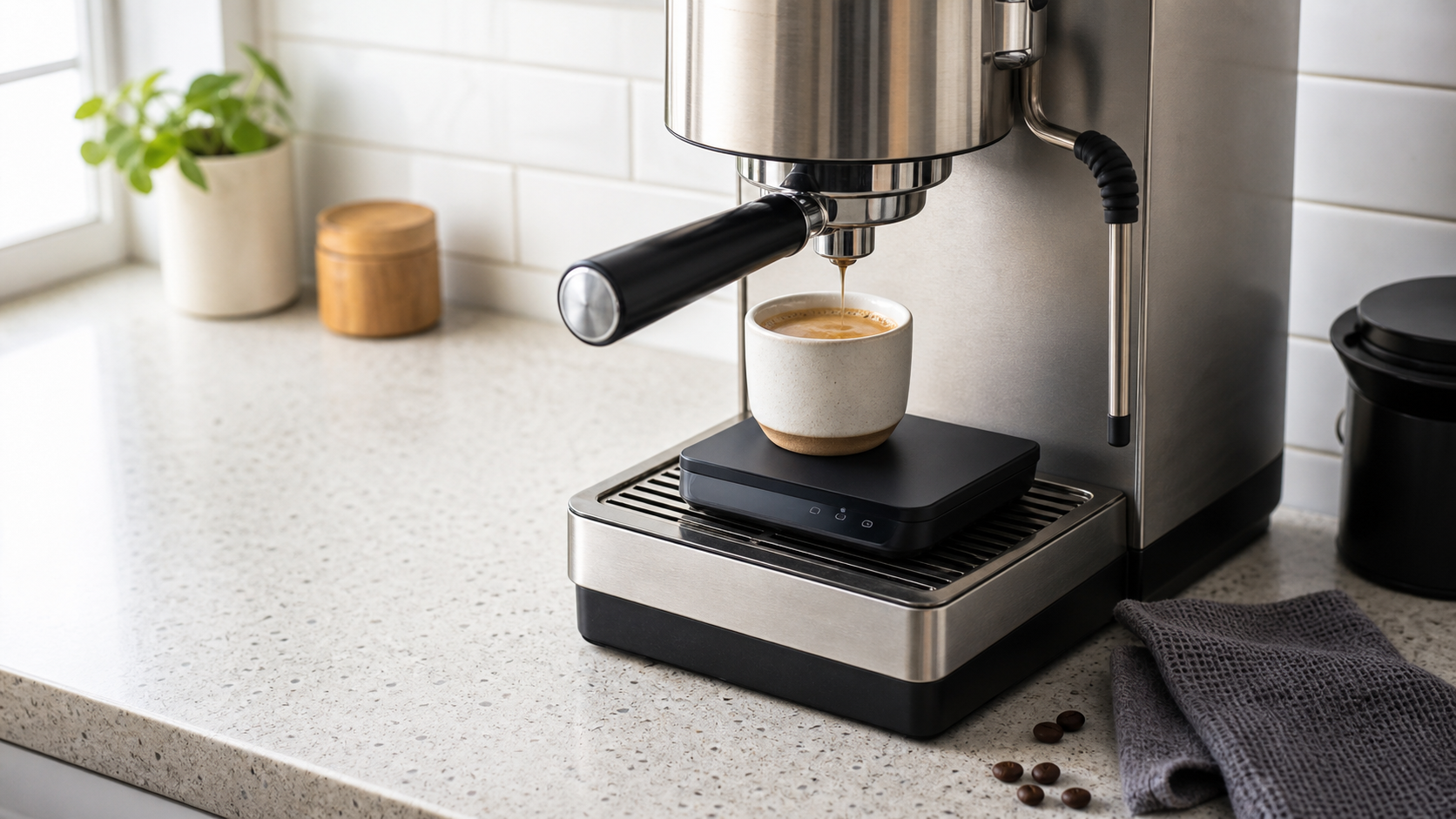
For compact espresso machines, the best coffee scale is not simply the most accurate one. It is the one that fits your drip tray, leaves room for your cup, keeps the display readable, and stays stable while the shot is running.
If your machine is tight under the portafilter, start by checking a mini espresso scale such as the Maestri House Mini Coffee Scale. If your tray has more room and you want a lower-cost first scale, the BAGAIL BASICS Coffee Scale with Timer is the budget timer pick. If you also brew pour-over and want a better coffee-station scale, the TIMEMORE Basic 2.0 is the upgrade pick. If spills and daily wiping are the main problem, the Greater Goods Coffee Scale with Timer is the easy-clean pick.
Do not buy from the product photo alone. A scale can look small on the counter and still fail under a Bambino-style, Dedica-style, or other compact machine. Measure the machine with the cup you actually use before buying.
For the broader context, pair this with the best coffee scales for espresso beginners, espresso machine size guide, and espresso accessories beginners can skip guides.
Who This Guide Is For
This guide is for:
- beginners who want to weigh espresso output on a compact machine
- apartment renters with a small counter and a small drip tray
- Bambino-style, Dedica-style, and other slim-machine owners
- latte drinkers trying to repeat better shots before steaming milk
- buyers who already know a normal kitchen scale feels too large
This guide is not for:
- commercial cafe use
- people shopping for premium connected scales first
- buyers who never plan to weigh espresso output under the machine
- anyone who wants fixed price, stock, or rating claims in the article body
The Real Fit Problem
Current public user discussions show a very specific pattern: people are not only asking whether espresso needs a scale. They are asking what to do when the scale does not fit under a compact machine.
The common complaints are practical:
- the scale is wider than the drip tray
- the scale feet hang off the tray edge
- the cup wobbles when it sits on top
- the machine has too little vertical clearance
- the display is blocked by the cup
- a towel, board, or improvised riser makes the reading feel unreliable
That is why this article is fit-first. Accuracy and 0.1g-style readability matter, but they do not help if the scale cannot sit flat under the cup.
This is based on current public user discussions and manufacturer and Amazon product information. It is not hands-on lab testing. Check current Amazon seller, exact dimensions, return policy, selected model, price, and availability before buying.
Quick Picks
| Pick | Best for | Why it fits |
|---|---|---|
| Maestri House Mini Coffee Scale | Mini drip-tray scale pick | Small platform is the first place to check for tight compact machines |
| BAGAIL BASICS Coffee Scale with Timer | Budget timer scale pick | Practical starter scale if your tray and cup clearance have enough room |
| TIMEMORE Basic 2.0 Coffee Scale | Coffee-station upgrade scale | Better coffee-focused workflow if you also brew pour-over or want flow-rate feedback |
| Greater Goods Coffee Scale with Timer | Easy-clean scale pick | Protective silicone cover helps with daily splashes and wiping |
Do not treat this table as a fixed shopping cart. Confirm the current Amazon seller, exact dimensions, selected color or model, return policy, price, and availability before buying.
The 5-Minute Fit Test Before You Buy
1. Measure drip-tray width
Measure the flat usable area, not the full machine width. Some drip trays have raised lips, rounded corners, or grooves that reduce the stable area.
If the scale body fits but the feet do not sit flat, the reading may drift or wobble. That matters more than whether the top plate technically fits.
2. Measure drip-tray depth
Depth is easy to miss. A scale can fit left-to-right but still hang over the front edge. That can make the cup feel unstable when you start or stop the shot.
If the machine has a removable front lip or a tray that slides, check how the scale sits when the tray is fully installed.
3. Measure cup plus scale height
Put your normal espresso cup under the group head. Measure the remaining room. Then compare that to the scale height plus the cup height.
This is the beginner mistake that causes the most frustration. A low cup may work. A favorite mug may not.
4. Check display visibility
During extraction, you need to see the number without moving the cup. If the cup blocks the display, the scale becomes less useful for stopping the shot by yield.
Front-facing displays are easier on many compact machines. Side displays can work on the counter but become awkward on a narrow drip tray.
5. Check button access
You need to tare the scale and start the timer without bumping the cup or tray. Touch buttons can be fine, but wet fingers, tight spacing, and low clearance can make them annoying.
If the buttons sit under the cup rim or too close to the machine body, the scale may still be technically usable but unpleasant every morning.
What Matters Most on Compact Machines
Stable feet matter more than platform size
Look for where the scale actually contacts the tray. A platform can be larger than the feet, or the feet can sit near the corners. If one foot hangs off, the reading can become unreliable.
Avoid running a shot on an unstable stack. A wobbly cup of hot espresso is not worth a slightly nicer number on the display.
Small is helpful, but not always better
A mini scale is easier to fit, but it gives you less room for cups. If your cup has a wide base, the cup may cover the display or sit too close to the edge.
The best fit is the smallest scale that still supports your normal cup safely.
Timer workflow helps beginners
A timer matters because espresso is not only weight. Dose, yield, and time together help you understand whether a shot is running too fast, too slow, too short, or too long.
You can use a phone timer, but a built-in scale timer keeps the routine simpler in a small kitchen.
Spill protection matters, but do not soak the scale
Compact espresso stations get wet. Cups drip. Steam wands splash. Drip trays overflow. A silicone cover, protected charging port, or easy-wipe surface is helpful.
Still treat the scale as electronics. Wipe it dry, keep liquid away from ports, and do not store it wet in a drawer.
Storage matters in an apartment
The scale should live close to the machine. If it has to be dug out from a cabinet, beginners stop using it.
Good places include:
- beside the machine
- in the top coffee drawer
- on a small tray with the tamper and towel
- upright in a narrow cabinet slot if the manual allows that storage position
Product Notes
Maestri House Mini Coffee Scale
Best for: Mini drip-tray scale pick
Why it was selected:
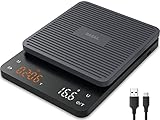
The Maestri House Mini Coffee Scale is the first scale to check if your machine has a small drip tray. Current product materials show a mini rechargeable format, 2kg capacity, 0.1g-style measurement, USB-C charging, and automatic timing workflow.
Good fit if:
- your compact machine has limited drip-tray space
- you mainly need the scale for espresso output
- you want a rechargeable mini scale
- you want timer support without jumping to a premium connected scale
Skip it if:
- your favorite cup has a wide base
- you brew large pour-over carafes often
- your machine is too low even with a mini scale
- you dislike touch controls on small electronics
Small-space notes:
Measure the cup and display together. A mini scale can fit the tray but still become awkward if the cup hides the display or sits too close to the edge.
Amazon check:
Check current Amazon seller, exact model, dimensions, selected color, charging cable, return policy, price, and availability before buying.
BAGAIL BASICS Coffee Scale with Timer
Best for: Budget timer scale pick
Why it was selected:
The BAGAIL BASICS Coffee Scale with Timer is the budget pick because it gives beginners dose, yield, and timer feedback before they spend more on accessories. Current product materials describe 0.1g-style measurement, built-in timer, USB-C charging, a silicone cover, and broad coffee use.
Good fit if:
- your machine has enough drip-tray width and cup clearance
- you want a lower-cost first coffee scale
- you also weigh beans, milk, or brewed coffee
- you want a timer without using your phone
Skip it if:
- your drip tray is extremely small
- you need the smallest possible espresso-only scale
- a larger rectangular scale would block the display or hang over the tray
- you want premium water resistance or connected features
Small-space notes:
This can be a good first scale for the whole coffee station, but it may not be the best fit for the tightest drip trays. Measure before assuming it will work under the portafilter.
Amazon check:
Check current Amazon seller, exact dimensions, charging cable, weight capacity, return policy, price, and availability before buying.
TIMEMORE Basic 2.0 Coffee Scale
Best for: Coffee-station upgrade scale
Why it was selected:
The TIMEMORE Basic 2.0 is the upgrade pick for people who want one better coffee scale for espresso and pour-over. Current product materials show 2kg capacity, 0.1g-style measurement, timer function, flow-rate function, rechargeable battery, and a closable charging-port design.
Good fit if:
- you make espresso and pour-over
- you want flow-rate feedback for manual brewing
- you have enough counter space for a coffee-station scale
- you want a more coffee-focused workflow than a basic kitchen scale
Skip it if:
- you only need the smallest scale for a tiny drip tray
- you do not use pour-over or flow-rate features
- your budget is better spent on grinder, beans, or cleaning supplies first
- the scale dimensions do not fit your compact machine workflow
Small-space notes:
Think of this as a coffee-station scale first and a compact-machine scale second. It may be excellent beside the machine, but tight drip trays still need a separate measurement check.
Amazon check:
Check current Amazon seller, exact Basic 2.0 model, selected size and color, dimensions, charging-port design, return policy, price, and availability before buying.
Greater Goods Coffee Scale with Timer
Best for: Easy-clean scale pick
Why it was selected:
The Greater Goods Coffee Scale with Timer is the cleanup-minded pick because current product materials describe 0.1g-style response, a built-in timer, multiple unit support, and a heat-resistant, dishwasher-safe silicone cover.
Good fit if:
- your coffee station gets wet or messy
- you want a protective cover over a simple coffee scale
- you want one scale for beans, espresso, and pour-over
- cleanup matters more than advanced espresso modes
Skip it if:
- you need the smallest possible drip-tray scale
- you want auto-timing or flow-rate modes
- a larger rectangular scale would block your display or cup placement
- you already own a scale that fits and wipes clean
Small-space notes:
The silicone cover can make daily wiping easier, but it does not solve footprint. Confirm the full scale fits your machine and drawer before buying.
Amazon check:
Check current Amazon seller, selected color, exact dimensions, silicone cover details, return policy, price, and availability before buying.
What I Would Do First
If I were buying for a compact espresso machine, I would do this in order:
- measure the drip tray's flat usable width and depth
- measure the cup plus scale height under the portafilter
- check whether the display will still be visible with the cup on top
- choose the smallest stable scale that fits the routine
- buy from a seller with a current return policy you are comfortable with
For a very tight machine, I would start with a mini scale. For a machine with more room, I would consider the budget timer scale first. For a setup that also includes pour-over, I would decide whether a larger coffee-station scale makes more sense than a tiny espresso-only scale.
Common Mistakes
Measuring the machine width instead of the drip tray
The machine can be wide while the usable drip tray area is small. Measure the part where the scale actually sits.
Forgetting the cup height
A scale can fit by itself, but the cup still needs room under the spout. Use your real cup, not the shortest cup in the cabinet unless that is what you plan to use daily.
Ignoring the scale feet
If the feet hang off the tray, the scale may wobble or read poorly. Platform width is not the same as stable foot placement.
Buying for pour-over first
Pour-over scales are often excellent, but many are larger than a compact espresso drip tray wants. If espresso output is the goal, fit under the machine comes first.
Leaving no room for cleanup
If removing the cup and scale spills espresso every morning, the setup will feel annoying. Leave enough finger room to lift the cup safely.
FAQ
What size coffee scale fits a compact espresso machine?
The right size depends on your machine and cup. Measure usable drip-tray width, usable depth, scale height, and cup height before buying. Mini espresso scales are often easier for tight machines than larger coffee-station scales.
Can I use a normal kitchen scale for espresso?
Sometimes. If it reads in small enough increments, responds quickly enough, has a usable timer or separate timer, and fits under your cup, it can work. Many kitchen scales are too large or too slow for compact-machine espresso output.
What if no scale fits under my machine?
You can still use a scale for beans and dose. Then pull espresso into a small cup by volume or timing until you decide whether a shorter cup, different scale, or different tray setup is stable enough. Do not use an unstable stack under hot espresso.
Is a mini scale always the best choice?
No. Mini scales fit tight trays better, but larger scales can be easier to read and more useful for pour-over or general coffee prep. Buy for your real workflow.
Do I need flow-rate features?
Not at first. Beginners can learn a lot from dose, yield, and shot time. Flow-rate features are a nice upgrade if you also brew pour-over or enjoy more data.
Should I buy the scale before the machine?
Usually no. Choose or measure the machine first, then buy the scale that fits the drip tray and cup clearance. If you already own the machine, measure before ordering.
Disclosure
Apartment Barista uses Amazon affiliate links. As an Amazon Associate, this site earns from qualifying purchases. Prices, sellers, return terms, product details, and availability can change at any time and should be checked on Amazon before buying.