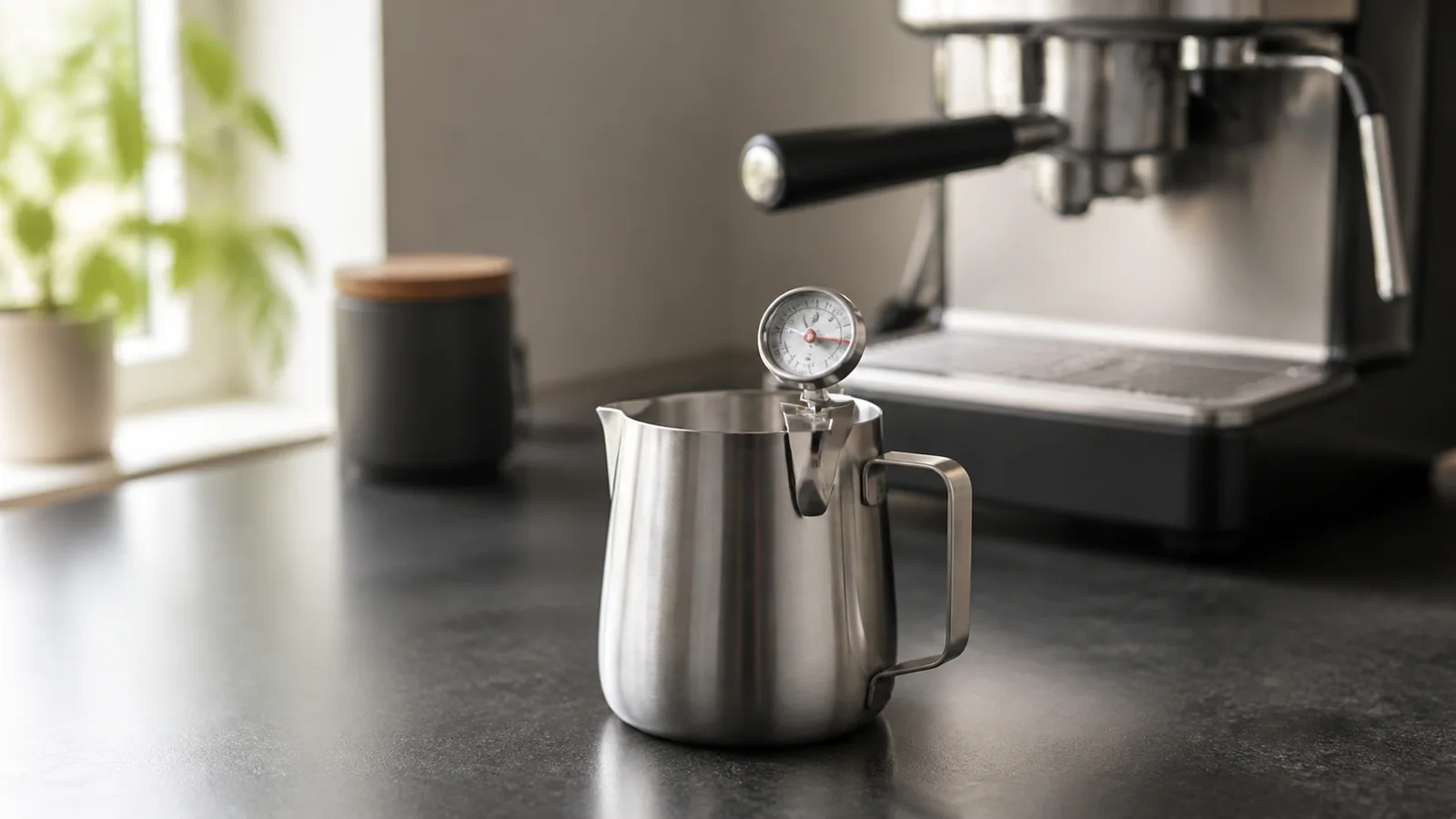

Quick Verdict
A milk thermometer is optional, not a requirement for your first compact espresso setup. It can be a useful training wheel when the usual ‘pitcher feels hot’ cue is inconsistent for you, when several people share the machine, or when you are trying to repeat one small milk drink. It will not correct a wand that is sitting in the wrong place, a pitcher that is too large for the milk amount, or a rushed cleanup routine.
For a small apartment, choose a simple clip-on style only if you will actually keep it with the pitcher and clean it after use. Otherwise, start with the pitcher you already own, learn the sound and movement of the milk, and add a thermometer later if temperature is still the variable you cannot repeat.
Who This Guide Is For
- A beginner using a compact espresso machine with a steam wand.
- Someone making one or two lattes, cappuccinos, or oat-milk drinks in a small kitchen.
- A reader who wants a repeatable stopping point without buying a large gadget or leaving another appliance on the counter.
Skip this guide if your machine has no steam wand, if you mainly use a separate automatic frother, or if your problem is large dry bubbles rather than deciding when to stop heating. Start with how to make latte at home without a big machine instead.
What Usually Goes Wrong
Beginners are often told to stop when the pitcher becomes too hot to hold. That can be a helpful personal cue, but it is not identical for every hand, pitcher, milk amount, or machine. A small compact machine can also heat a modest amount of milk quickly enough that guessing feels stressful.
The opposite mistake is treating a number on a dial as a complete technique. The thermometer does not create a whirlpool, add air, or fix a wand tip that is too deep. If the milk is foamy, thin, or blobby, use the texture diagnosis in why your oat-milk latte is foamy, thin, or blobby before buying more tools.
How to Choose
| Decision factor | Why it matters in a small space | What to verify |
|---|---|---|
| Clip and stem length | A clip keeps the dial near the pitcher rather than on the counter. A long stem can be awkward in a very small pitcher. | Confirm the current stem length, clip position, and your pitcher depth. |
| Dial readability | You should be able to glance at the reading while keeping one hand on the pitcher handle. | Confirm the dial size and whether its markings are useful to you. |
| Cleanup and storage | Milk residue should not be left on the stem in a shared tiny sink. | Confirm the maker’s care instructions and leave a dry storage spot. |
| Workflow fit | A thermometer should help you learn a stopping point, not make steaming feel like a laboratory task. | Try it for a few drinks, then decide whether it earns drawer space. |
Shortlist and Tradeoffs
CDN ProAccurate Beverage Frothing Thermometer
This is a focused, analog clip-on option for a reader who wants to watch milk temperature while steaming rather than checking after the fact. Its small-pitcher-oriented stem and adjustable clip make the product angle honest for compact latte practice. It is not a promise of better microfoam, and it is not automatically the right choice for every pitcher.
Buy it if the stop point is the part of steaming you cannot repeat and you have measured enough room for the clip. Skip it for now if you are still learning wand position, use an automatic frother, or do not want another item to wash and store. Before buying, re-check the exact listing, stem size, dial markings, seller, care guidance, and whether the selected version fits your own pitcher.
Small-Kitchen Workflow
- Put the pitcher, cloth, and thermometer in one reachable zone before turning on steam. Do not balance the dial on a machine or a crowded drip tray.
- Purge the wand only as your machine’s manual directs, then position the thermometer clip so the stem is in the milk but is not fighting the wand for space.
- Focus first on the milk’s motion and sound. Glance at the dial as a stopping cue; do not stare at it instead of controlling the pitcher.
- Pour promptly, wipe and purge the wand according to the manufacturer’s instructions, then rinse and dry the thermometer stem. A thermometer is not a substitute for the steam-wand cleaning cloth routine for milk drinks.
- Store the dry thermometer with the pitcher or in a shallow drawer. If it repeatedly ends up loose on the counter, it is probably not helping your apartment workflow.
What Not to Buy Yet
Do not add a second thermometer, a larger pitcher, or latte-art accessories simply because the first few drinks are uneven. First repeat one milk amount in one pitcher, note what changes, and keep the cleanup sequence short. A scale can help with beverage repeatability in a different part of the workflow, but it does not measure milk temperature; see best coffee scales that fit compact espresso machines if weighing is the actual missing variable.
Before You Buy
- Confirm the exact product version and seller on Amazon.
- Confirm the stem length, clip fit, pitcher depth, price, availability, return terms, and care guidance.
- Read your espresso-machine manual for steam-wand and cleaning directions.
- Measure the pitcher, drawer, sink route, and clear counter space before adding another tool.
Final Recommendation
For a compact espresso beginner, a milk thermometer is worth considering when it removes one specific uncertainty: when to stop heating. Choose a clip-on model only if it fits the pitcher and you will clean and store it easily. If your main issue is foam texture or counter clutter, keep practicing the basic workflow first and buy later only when the temperature cue is clearly the remaining problem.