
Quick Verdict
If 18g overflows your compact portafilter, that does not mean your Bambino, Dedica, or other small machine is broken. It usually means the basket volume, coffee density, grind fluffiness, or accessory stack does not match the recipe number you copied.
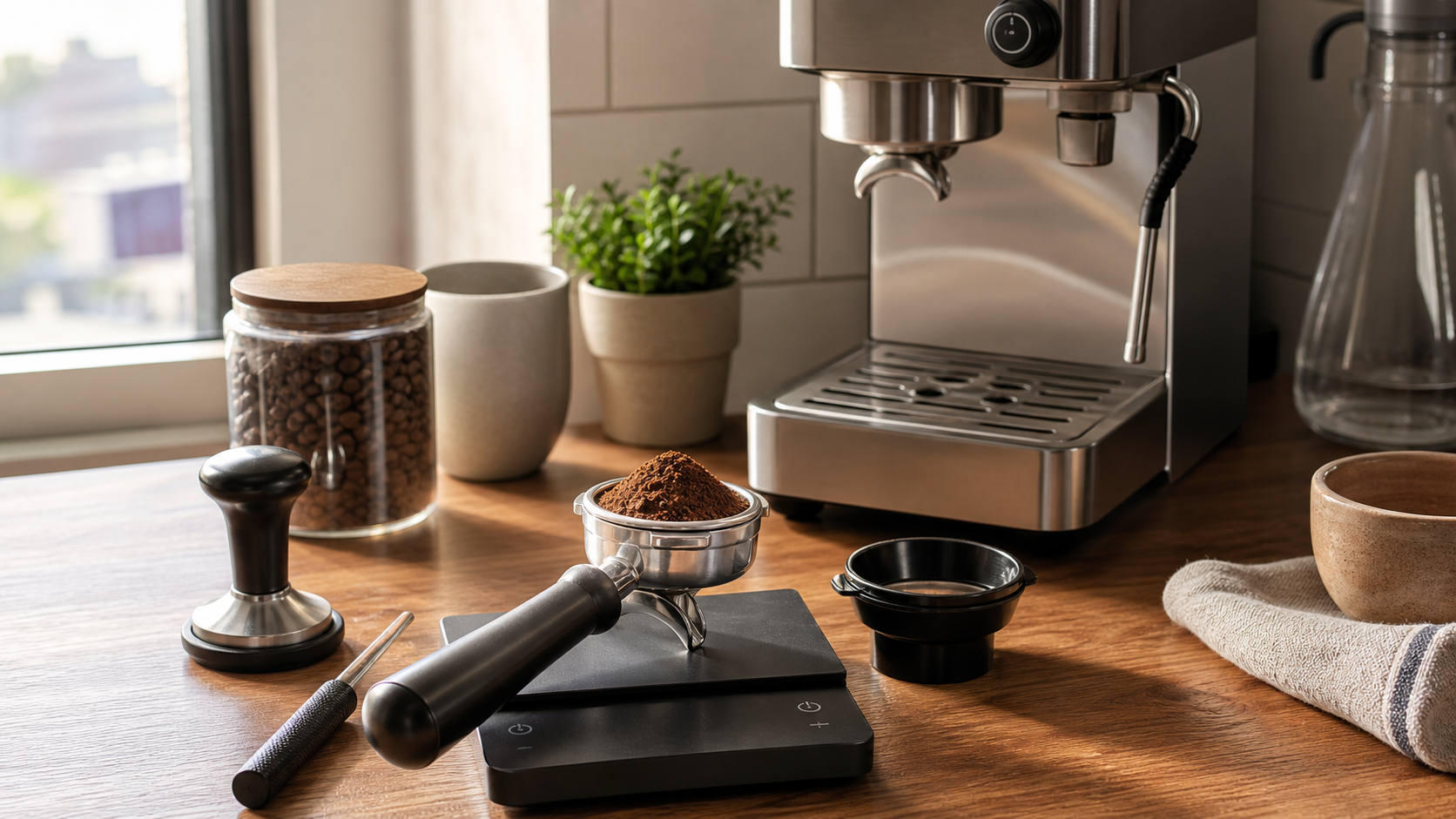
Breville markets an ideal 18g dose with its 54mm portafilter for full flavor, and its Bambino Plus materials also show a balanced 2-cup basket range of about 16–19g. After tamping, Breville's Razor tool is meant to trim the puck to a consistent height—not to force every coffee into one magic gram number. Treat 18g as a starting point, then choose a dose that fits cleanly and tastes good.
Apartment Barista uses Amazon affiliate links. As an Amazon Associate, this site earns from qualifying purchases. Prices and availability can change at any time and should be checked on Amazon before buying.
Decision Table: What To Do Next
| What you see | Likely meaning | Do this next | Skip this for now |
|---|---|---|---|
| Dose sits cleanly below the rim after a normal tamp, with room for your machine's headspace check | Basket and dose are compatible enough to dial in | Keep that dose for several shots; change only grind or yield next | Buying a larger basket only to make the number look like 18g |
| Coffee spills over the rim while grinding or distributing, but the tamped puck has normal headspace | Transfer mess, not necessarily overfill | Confirm basket size, then consider one compatible funnel | Using a funnel to hide an already overfilled basket |
| Even after settling, 18g cannot be tamped without overflowing, or the puck clearly crowds the shower screen | Dose volume is too high for this basket + coffee + accessories | Drop dose about 0.5–1g and retry (still inside a documented 16–19g 2-cup window when that applies), recheck headspace | Tamping much harder as the main fix; using a funnel to hide overfill |
| Dose fits without a puck screen, then fails after you add one | The screen used basket space | Recheck headspace with the screen in place; lower dose or remove the screen for now | Adding more tools the same morning |
| Stock pressurized basket behaves differently from a non-pressurized replacement | Basket type changed the workflow | Re-learn dose on the basket you actually installed | Copying a 58mm café recipe by weight alone |
This table is a workflow triage, not a lab measurement of every basket on the market. Evidence labels below stay conservative: manufacturer guidance where cited, and practical apartment workflow logic elsewhere.
Who This Guide Is For
This guide is for:
- Bambino, Bambino Plus, Dedica, and other compact-machine owners whose usual dose overflows
- beginners who copied an 18g recipe and assumed something was wrong when it did not fit
- people using a stock basket, a replacement basket, or a puck screen and unsure how to check headspace
- small-kitchen users who want less coffee on the counter and a simpler morning routine
This guide is not for:
- anyone looking for a universal gram number for every basket
- readers who want to change grinder, basket, dose, tamper, and puck screen all at once
- commercial café workflows
- people who have not checked whether their basket is pressurized or non-pressurized
Why the Same 18g Can Look Different
Grams measure coffee mass; a portafilter needs a particular coffee volume after grinding, settling, and tamping. That volume changes more than beginners expect.
- Basket geometry matters. Two baskets with a similar diameter can have different depths, wall shapes, and usable capacity. A replacement basket may also be rated differently from the stock basket.
- Coffee density matters. A lighter, puffier coffee can occupy more space at the same weight than a denser coffee. Do not treat a dose that fit one bag as a permanent basket limit.
- Grind volume matters. Freshly ground coffee can sit high and fluffy before it settles. This can create a transfer problem even when the final tamped dose has reasonable room.
- Accessories use space. A puck screen, a different basket, or a funnel changes the workflow. A funnel contains loose grounds; it does not create extra basket capacity.
- Basket type matters. A pressurized starter basket and a non-pressurized basket should not be treated as interchangeable recipe containers. Read pressurized vs non-pressurized baskets for beginners before changing equipment.
The simplest interpretation is: 18g is a test point, not a pass-or-fail test for your machine.
Manufacturer Starting Range vs Your Exact Basket
Manufacturer-researched (not Hands-on tested): Breville's Bambino family marketing describes barista-style performance with a 54mm portafilter and an ideal 18g dose. Bambino Plus instruction materials also present a balanced extraction table that lists roughly 8–11g for 1-cup baskets and 16–19g for 2-cup baskets, and they instruct users to use the Razor dose-trimming tool after tamping so the puck height is consistent.
What that means in an apartment kitchen:
- 18g is a manufacturer-facing starting ideal, not a warranty requirement that every coffee must meet.
- If your 2-cup workflow is happier at 16–17g with clean headspace, you are still inside a commonly documented compact-machine range.
- After tamping, if your machine includes a Razor-style tool, use it the way the manual shows: shoulders on the basket rim, trim excess, wipe the rim. That controls puck height for that Breville-style workflow; it is not a reason to force every roast into 18.0g.
Sources reviewed for this update (accessed 2026-09-14):
- Breville Bambino product page (US) — ideal 18g / 54mm framing
- Breville Bambino Plus instruction booklet (US PDF) — balanced basket ranges and Razor-after-tamp step
- Breville BES500 instruction manual mirror (US) — same dose/Razor guidance
Always prefer your exact booklet and basket marking over a screenshot from another region or another basket. Dedica-style and other compact machines can use different baskets and tools—do not assume a Breville Razor step applies unchanged.
A Calm Way to Find Your Starting Dose
Use one basket, one coffee, and one simple recipe for several shots. Do not upgrade the basket just because the first dose feels crowded.
- Check which basket is installed and whether it is stock, replacement, pressurized, or non-pressurized.
- Weigh a dose rather than relying only on a grinder timer.
- Start with a dose that transfers cleanly and can be tamped without coffee escaping over the rim.
- Lock in a simple yield target, such as roughly twice the dry coffee weight, then taste and adjust gradually. Treat this as a starting framework, not an extraction guarantee.
- After tamping, follow your machine's manual or supplied headspace tool if it has one. The puck should not be visibly crushed into the shower screen before brewing.
- Change only one variable next: dose, grind, or yield. Keep notes for two or three attempts before drawing a conclusion.
If a modestly lower dose fits cleanly and gives you a drink you enjoy, that is a valid compact-machine recipe. You do not need a larger basket simply to make the number look familiar.
Headspace Is More Useful Than a Magic Number
Headspace is the room between the prepared coffee puck and the shower screen or group area. Too little room can mean the puck is compressed before the shot begins; too much room can also change the way the water meets the coffee. The correct check is machine- and basket-specific, so use the manual, included tool, or basket maker's guidance rather than an internet rule of thumb.
For Breville-style compact machines, the supplied Razor-style leveling tool can be a useful reference when the manual says to use it. It is a check for that workflow, not a reason to shave every basket until it matches an online recipe. For Dedica-style or other compact machines, follow the exact manual and basket guidance instead of assuming a Breville tool applies.
If you use a puck screen, repeat the headspace check with the screen in place. It takes volume from the basket, so a dose that was comfortable without it may no longer be the right starting point. The puck screen guide for beginners explains why it is optional rather than a required fix.
What to Do When 18g Overflows
First: solve the volume problem
Lower the dose slightly and keep the rest of the recipe stable long enough to learn from it. That is usually a better first move than pressing coffee down harder or buying several accessories. If your basket is clearly too shallow for the recipe you want, research a correctly compatible basket later; do not buy one based on diameter alone.
Second: solve the transfer problem
If the dose fits after settling but loose grounds spill while you grind or distribute, a compatible funnel can make the counter easier to use. The funnel is a wall for the transfer stage, not a larger basket.
Third: solve the taste problem deliberately
If a lower dose tastes weak, sharp, bitter, or unbalanced, adjust only one other variable at a time. Grind size, yield, and coffee freshness all affect the result. The bottomless portafilter guide can help readers with a compatible non-pressurized setup diagnose visible flow, but it is not needed to learn a stable dose.
Two Useful Support Tools, Not Mandatory Upgrades
A compact scale for a repeatable dose
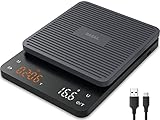
The BAGAIL BASICS Coffee Scale with Timer is the support example here because it helps you see whether 16g, 17g, or 18g is actually entering the basket. A scale is more informative than guessing from a timed grinder dose.
Good fit if:
- you do not know the dry dose reaching the basket
- you want to compare two nearby doses without changing everything else
- it fits your drip tray and leaves enough cup clearance
Skip it if:
- the platform cannot sit safely on your particular machine
- you already have a scale that is accurate and easy to use
- you are trying to solve a basket-compatibility issue by buying more gear
Small-space note:
Store the scale dry and measure it against your tray, cup, and portafilter clearance. Coffee scales that fit compact espresso machines has a fit-first checklist.
Amazon check:
Confirm current dimensions, seller, return policy, price, and availability before buying.
A funnel only for a confirmed compatible Breville-style basket
The CAFE HOME SHOP 54mm Dosing Funnel is a compatibility-specific example for a confirmed Breville-style setup that spills grounds during transfer. It can keep a fluffy dose inside the rim while you settle or distribute.
Good fit if:
- your exact basket and portafilter are confirmed compatible
- you spill grounds even though the final dose has reasonable headspace
- your grinder cradle leaves room for the funnel
Skip it if:
- you have a 51mm, 58mm, or unverified replacement basket
- the basket is actually overfilled
- you want a funnel to correct an unsuitable dose or recipe
Small-space note:
It is a small removable tool, but it should have a designated dry drawer or portafilter-storage spot instead of rolling across the counter.
Amazon check:
Confirm the exact variant, basket and portafilter fit, seller, return policy, price, and availability before buying.
For more on this low-mess workflow, see dosing funnel and WDT workflow for small espresso counters.
What I Would Do First
If a compact basket is overflowing, I would not buy a bottomless portafilter, puck screen, precision basket, and new tamper on the same day. I would weigh the dose, choose an amount that fits after tamping, and make a few shots with only that change.
If the drink is good and the workflow is clean, stop there. If grounds are the only annoyance, add one correctly fitted funnel. If you later want a larger basket, first confirm the exact portafilter, basket depth, group clearance, tamper fit, and return policy. A larger basket is an equipment choice, not a requirement to graduate from beginner espresso.
Common Mistakes
- Treating 18g as a universal rule because it is common in 58mm recipes.
- Assuming every 54mm basket has the same depth and usable dose range.
- Ignoring manufacturer ranges (for example, treating a balanced 2-cup window as a single forced 18g).
- Forcing the coffee down before checking headspace.
- Adding a puck screen without rechecking the prepared puck height.
- Using a funnel to hide an overfilled basket.
- Changing dose and grind size together, then not knowing why the shot changed.
- Buying a replacement basket or funnel without confirming exact compatibility and return terms.
FAQ
Is 18g wrong for a Bambino or Bambino Plus?
No. Breville uses 18g as an ideal dose in its 54mm Bambino materials, so it is a reasonable starting point. Official balanced 2-cup basket guidance also spans about 16–19g, with the Razor check after tamping. It is not wrong to use a different amount inside that kind of range when your exact basket, coffee, headspace, or accessory stack calls for it.
Can I just tamp harder to make 18g fit?
Do not use extra force as the main solution to an overflowing basket. Dose volume and headspace come first. A normal consistent tamp is more useful than trying to compress an unsuitable amount into the basket.
Does a 54mm portafilter always need less coffee than a 58mm one?
No. Diameter alone does not tell you the basket's depth, shape, or intended dose range. Compare the exact basket and its guidance, then test a clean repeatable dose.
Do I need a bigger basket if 18g does not fit?
Not necessarily. Start by using the dose that fits your current basket and tastes good. Consider a compatible larger basket only if you have a clear recipe reason and have checked fit, headspace, tamper compatibility, seller, and return terms.
Disclosure
Apartment Barista uses Amazon affiliate links. As an Amazon Associate, this site earns from qualifying purchases. Prices and availability can change at any time and should be checked on Amazon before buying.