
Quick Answer
Use a pressurized basket if you are a beginner who wants to start with pre-ground coffee, keep the counter simple, and learn the machine before buying a grinder.
Use a non-pressurized basket if you want more control over flavor and you are ready to use fresh beans with an espresso-capable grinder.
The most important beginner rule is:
- pressurized basket: easier starting path, less grinder pressure, less flavor control
- non-pressurized basket: harder starting path, much better grinder matters, more control when dialed in
Neither basket is "for good people" or "for bad people." They solve different beginner problems.
If you are still deciding on the whole setup, read this with is a burr grinder necessary for espresso, Breville Bambino vs De'Longhi Dedica, espresso machine buying guide for beginners, and best compact espresso machines for small kitchens.
Apartment Barista uses Amazon affiliate links. As an Amazon Associate, this site earns from qualifying purchases. Prices, sellers, return terms, and availability can change at any time, so check Amazon before buying.
Who This Guide Is For
This guide is for:
- beginners choosing a first compact espresso machine
- apartment renters who may not have grinder space yet
- small-kitchen users trying to keep the setup simple
- latte and oat milk latte drinkers who want a realistic starting path
- buyers comparing Bambino, Dedica, and a first grinder plan
This guide is not for:
- advanced hobbyists already dialing in specialty espresso daily
- commercial cafe workflows
- buyers who already know they want a dedicated single-dose grinder setup
- readers looking for a guaranteed perfect shot with no learning curve
The Real Beginner Problem
Most beginners do not wake up asking, "Which basket geometry should I choose?"
They ask something more practical:
"Can I start making espresso at home without immediately buying another appliance, or will that just make the machine frustrating?"
That is why basket confusion keeps coming back in public user discussions. One person says a grinder is mandatory. Another says pre-ground coffee is fine. Both can be partly right because they may be talking about different baskets.
A pressurized basket creates part of the brewing resistance through the basket design itself. That makes it more forgiving when the coffee is not perfectly ground for your machine.
A non-pressurized basket depends much more on the coffee puck itself to create resistance. That means grind size, freshness, dose, and distribution become much more important.
For a beginner in a small apartment, the basket choice is really a workflow choice:
- simpler start now
- or better control later
Quick Comparison
| Question | Pressurized basket | Non-pressurized basket |
|---|---|---|
| Can it work with pre-ground coffee? | Often yes | Usually frustrating |
| Do you need an espresso-capable grinder right away? | Not always | Yes, in practice |
| Is it easier for beginners? | Usually yes | Not at first |
| Can it still make enjoyable milk drinks? | Yes, especially for casual beginners | Yes, with more control once dialed in |
| Does it give more flavor control? | Less | More |
| Is it the better long-term learning path? | Usually not | Usually yes |
What A Pressurized Basket Actually Does
A pressurized basket is designed to make extraction more forgiving. Current Breville Bambino manuals still describe dual-wall baskets as the path for pre-ground coffee and older beans, which matches the way many beginners actually start.
This does not mean pressurized baskets are fake or useless. It means they are solving a different problem.
They make sense when:
- you are using pre-ground coffee on purpose
- you want to learn drink prep, cleanup, and milk workflow first
- you are not ready to buy a separate grinder yet
- your kitchen is too tight to add another tall appliance immediately
- you mainly drink milk drinks and want a smoother first month
They become limiting when:
- you want to tune flavor more precisely
- you are buying fresher beans regularly
- you want to understand dose and grind changes
- you feel like every shot tastes mostly the same
What A Non-Pressurized Basket Actually Does
A non-pressurized basket asks the coffee itself to create the right resistance. That is why espresso people keep talking about grind size so much.
Once you move to a single-wall, non-pressurized basket:
- the grinder matters more
- stale coffee matters more
- uneven distribution matters more
- random store pre-ground coffee usually stops being satisfying
The upside is that you gain more control. If you want to improve espresso over time, this is usually the better long-term route.
The downside is that it is a less forgiving first-week experience, especially if you are already trying to learn steaming, cleanup, and counter organization in a small kitchen.
The Best Beginner Decision Rule
If you are a true beginner, use this decision path:
Start With Pressurized First If...
- you do not own a grinder yet
- you need the lowest-clutter starting point
- you are using pre-ground coffee for the first few weeks
- you mainly want milk drinks and routine practice first
- your budget needs to go to the machine before the grinder
Start With Non-Pressurized First If...
- you already plan to buy fresh beans regularly
- you are buying an espresso-capable grinder now
- you actually want the learning curve
- you care about shot control more than the easiest start
- you will get annoyed by a capped-out beginner path
Do Not Force The "Advanced" Path Too Early If...
- the grinder budget is not there yet
- the setup already feels crowded
- you are still learning puck prep basics
- you are making one milk drink before work and do not want the setup to become a stress test
Product Examples
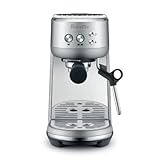
Breville Bambino
Best for: Compact machine with both basket paths
Why it fits:
The Breville Bambino is the clearest example of a beginner machine that does not force you into only one path. Current Breville materials for the Bambino line still show both dual-wall and single-wall basket support, which makes it useful for this exact guide.
Good fit if:
- you want to start with pressurized baskets and upgrade later
- you want a compact machine that can stay on the counter
- you want room to add a grinder later instead of buying everything at once
- you make espresso plus occasional milk drinks
Skip it if:
- you want the narrowest possible machine body
- you already know you want automatic milk help
- you do not want a separate grinder in the future
Small-space notes:
The Bambino works best for renters who want one machine that can support a learning phase and a better grinder phase later. Still measure water-tank access, cup space, and grinder room before buying.
Tradeoff:
Its strength is flexibility, not maximum convenience. It can start gently, but you still need to decide when to leave the dual-wall comfort zone and move into grinder-dependent espresso.
Amazon check:
Check the current Amazon seller, exact model, included baskets, return policy, dimensions, price, and availability before buying.
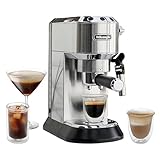
De'Longhi Dedica Deluxe
Best for: Slim starter machine path
Why it fits:
The De'Longhi Dedica Deluxe is a strong example of the slim beginner path. Current De'Longhi support materials still position the Dedica around compact size, removable tank and drip tray workflow, and compatibility with ground coffee use, which is exactly why it keeps showing up in first-machine discussions.
Good fit if:
- your counter width is very limited
- you want the simplest slim machine path first
- you are comfortable starting in the more forgiving basket path
- you care about fitting the machine more than building an accessory ecosystem immediately
Skip it if:
- you want the easiest long-term accessory path
- you hate cramped cup or tray workflows
- you already plan to jump into fresh-bean single-wall espresso right away
Small-space notes:
The Dedica is useful when every inch of width matters. That makes it friendly for narrow counters, but it does not remove the need to think about tank access, front workspace, and future grinder placement.
Tradeoff:
It solves width more than it solves the whole beginner workflow. That is great when the counter is the main problem, but less great when your real problem is wanting a stronger long-term upgrade path.
Amazon check:
Check the current seller, return terms, color, included accessories, dimensions, price, and availability on Amazon before buying.
Baratza Encore ESP
Best for: Entry grinder for the non-pressurized path
Why it fits:
The Baratza Encore ESP is the practical reminder that the basket choice eventually becomes a grinder choice. Current Baratza materials still position the ESP version around espresso-focused adjustment, which is why it makes sense here instead of a general burr grinder.
Good fit if:
- you are ready to move beyond pre-ground coffee
- you want to use a single-wall basket seriously
- you need a grinder that still fits a normal apartment counter
- you want a clearer first electric-grinder path
Skip it if:
- you are intentionally staying in a pressurized beginner path for now
- your apartment is extremely noise-sensitive in the morning
- you have no space for another visible appliance yet
Small-space notes:
This is a reasonable first electric grinder if you want to upgrade from a pressurized path without jumping into a huge espresso bar. Measure cabinet height and counter clutter before adding it.
Tradeoff:
It makes the non-pressurized path more realistic, but it also adds noise, height, another outlet need, and more daily cleanup than a pre-ground starter path.
Amazon check:
Check the current Amazon seller, exact ESP model, included cup or accessories, dimensions, return policy, price, and availability before buying.
What I Would Do First
If this is your first small-kitchen espresso setup, I would not rush into the hardest path just because the internet says that is the "real" way.
I would choose one of these two starts:
- Compact machine plus pressurized basket plus pre-ground coffee for the first month.
- Compact machine plus real espresso grinder plus non-pressurized basket from day one.
I would skip the awkward middle path:
- buying a machine
- refusing to use the pressurized basket
- not buying a proper grinder
- then blaming the machine for bad shots
That path wastes the most money and creates the most frustration.
Apartment Fit Checks Before Buying
Before buying anything, check these in your real kitchen:
- Can you remove or refill the water tank without dragging the machine every day?
- Is there enough room in front for cup, scale, towel, and portafilter movement?
- If you add a grinder later, where will it actually live?
- Is the machine still usable when the dish rack, toaster, or microwave are in normal positions?
- If you mainly drink lattes, do you have room for milk pitcher movement and quick steam-wand cleanup?
- If the machine is under cabinets, can you still work comfortably when you add a grinder or accessories?
Common Beginner Mistakes
- Buying a non-pressurized basket first but not budgeting for a real grinder.
- Treating pre-ground coffee in a single-wall basket as a fair test of the machine.
- Assuming "burr grinder" automatically means espresso-ready.
- Spending all the budget on the machine and leaving nothing for the grinder, scale, or cleaning basics.
- Treating pressurized baskets like a shameful backup instead of a useful temporary learning path.
- Staying with the pressurized path forever even after wanting more control and fresher beans.
FAQ
Is a pressurized basket bad for beginners?
No. It is often the most realistic way to start if you are using pre-ground coffee, learning milk drinks, or delaying the grinder purchase for budget or space reasons.
Can I use pre-ground coffee in a non-pressurized basket?
Usually not well. Sometimes a local roaster can grind closer to espresso than supermarket coffee, but it is still rarely dialed in for your exact machine, basket, dose, and bean age.
Do I need a grinder for a non-pressurized basket?
In practice, yes. If you want the benefits of a single-wall basket, a proper grinder is usually the tool that makes that path work.
Which basket is better for milk drinks?
Either can work for milk drinks, but they serve different goals. Pressurized baskets can be fine for casual milk-drink beginners. Non-pressurized baskets become better once you want more flavor control and better espresso underneath the milk.
Should I buy a machine that includes both basket types?
Usually yes. It gives you a safer upgrade path. You can start with the more forgiving basket, then move to the more demanding basket when your grinder plan and routine are ready.
Disclosure
Apartment Barista uses Amazon affiliate links. As an Amazon Associate, this site earns from qualifying purchases. Prices, sellers, return terms, and availability can change at any time and should be checked on Amazon before buying.