

Quick Answer
Yes, a burr grinder is necessary if you want to make traditional espresso with fresh whole beans and a single-wall, non-pressurized basket. Espresso needs a fine, repeatable grind. A blade grinder or a random coffee grinder usually cannot give enough control.
No, a burr grinder is not always necessary on day one if you are using a beginner machine with a dual-wall, pressurized basket and pre-ground coffee. That path can help you learn the machine, milk workflow, cleanup, and counter setup before spending more.
The simple rule is:
- single-wall basket plus fresh beans: buy an espresso-capable burr grinder
- dual-wall basket plus pre-ground coffee: a grinder can wait
- tiny apartment or noise-sensitive routine: consider a manual grinder
- serious long-term espresso learning: plan for a grinder sooner rather than later
If you already know you want to improve shot quality, start with the best burr grinders for beginner espresso. If you are still planning the whole setup, read this with the beginner espresso setup under $500 and what you need for a beginner espresso setup.
Who This Guide Is For
This guide is for:
- beginners buying a first espresso machine
- apartment renters with limited counter space
- small-kitchen users who cannot fit every coffee tool at once
- latte and oat milk latte drinkers deciding whether grinder quality matters under milk
- buyers choosing between fresh beans, pre-ground coffee, and manual grinding
This guide is not for:
- commercial cafe setups
- advanced espresso hobbyists tuning high-end grinders
- people who only make drip coffee and never plan to pull espresso shots
- buyers looking for a guaranteed perfect shot from one purchase
The Need Behind This Guide
The real beginner question is not just "Do I need a grinder?"
It is:
"Can I start making espresso without adding another appliance, or will skipping the grinder make the machine frustrating?"
That answer depends on the basket in your portafilter. A single-wall basket relies on the coffee puck itself to create resistance. That means the grind must be fine, fresh, and adjustable. If the grind is too coarse, water runs through too quickly. If the grind is too fine, the machine can choke or produce a harsh, bitter shot.
A dual-wall, pressurized basket is more forgiving. It creates extra resistance through the basket design, so it can work with pre-ground coffee or coffee that is not perfectly dialed in. It is useful for learning, but it also limits how much control you have over flavor and texture.
That is why two beginners can get different advice and both can be right. One person using fresh beans in a single-wall basket needs a real grinder. Another person using pre-ground coffee in a pressurized basket can learn the routine first and upgrade later.
The Basket Rule
| Your setup | Do you need a burr grinder now? | Best beginner path |
|---|---|---|
| Single-wall basket with fresh beans | Yes | Buy an espresso-capable burr grinder |
| Dual-wall basket with pre-ground coffee | Not immediately | Learn the machine, then upgrade |
| Blade grinder with any basket | No, but it is not a good espresso solution | Skip the blade grinder and save for burrs |
| Manual espresso maker with fresh beans | Yes | Use a good manual or electric burr grinder |
| Milk drinks only, casual routine | Eventually, but you can start simpler | Use pressurized basket first if your machine supports it |
Do not treat "burr grinder" as one universal category. Some burr grinders are good for drip coffee but awkward for espresso because the adjustment steps are too large or the fine range is limited. For espresso, you want a grinder with useful fine adjustment, not just the word "burr" on the box.
Why Espresso Is Hard on Grinders
Espresso uses pressure and a short brew time. Small grind changes can make a shot run too fast or too slow.
For beginners, that means the grinder needs to do three jobs:
- grind fine enough for espresso
- make repeatable changes between settings
- produce grounds that are consistent enough to avoid wild channeling and sour or bitter swings
A blade grinder is the wrong tool because it chops beans unevenly. You get dust, chunks, and guesswork. That can be acceptable for a casual emergency cup of coffee, but it is not a good way to learn espresso.
A generic burr grinder may still be frustrating if the espresso range is too narrow. You might find one setting too fast and the next setting too slow. That is why espresso-focused entry grinders matter: they give beginners smaller steps where those steps actually count.
Three Beginner Paths
1. Buy an entry espresso-capable burr grinder
Best for: Entry burr grinder path
The Baratza Encore ESP is the clearest first path for many apartment beginners because it is an espresso-focused version of a familiar entry grinder. The important detail is the ESP adjustment range, not just the brand name. Current Baratza materials describe a divided adjustment system where the espresso range uses smaller steps than the filter coffee range.
Good fit if:
- you want to use fresh whole beans
- your machine includes or supports single-wall baskets
- you want to learn dose, yield, shot time, and grind adjustment
- you have space beside the machine for a compact electric grinder
- you want one grinder that can also handle brewed coffee settings
Skip it if:
- you are not sure you will keep making espresso
- morning grinder noise is a major apartment problem
- you need a grinder that disappears into a drawer
- you already plan to buy a higher-end espresso grinder soon
Small-space note:
Measure the whole work zone, not only the grinder footprint. You need room for beans, a dosing cup or portafilter, a scale, tamping, and wiping grounds from the counter.
Amazon check:
Check current Amazon seller, return terms, exact ESP model, selected color, included dosing cup, dimensions, price, and availability before buying. Confirm it is the Encore ESP, not the older non-ESP Encore.
2. Use a manual burr grinder for quiet small-space espresso
Best for: Manual quiet grinder path
The KINGrinder K6 is the quiet, low-clutter path for beginners who want fresh grinding but do not want another electric appliance on the counter. Current KINGrinder materials describe external adjustment in small click steps, and the hand-powered format makes it easier to store in a drawer or cabinet.
Good fit if:
- you make one or two drinks at a time
- you live with roommates, thin walls, or sleeping family members
- you want to keep the counter clear
- you do not mind physical effort
- you want a grinder that can travel or move between storage and counter
Skip it if:
- you make several milk drinks every morning
- you have wrist or hand comfort concerns
- you want the fastest routine before work
- you prefer pressing a button and preparing milk while the grinder runs
Small-space note:
A manual grinder saves counter space, but it does not save effort. Espresso grind is fine, and fine hand grinding takes patience. This path is best when quiet and storage matter more than speed.
Amazon check:
Check current Amazon seller, exact K6 model, color, capacity, handle style, included parts, return policy, price, and availability before buying. Some listings can look similar across different KINGrinder models.
3. Start with a pressurized basket and pre-ground coffee
Best for: Pressurized-basket learning path
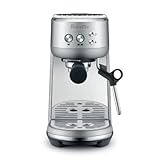
The Breville Bambino is a useful example because current Breville materials show both single-wall and dual-wall baskets included with the machine. That gives beginners two learning paths: fresh beans with grinder control, or pre-ground coffee with the more forgiving dual-wall basket.
Good fit if:
- you want to learn the machine before adding a grinder
- your budget needs to cover the machine, scale, beans, and cleaning first
- you mostly make milk drinks and want a simple start
- you are not ready to dial in a new grind every time beans change
- your kitchen cannot fit a machine and grinder yet
Skip it if:
- you already know espresso flavor control matters to you
- you want to use fresh whole beans from the start
- you dislike being limited by pre-ground coffee freshness
- you want to practice single-wall basket technique immediately
Small-space note:
This is the lowest-clutter starting path, but it should be treated as a learning phase. It helps you understand water tank access, milk steaming, drip tray cleanup, cup clearance, and daily routine before expanding the setup.
Amazon check:
Check current Amazon seller, exact model, included baskets, dimensions, return policy, accessories, price, and availability before buying. Product bundles and included accessories can change, so confirm the basket set on the current listing before relying on this path.
When to Buy the Grinder Now
Buy the grinder now if you want to use fresh whole beans, compare shot times, and make meaningful changes when espresso tastes sour, bitter, thin, or harsh.
You should also buy the grinder now if your machine uses a single-wall basket and does not include a forgiving pressurized path. Pre-ground coffee in a single-wall basket is usually frustrating because it was not ground for your exact machine, dose, basket, and coffee age.
The grinder should also come first if your budget choice is "nicer machine with weak grinder" versus "simpler machine with capable grinder." A capable grinder often improves a beginner setup more than another accessory.
When It Is Okay to Wait
It is okay to wait if you are still figuring out whether you enjoy the espresso routine at all.
Waiting makes sense if:
- your machine includes dual-wall baskets
- you are using decent pre-ground coffee as a temporary learning step
- your first goal is milk drinks, not flavor tuning
- you need to keep the counter minimal for now
- buying the grinder immediately would make you skip a scale or cleaning supplies
If you wait, set a clear upgrade trigger. For example: "After one month, if I still use the machine most mornings, I will buy a grinder." That prevents the temporary path from becoming a permanent source of weak or stale-tasting espresso.
What Not to Do
Do not buy a blade grinder for espresso. It is cheap, but it teaches the wrong lesson because the grind is uneven and hard to repeat.
Do not assume every burr grinder is espresso-ready. A grinder can be excellent for drip coffee and still be annoying for espresso.
Do not use pre-ground coffee in a single-wall basket and assume the machine is bad. The grind may simply be wrong for your basket.
Do not spend all the budget on the machine and leave nothing for grinder, scale, beans, and cleaning. Espresso is a system, not one appliance.
Do not buy a grinder so large or loud that you avoid using it. In a small apartment, the best grinder is the one that fits your real morning routine.
Small-Apartment Setup Advice
If your counter is tiny, place the machine first. Then decide where grinding happens.
For an electric grinder, leave enough room for:
- opening the hopper or lid
- moving a dosing cup
- setting down a portafilter
- weighing beans or grounds
- brushing grounds into the sink or trash
For a manual grinder, decide where it lives between uses. A drawer-friendly grinder is only helpful if the drawer is easy to reach and not packed with unrelated tools.
For the pressurized-basket path, keep the setup honest. You still need a scale, fresh enough coffee, a clean basket, and regular cleaning. Pressurized does not mean no technique; it just reduces how much grind precision you need at the start.
FAQ
Is a burr grinder necessary for espresso?
Yes, for traditional espresso with fresh beans and a single-wall basket. Not always on day one if your machine has a dual-wall, pressurized basket and you are intentionally starting with pre-ground coffee.
Can I use pre-ground coffee for espresso?
You can use pre-ground coffee more successfully with a pressurized basket. It is usually frustrating in a single-wall basket because the grind was not dialed in for your exact machine and dose.
Is a manual grinder good enough for espresso?
A good manual burr grinder can work well for espresso, especially in a small apartment. The tradeoff is effort and speed. It is best for one or two drinks, not a long line of morning lattes.
Is an electric grinder too loud for an apartment?
Some electric grinders are noticeable, especially early in the morning. They usually run briefly, but noise still matters in studios, shared apartments, and homes with sleeping family members. A manual grinder is the quieter path.
Should I buy a grinder before a scale?
Do not skip the scale. If the budget is tight, plan the machine, grinder, and scale together. A grinder gives control, but the scale tells you what changed.
Can milk cover up bad espresso?
Milk can soften bitterness and thinness, but it does not fix stale coffee or a wildly wrong grind. If you drink lattes every day, the grinder still matters once you want repeatable flavor.
What should I check before buying any grinder on Amazon?
Check the exact model, seller, return terms, dimensions, included accessories, color or configuration, price, and availability. Product pages and featured sellers can change, so verify the listing before buying.
Disclosure
Apartment Barista uses Amazon affiliate links. As an Amazon Associate, this site earns from qualifying purchases. Prices and availability can change at any time and should be checked on Amazon before buying.