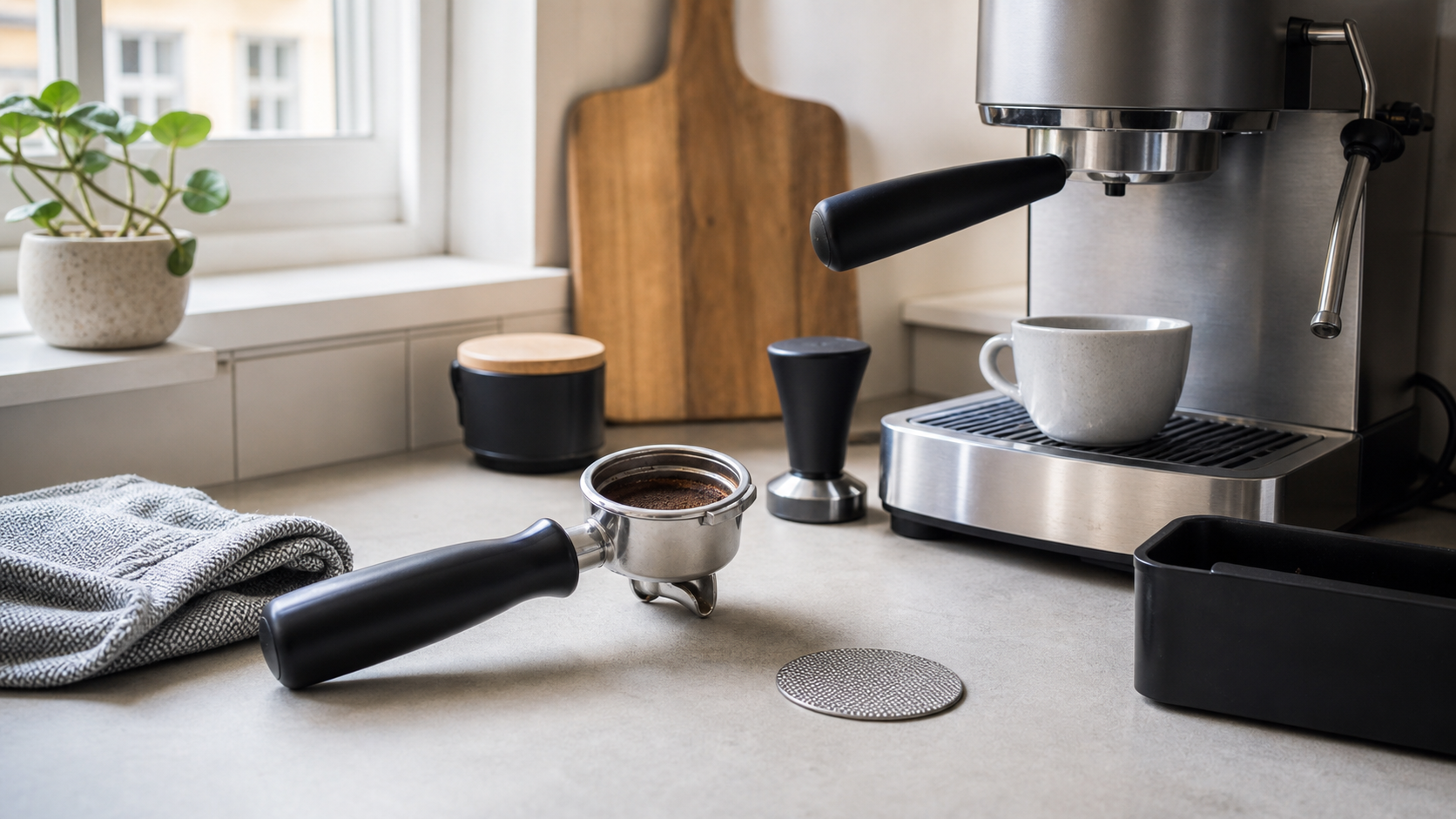


Quick Verdict
Most espresso beginners do not need a puck screen on day one. A puck screen can be useful later, especially if you want to keep the shower screen cleaner or experiment with water distribution, but it is not a shortcut around grinder, dose, basket, or puck-prep problems.
If you are still learning dose, yield, grind size, tamping, basket type, and cleanup, add fewer variables first. A puck screen gives you one more wet metal part to rinse, dry, store, and remember. In a small apartment kitchen, that extra step matters more than it looks in a video.
The better beginner rule is simple: get your recipe repeatable, keep the machine clean according to the manual, then decide whether a puck screen solves a real problem you still have.
For many beginners, the first useful accessories are still a scale, a basic puck-prep tool if grounds are clumpy, a tamper that actually fits the basket, and a cloth routine you can repeat after every drink.
Apartment Barista uses Amazon affiliate links. As an Amazon Associate, this site earns from qualifying purchases. Prices and availability can change at any time and should be checked on Amazon before buying.
Who This Guide Is For
This guide is for:
- beginners who keep seeing puck screens recommended online
- compact-machine owners with small drip trays and limited cup clearance
- apartment renters who want easier cleanup without adding clutter
- latte drinkers who care more about a reliable morning routine than accessory testing
- Breville Bambino, Bambino Plus, De'Longhi Dedica, and similar compact-machine users checking 51mm, 53.3mm, or 54mm accessory advice
This guide is not for:
- experienced users already testing basket depth, headspace, flow, and extraction changes
- people who enjoy changing one puck-prep variable at a time
- commercial cafe workflows
- anyone looking for a product that will automatically fix sour, bitter, or spraying shots
What a Puck Screen Actually Does
A puck screen is a thin screen that sits on top of the tamped coffee bed before you lock in the portafilter. It is not the same thing as the machine's shower screen, which is part of the group head.
People use puck screens for a few reasons:
- to reduce coffee grounds reaching the shower screen
- to help water contact the puck more evenly
- to make the top of the puck look cleaner after the shot
- to reduce some mess inside the group head
- to experiment with extraction consistency
Those are real reasons, but they do not make the screen essential for every beginner.
A puck screen also adds:
- one more part to rinse while it is hot and wet
- one more item that can trap coffee oils
- another variable that can change shot timing
- a possible cup-clearance issue on compact machines
- a possible headspace issue if your basket is already full
That is the tradeoff beginners should understand before buying.
The Beginner Problem: Too Many Variables
Current public espresso discussions show a common beginner pattern. Someone gets a machine, then quickly considers a puck screen, WDT tool, dosing funnel, bottomless portafilter, upgraded basket, spring-loaded tamper, new recipe, and different dose.
The problem is not that those tools are fake. The problem is that adding several at once makes diagnosis harder.
If your next shot runs faster, tastes different, or sprays less, what changed?
- the screen
- the dose
- the headspace
- the grind
- the basket
- the tamp
- the distribution
- the bean age
- the machine temperature
For a beginner, the fastest route is usually not buying every small puck tool. It is changing one thing, making notes, and keeping the routine repeatable enough that you can learn from it.
If you are already tempted by multiple accessories, read espresso accessories beginners can skip and should beginners buy a bottomless portafilter before filling the drawer.
When a Puck Screen Helps
A puck screen can be worth trying when your basics are already stable.
It may help if:
- you use a non-pressurized basket with fresh-ground coffee
- you already weigh dose and yield
- your basket has enough headspace for the screen
- your shower screen gets messy quickly
- you are willing to rinse and dry the screen after each use
- you want to test whether it improves consistency in your specific setup
It is most useful as a controlled experiment. Try it after the recipe is repeatable, not while the whole routine is still changing.
When Beginners Should Wait
Wait on a puck screen if:
- you are not weighing your coffee yet
- you are still using pre-ground coffee in a pressurized basket
- you do not know your basket size or dose range
- your current dose already leaves little headspace
- your scale and cup barely fit under the machine
- your main frustration is taste rather than cleanup
- your small counter already feels hard to reset
If the machine manual says to wipe the shower screen and run water through the group head, a puck screen does not remove that responsibility. It may reduce some mess, but it does not replace machine-specific cleaning.
For cleaning basics, start with how to clean an espresso machine. For basket confusion, read pressurized vs non-pressurized baskets for beginners.
Apartment Fit Checks Before Buying One
Before buying a puck screen, check:
- the exact basket diameter, not just the machine brand
- whether the screen thickness leaves enough headspace above the coffee
- whether your dose has to change to fit the screen
- whether the cup still fits under the portafilter
- whether your scale still fits with the cup in place
- whether you have a place to rinse and dry the screen
- whether the screen is easy to remove when hot
- current Amazon seller, exact size, return policy, price, and availability
Do not buy only because a listing says "Breville," "Sage," "51mm," or "54mm." Compact espresso accessories are easy to buy wrong. The exact basket and machine matter.
Better First Accessories for Most Beginners
A WDT tool if grounds are clumpy
The Aieve WDT Espresso Distribution Tool is more useful than a puck screen if your grounds land in clumps or mound unevenly before tamping.
Good fit if:
- you use fresh-ground coffee in a non-pressurized basket
- your grinder produces clumps
- your shots show channeling even when dose and yield are consistent
- you want a small tool that can live near the machine
Skip it if:
- you use only pressurized baskets with pre-ground coffee
- you are not weighing your dose yet
- you expect it to fix grind size or stale beans
Small-space note:
Needles need safe storage. A WDT tool should not roll loose in a drawer with towels, puck screens, brushes, and milk pitchers.
Amazon check:
Check the current Amazon seller, mount style, included needles, return policy, price, and availability before buying.
A fitted tamper after you confirm basket size
The Normcore V4 53.3mm Spring-Loaded Tamper is a useful example of a size-specific tamper for compatible Breville-style 54mm baskets. It is not universal.
Good fit if:
- your basket is compatible with this 53.3mm size
- your included tamper leaves a loose edge
- you struggle to tamp level
- you want more repeatability before testing smaller variables
Skip it if:
- your machine uses a different basket size
- your stock tamper already fits well enough
- you have not confirmed the basket you actually use
- you are still changing dose, basket, and grind every session
Small-space note:
One fitted tamper can be more useful than a drawer full of similar tools. Buy the right size once instead of buying several almost-right accessories.
Amazon check:
Check current Amazon seller, selected size, basket compatibility, included springs, return policy, price, and availability before buying.
A daily wipe-down cloth
The Amazon Basics Microfiber Cleaning Cloths are not exciting, but they support the part of espresso beginners underestimate: resetting the counter after grounds, water, milk, and drip-tray mess.
Good fit if:
- you make milk drinks in a small kitchen
- your drip tray and scale need frequent wiping
- you want a dedicated coffee cloth instead of using food-prep towels
- you need a simple cleanup habit before adding more accessories
Skip it if:
- you do not have a drying and laundry routine
- you are looking for a chemical cleaner
- you need descaler or machine-specific cleaning tablets instead
Small-space note:
Keep one cloth for the coffee station and rotate it often. Wet cloths should not live bunched up next to beans or clean cups.
Amazon check:
Check current Amazon seller, pack size, cloth dimensions, washing guidance, return policy, price, and availability before buying.
Cleaning tablets only when your manual calls for them
Urnex Cafiza Cleaning Tablets are a support item for compatible espresso machines and backflush or cleaning-tablet routines. They are not a descaler, and they are not a universal requirement.
Good fit if:
- your machine manual calls for detergent cleaning tablets
- your machine has a compatible cleaning program or backflush routine
- you understand the difference between cleaning coffee oils and descaling mineral buildup
- you want maintenance supplies ready before the reminder light appears
Skip it if:
- your manual does not call for this type of cleaner
- you need descaling solution instead
- you are trying to fix a recipe or grind issue
Small-space note:
Store cleaning tablets away from food, beans, milk tools, and children. Keep the package label readable so you do not confuse cleaner types later.
Amazon check:
Check current Amazon seller, tablet format, machine compatibility, return policy, price, and availability before buying.
If You Do Buy a Puck Screen
Use it like a test, not a magic upgrade.
Start this way:
- Keep your current dose, yield, and grind the same.
- Confirm the basket is not overfilled once the screen is added.
- Pull a shot without changing anything else.
- Watch whether shot time or taste changes.
- Rinse and dry the screen immediately.
- Keep notes for a few sessions before deciding whether it stays.
If the screen makes the workflow slower, messier, or harder to fit under a compact machine, it is fine to stop using it. A tool that looks useful online may not be useful in a cramped morning routine.
What I Would Do First
For a beginner in a small apartment, I would build the routine in this order:
- Confirm whether you are using a pressurized or non-pressurized basket.
- Use a scale that fits under your machine.
- Keep dose and yield consistent for several drinks.
- Fix obvious clumping with WDT if needed.
- Confirm your tamper actually fits the basket.
- Create a wipe-down and cleaning routine.
- Add a puck screen only if shower-screen mess, headspace, or water distribution is still a specific problem.
That order keeps the learning curve clearer and the counter easier to reset.
Common Mistakes
Using a puck screen to cover up overfilling
If your basket is already too full, adding a screen can make headspace worse. Reduce dose or use the correct basket instead of forcing another part into the stack.
Forgetting the screen must be cleaned
A puck screen can keep the group head cleaner, but coffee oils and fine grounds still need to go somewhere. The screen itself becomes part of the cleaning routine.
Changing the recipe and screen at the same time
If you change dose, grind, basket, and puck screen together, you will not know which change mattered.
Buying the wrong size
Accessory listings can be confusing. Confirm your exact basket and machine before buying any 51mm, 53.3mm, or 54mm screen.
Ignoring compact-machine clearance
On a small machine, a cup, scale, portafilter, screen, and taller basket can fight for the same space. Measure the whole workflow, not only the screen.
FAQ
Does a puck screen make espresso taste better?
Not automatically. It may help water contact the puck more evenly in some setups, but taste still depends on beans, grind, dose, yield, basket, distribution, tamping, and machine routine.
Should beginners use a puck screen?
Most beginners should wait until the basic recipe is repeatable. A puck screen is easier to judge after you already know your dose, yield, basket, and cleanup routine.
Does a puck screen replace cleaning the shower screen?
No. It may reduce how much coffee reaches the shower screen, but you still need to follow the machine manual for wiping, rinsing, cleaning, and descaling.
Can a puck screen cause problems?
Yes. It can reduce headspace, change shot timing, add cleanup, trap oils, or create cup-clearance issues if the basket and machine are already tight.
Should I buy a bottomless portafilter or puck screen first?
For most beginners, neither should come first. Start with a scale, grinder plan, basic puck prep, and cleanup routine. Add diagnostic tools later if you have a specific problem to solve.
Disclosure
Apartment Barista uses Amazon affiliate links. As an Amazon Associate, this site earns from qualifying purchases. Prices and availability can change at any time and should be checked on Amazon before buying.