

Quick Verdict
If one person drinks regular espresso and the other drinks decaf, you do not automatically need two full grinders. The best first setup for most small kitchens is one espresso-capable grinder with a single-dose-style workflow, two clearly separated bean containers, and written grind notes for each coffee.
That is why the Baratza Encore ESP is the safest first electric grinder here. It is simple, compact, and easier to recommend when a shared household wants one espresso-capable grinder without jumping straight to a second full station.
If the decaf drinker only makes a cup a few times a week, a cheaper second grinder can make more sense than upgrading the main grinder. In that case, keep your primary electric grinder for regular espresso and add a manual grinder such as the KINGrinder K6 for decaf. If you know from day one that you want a more guided timed-dose routine for the main beans, the Breville Smart Grinder Pro is the more convenience-focused alternative.
The mistake to avoid is building a second full coffee station before you understand the real routine. Start with the switching problem first: how often you swap beans, how much purge waste annoys you, and whether both people will actually remember grind settings. If you still need help choosing the rest of the station, pair this guide with best burr grinders for beginner espresso, how to store coffee beans in a small kitchen, and espresso machine vs grinder: how to split a beginner budget.
Who This Guide Is For
This guide is for:
- couples sharing one espresso machine
- one regular coffee drinker and one decaf drinker
- small-kitchen or apartment households without room for a second full setup
- beginners who want a simpler shared morning routine
- milk-drink households that still want a workable espresso base
This guide is not for:
- commercial cafe service
- buyers who want zero dialing or zero cleanup
- large households making many back-to-back drinks every morning
- people who want to keep several coffees loaded in large hoppers at once
- anyone expecting decaf to behave exactly like their regular beans
Why This Setup Gets Tricky Fast
Regular and decaf espresso do not always pull the same way. In current public Reddit discussions, people dealing with one regular drinker and one decaf drinker keep asking the same questions:
- Can one grinder handle both?
- Do I need a second grinder just for decaf?
- Will I waste beans purging retained grounds?
- Does decaf need a finer grind?
- Is a hopper grinder the wrong choice for a shared setup?
The answer is usually not "buy the fanciest grinder." It is "choose the workflow that creates the least friction in your kitchen."
For most beginners, that means:
- weigh only the beans you need right now
- keep regular and decaf in separate labeled containers
- save a starting grind setting for each bean
- accept that switching beans still needs small taste-based adjustments
This guide is based on current public user-demand research, official product pages, and current Amazon-facing product checks. It is not hands-on testing.
Quick Picks
| Pick | Best for | Why it fits |
|---|---|---|
| Baratza Encore ESP Coffee Grinder | First electric shared-household pick | Straightforward espresso-focused grinder that works well when both people can keep simple switching notes |
| Breville Smart Grinder Pro | Timed-dose main grinder pick | Guided screen workflow and repeatable dosing if one person will usually handle the regular-bean routine |
| KINGrinder K6 Manual Coffee Grinder | Manual decaf-only second grinder pick | Quiet, drawer-friendly second grinder for decaf when it is used less often |
| OXO Steel POP Coffee Container with Scoop | Separate bean storage pick | Keeps regular and decaf beans apart without taking up much space |
These are workflow roles, not a fixed cart. Check the current Amazon seller, exact model or version, dimensions, included accessories, return terms, price, and availability before buying.
The Short Buying Rule
Use one grinder if:
- both people can keep notes
- you are willing to switch settings
- you do not mind a little dialing when a new bag opens
- counter space matters more than absolute convenience
Use two grinders if:
- one person drinks decaf almost every day
- you hate changing grind settings back and forth
- your machine is used several times a day
- you have enough storage for a second grinder
Use a manual second grinder if:
- decaf is occasional
- you want to spend less money
- you need the second grinder to live in a drawer, not on the counter
Apartment Fit Checks Before You Buy
Before you buy anything, check these practical points:
- Measure where the main grinder will live, including height under cabinets.
- Decide whether the second grinder can live in a drawer or cabinet.
- Plan separate containers for regular and decaf so beans do not get mixed.
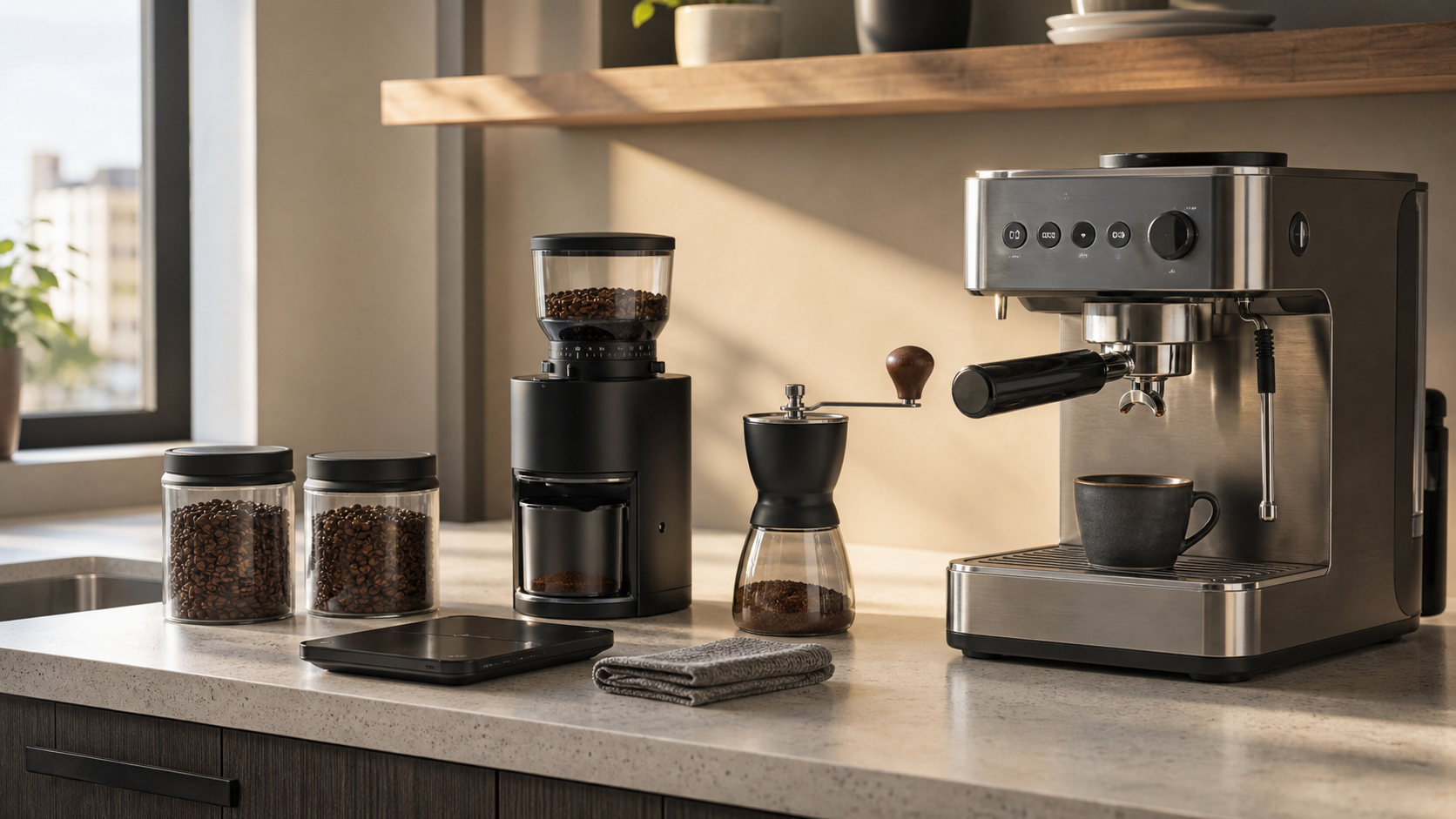
- Leave enough daily space for the grinder, espresso machine, scale, and cleanup towel.
- If one person drinks espresso before bed, choose a workflow that does not require moving many things around at night.
- If your machine has a built-in grinder, be realistic that switching beans will usually be less convenient than using a separate grinder.
- Check current Amazon or brand pages for exact version, seller, return policy, dimensions, included accessories, and availability before buying.
The biggest apartment mistake is forgetting that a "small" grinder still needs working room around it. You need space to open the bean bin, remove the catch cup, wipe stray grounds, and put the scale somewhere while the shot is being pulled.
What Current Research Suggests
Current Reddit discussions still show that this is a live problem in 2026. Users describe regular-plus-decaf households using one single-dose grinder, pairing a main electric grinder with a second decaf grinder, or simply keeping written settings for each coffee.
Three patterns repeat:
- Decaf often needs a finer grind than the regular bean.
- A single-dose-style grinder makes switching easier than keeping two beans in one hopper.
- A second grinder makes sense only when the switching itself becomes the daily pain point.
That is why this guide focuses more on grinder workflow and storage than on the espresso machine body. For most shared households, the machine is not the main decaf problem. Bean switching is.
Product Reviews
Baratza Encore ESP Coffee Grinder
Best for: First electric shared-household pick
Why it was selected:
The Baratza Encore ESP is included because it is still one of the safest beginner electric grinder references for espresso. Current Baratza guidance keeps it clearly espresso-focused and shows an included dosing cup, simple hopper adjustment, and compatibility with a single-dose hopper accessory. Current Amazon listing data still shows compact upright dimensions for a small kitchen.
Good fit if:
- you want a straightforward first electric espresso grinder
- you want one main grinder that can later become the dedicated regular-bean grinder
- you prefer simple controls over lots of workflow extras
- you have a compact machine and want a separate grinder that does not dominate the counter
Skip it if:
- you want a no-thinking bean switch with almost no adjustment
- you want the quietest grinder in the room
- you want a grinder designed mainly for low-retention single dosing
- you do not want to think about hopper management at all
Small-space notes:
The Encore ESP works best here when you treat it as a measured-dose workflow, not as a hopper full of mixed routines. If you leave regular beans in the hopper and only switch to decaf sometimes, the workflow can still work, but you should expect some purge waste and redialing.
Tradeoff:
It is a strong beginner grinder, but it is not a magic two-bean machine. The value is simplicity and footprint, not a perfect multi-bean workflow.
Amazon check:
Check the current Amazon seller, exact ESP model, included dosing cup, return policy, dimensions, price, and availability before buying. If you plan to single dose regularly, confirm whether you also want the Baratza single-dose hopper accessory.
Breville Smart Grinder Pro
Best for: Timed-dose main grinder pick
Why it was selected:
The Breville Smart Grinder Pro is included because some shared households want the main regular-bean routine to feel guided and repeatable. Current Breville and Amazon-facing product research still shows 60 grind settings, timed dosing, and portafilter-cradle support. That can make it easier for one person to keep the regular setup stable while a second grinder handles occasional decaf later.
Good fit if:
- one person makes the regular espresso most of the time
- you prefer a screen and timed-dose workflow
- you want a dedicated main grinder that can stay dialed for one bean
- you do not mind a taller grinder body
Skip it if:
- you want the smallest possible grinder for a tight counter
- you want a low-retention single-dose-first workflow
- both people will constantly switch between regular and decaf in the same grinder
Small-space notes:
This can work well in an apartment if you decide the regular-bean workflow should stay stable and the decaf workflow should live somewhere else. It is less elegant for frequent back-and-forth switching in one hopper, but it is more convenient for a "main coffee plus occasional decaf" split.
Tradeoff:
The Smart Grinder Pro adds convenience, but it is taller and less switch-friendly than a measured-dose routine. It is best when your household wants a predictable main grinder more than a minimalist one-grinder experiment.
Amazon check:
Check the current Amazon seller, exact Smart Grinder Pro model, included cradles, return policy, dimensions, price, and availability before buying. Also confirm cabinet clearance, because hopper height matters more in a small kitchen than the footprint alone.
KINGrinder K6 Manual Coffee Grinder
Best for: Manual decaf-only second grinder pick
Why it was selected:
The KINGrinder K6 is the best cheap second-grinder idea for this topic. Current KINGrinder product information still presents it as a precise manual grinder with fine external adjustment and a roughly 25 g to 30 g hopper capacity. Current Reddit discussions about regular-plus-decaf households still mention the K6 as a practical second grinder for decaf when the decaf drinker uses it less often.
Good fit if:
- decaf is only needed a few times a week
- you want to avoid changing your main electric grinder every day
- you need the second grinder to store in a drawer
- you care about keeping the second setup cheap and quiet
Skip it if:
- both people drink several espresso drinks every day
- you dislike hand grinding for espresso
- you have wrist, grip, or mobility concerns
- you want the second grinder to feel effortless before bed or early in the morning
Small-space notes:
This is a very strong apartment solution because it solves the decaf problem without forcing a second full-size electric grinder onto the counter. For many households, that is enough. The decaf grinder comes out only when needed, then goes back in the drawer.
Tradeoff:
You save money and counter space, but you pay with hand effort. For one occasional decaf drink, that trade can be excellent. For daily back-to-back milk drinks, it can get old fast.
Amazon check:
Check the current Amazon seller, exact K6 model, included parts, return policy, price, and availability before buying. Read recent owner feedback about espresso grind effort, because the comfort of hand grinding matters as much as the burr spec.
OXO Steel POP Coffee Container with Scoop
Best for: Separate bean storage pick
Why it was selected:
The OXO Steel POP coffee container is here because this problem is not only about grinders. Separate bean storage is what keeps the shared routine from turning into a guessing game. Current OXO product information still describes the 1.7 qt container as airtight, stackable, and sized for about 1 lb of coffee beans.
Good fit if:
- you want regular and decaf clearly separated
- you prefer one container near the grinder and another in a cabinet
- you want a simple storage tool instead of a bulky second station
- you want the scoop attached so fewer loose accessories live on the counter
Skip it if:
- you prefer vacuum canisters
- you only buy very small bean bags and already have airtight jars
- you want long-term bulk storage for several pounds of coffee
Small-space notes:
Shared espresso gets easier when both coffees are labeled and visible. A good storage container can remove a surprising amount of friction: less bag-folding, less confusion, less chance of one person using the wrong beans half awake.
Tradeoff:
This helps organization more than extraction quality. It is useful, but it does not replace fresh coffee, good dialing, or thoughtful grinder switching.
Amazon check:
Check the current Amazon seller, exact container size, return policy, price, and availability before buying. If you keep it on the counter, confirm that the height works under your cabinets and that the footprint does not block your daily prep area.
Two Simple Setup Paths
Path 1: One Grinder, Two Beans
Best for:
- couples with very limited counter space
- households willing to keep notes
- readers who want the simplest equipment list
How it works:
- keep regular and decaf in separate containers
- weigh only the beans needed for the next drink
- use one grinder
- keep a starting grind number and dose note for each bean
This is usually the best first answer.
Path 2: Main Grinder Plus Decaf-Only Second Grinder
Best for:
- households where decaf is frequent enough to matter
- people who hate switching grind settings all the time
- households with one daytime drinker and one evening decaf drinker
How it works:
- keep the main electric grinder dialed for regular beans
- use a manual second grinder or a smaller second grinder for decaf
- store the second grinder off the counter when not needed
This is the better answer only when the switching itself becomes the problem.
What I Would Do First
If I were starting from zero in a small apartment, I would buy one compact electric grinder first, not two grinders. I would keep regular and decaf in separate labeled containers, save a written starting point for both coffees, and live with that setup for a few weeks.
If the decaf drinker only uses the setup a couple of times a week, I would add a manual grinder later instead of replacing the main grinder. That gives you a second path without doubling your counter clutter.
What I would not do first is buy two large electric grinders for a kitchen that barely fits one machine, one scale, and one drying towel.
Common Mistakes
- keeping regular and decaf in one hopper and hoping it will stay simple
- forgetting that decaf may need a finer setting
- switching beans without writing down a starting grind note
- buying a second grinder before proving the shared workflow is actually a problem
- leaving both bean bags open on the counter and creating a messy routine
- assuming a built-in grinder is the easiest answer for mixed regular and decaf use
FAQ
Do regular and decaf espresso usually need the same grind setting?
Not always. Current user discussions repeatedly mention that decaf often runs faster and needs a finer grind. Treat the saved setting as a starting point, not a permanent rule.
Do I need two grinders for regular and decaf espresso?
No. Many shared households can manage with one grinder if they single dose, separate the beans, and keep notes. A second grinder is useful only when the switching becomes more annoying than the extra storage.
What if my espresso machine has a built-in grinder?
That can work for one coffee, but it is usually less convenient for shared regular-plus-decaf use. If your machine grinder is already dialed for regular beans, an external second grinder for decaf is often simpler than emptying and refilling the built-in hopper.
Should the second grinder be electric or manual?
If decaf is occasional, manual is often the smarter small-space answer. If both people drink espresso often, a second electric grinder may be worth the space and cost.
How should I store regular and decaf beans in a small kitchen?
Keep them in separate labeled airtight containers. Store the daily-use beans closest to the grinder and keep backup bags away from heat, sunlight, and steam. If one coffee is used less often, cabinet storage usually makes more sense than leaving everything on the counter.
What should I check on Amazon before buying?
Check the current seller, exact grinder version or model, return policy, dimensions, included accessories, price, and availability. For storage containers, confirm size and cabinet fit. For grinders, confirm whether the listing matches the specific version you researched.
Final Recommendation
For most couples or shared households, the best espresso setup for regular and decaf drinkers is one compact electric grinder, separate labeled bean storage, and a written switching routine. Start there before buying more hardware.
If the decaf drinker is occasional, add a manual grinder later instead of building a second full station. If both people use the machine heavily every day, then a second grinder becomes easier to justify.
The goal is not to build the most impressive coffee corner. The goal is to make regular and decaf espresso easy enough that both people still want to use the setup on a normal weekday.