


Quick Verdict
If you are building your first espresso setup, do not spend the whole budget on the machine. For most beginners, the safer move is to buy a machine you can live with, then protect enough money for a real grinder, a scale, and the cleaning supply your machine actually needs.
In plain English: cut the machine tier before you cut the grinder or the scale. A nicer machine cannot rescue stale pre-ground coffee, inconsistent grind size, or a routine you cannot repeat.
For many Apartment Barista readers, the split works like this:
- choose a compact machine that fits the counter
- decide whether your grinder budget should go to an electric grinder or a quieter manual grinder
- leave room for a scale before buying optional accessories
- leave a little money and storage space for cleanup from day one
The Breville Bambino is the compact machine anchor here. The Baratza Encore ESP is the first electric grinder anchor. The KINGrinder K6 is the manual grinder savings route. The BAGAIL BASICS Coffee Scale with Timer is the first accessory anchor, and Urnex Liquid Dezcal is the maintenance reminder when your machine manual allows that kind of descaler.
Apartment Barista uses Amazon affiliate links. As an Amazon Associate, this site earns from qualifying purchases. Prices, availability, sellers, return terms, and bundle details can change at any time, so check the current Amazon page before buying. For related planning, pair this guide with beginner espresso setup under $500, how much should you spend on your first espresso machine, and espresso accessories beginners can skip.
Who This Guide Is For
This guide is for:
- beginners choosing a first real espresso setup
- apartment renters and small-kitchen users who cannot afford wasted counter space
- buyers comparing a separate grinder setup with a machine-heavy budget
- latte and oat milk latte drinkers who still need a simple routine
- shoppers who want a realistic path instead of a giant accessory list
This guide is not for:
- commercial cafe use
- advanced hobbyists building a high-end espresso station
- buyers who already know they want a premium grinder and premium machine
- anyone looking for one perfect budget number that fits every kitchen
The Real Budget Mistake
Current public beginner discussions keep repeating the same problem: people shop for the machine first, then realize the rest of the setup still costs money and space. In one recent r/espresso thread about a $500 setup, a commenter said a cheap 0.1g scale is "critical" because consistency falls apart without it. In another well-known budget thread, the community guidance pushed buyers to separate machine and grinder budgets and treat manual gear as the cheaper route when money is tight.
That does not mean the grinder is the only thing that matters. It means the machine should not take over the whole plan.
The full beginner setup usually includes:
- espresso machine
- grinder or grinder plan
- scale
- towel or small cleanup routine
- machine-specific cleaning or descaling supply
- beans for learning
If you mainly drink milk drinks, you also need to think about milk workflow, steam-wand cleanup, and cup clearance around the scale.
A Simple Budget Split That Usually Makes Sense
If your total budget is tight
Keep the machine modest and protect the grinder plan. If you cannot afford a good first electric grinder yet, a manual grinder can be the cleaner compromise than overspending on the machine and using random pre-ground coffee.
Good fit if:
- you make one or two drinks at a time
- you want real espresso learning without buying everything at once
- you are willing to hand grind to protect the budget
- you care more about results than speed
Skip this path if:
- you hate manual prep before coffee
- you expect several back-to-back milk drinks
- you want maximum convenience right away
If your budget is in the balanced beginner zone
This is where most readers should aim. The priority is not "best machine I can barely afford." The priority is:
- compact machine
- espresso-capable grinder
- scale
- cleaning supply
- optional accessories later
That usually means the machine gets the largest share, but not all of it. A practical rule from current public espresso-buying discussions is to treat the grinder as a meaningful percentage of the machine budget, not an afterthought.
If your budget is higher
Use the extra money to make the routine easier, not more crowded.
Better places for extra budget:
- quieter or easier grinder workflow
- better milk routine
- scale fit that works under the machine
- a machine that leaves room to steam and clean
- nicer maintenance tools after the basics are covered
Worse places for extra budget:
- buying a big machine that fills the counter
- buying a built-in-grinder machine just because it looks complete
- buying several accessories before you know your basket size and routine
Quick Picks
| Pick | Budget role | Why it fits |
|---|---|---|
| Breville Bambino | Compact machine anchor | Leaves room for a grinder and scale while still giving a real portafilter workflow |
| Baratza Encore ESP | First electric grinder anchor | Protects the grinder budget with an espresso-focused adjustment range |
| KINGrinder K6 | Manual grinder savings route | Lets a tight budget keep espresso-capable grinding without paying for a motor first |
| BAGAIL BASICS Coffee Scale with Timer | First accessory anchor | Helps dose, yield, and shot time stay repeatable |
| Urnex Liquid Dezcal | Maintenance reminder | Keeps cleanup budget visible when the machine manual allows this type of descaler |
These are setup roles, not a fixed-price cart. Check current Amazon seller, exact model, dimensions, return policy, price, and availability before buying.
Apartment Fit Checks Before You Spend
Before you choose where the money goes, check these small-space details:
- measure machine width, depth, and working room for the portafilter handle
- measure whether a scale fits under the cup and drip tray
- leave room for a grinder, not just the machine
- check whether the water tank can be removed without sliding the machine forward
- decide whether grinder noise matters in your apartment
- decide whether you will really hand grind before work
- check the Amazon or brand page for the current seller, return terms, included accessories, and exact model name
The cheapest mistake is measuring first. The expensive mistake is buying a machine that leaves no room for the rest of the setup.
Product Reviews
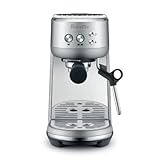
Breville Bambino
Best for: Compact machine anchor
Why it was selected:
Current Breville materials describe the Bambino as a compact machine with a 54 mm portafilter, dual-wall and single-wall baskets, a manual steam wand, and a very fast heat-up system. That makes it a strong machine anchor for a budget-split guide because it is small enough to fit many apartment counters without forcing an all-in-one machine choice.
Good fit if:
- you want a real espresso machine in a small kitchen
- you make espresso and milk drinks
- you can leave room for a separate grinder and scale
- you want a setup that can improve over time
Skip it if:
- buying it would erase the grinder budget
- you need the quietest possible routine
- you want a built-in grinder
- you want automatic milk texturing
Small-space notes:
The machine body is compact, but the routine still needs space around it. You need room for the portafilter handle, the scale, the milk pitcher, and the steam-wand wipe-down.
Tradeoff:
The Bambino is the kind of machine that works well when the rest of the setup is protected. It becomes a bad buy if you pair it with no grinder plan, no scale, and no cleanup budget.
Amazon check:
Check the current Amazon seller, exact Bambino model, included baskets and accessories, dimensions, return policy, price, and availability. Also confirm that you are not accidentally looking at the Bambino Plus or a bundle that changes the value.
Baratza Encore ESP
Best for: First electric grinder anchor
Why it was selected:
Current Baratza materials describe the Encore ESP as an espresso-focused version of the Encore with a grind resolution designed for espresso and an included dosing cup. It is a useful budget anchor because it shows what a beginner electric grinder budget looks like before money gets lost on optional accessories.
Good fit if:
- you want an electric grinder for daily convenience
- you want separate grinder control instead of a built-in machine grinder
- you make espresso often enough that hand grinding sounds annoying
- you want a compact upright grinder for a small counter
Skip it if:
- you need the cheapest possible espresso-capable path
- you need the quietest possible routine
- you mainly use pre-ground coffee
- you want to save money by going manual first
Small-space notes:
The grinder is narrow, but it still needs its own outlet, bean space, and cleanup zone. In a tight kitchen, grinder height under cabinets matters too.
Tradeoff:
This is the convenience spend. The electric grinder makes the routine easier, but it costs more money and adds noise compared with the manual route.
Amazon check:
Check the current Amazon seller, exact ESP model, dimensions, return policy, price, included dosing cup, and availability. Make sure the listing is the ESP version, not the older non-ESP Encore.
KINGrinder K6
Best for: Manual grinder savings route
Why it was selected:
Current KINGrinder materials describe the K6 with external adjustment, 16 microns per click, hand disassembly for cleaning, and a hopper capacity around 25 g to 30 g. That makes it a realistic money-saving route when the beginner budget cannot stretch to both a better machine and an electric grinder.
Good fit if:
- you want to save money without giving up fresh-ground espresso
- you make one drink at a time
- you care about quiet mornings or shared walls
- you would rather spend less on the grinder motor and more on the rest of the setup
Skip it if:
- you hate hand grinding
- you regularly make several milk drinks in a row
- you have grip or wrist concerns
- you want the easiest possible morning routine
Small-space notes:
The K6 is easy to store in a drawer and does not need permanent counter space. That matters when the machine already uses most of the visible coffee area.
Tradeoff:
The K6 saves money and noise, but it turns convenience into effort. It is a smart budget tool only if you are honest about whether you will keep using it.
Amazon check:
Check the current Amazon seller, exact K6 model, capacity, return policy, price, and availability. Read current owner feedback for hand-grinding comfort, because that part does not show up well in a spec sheet.
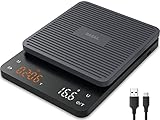
BAGAIL BASICS Coffee Scale with Timer
Best for: First accessory anchor
Why it was selected:
The BAGAIL BASICS scale is here because it solves the most common beginner problem: repeating a drink. Current listing details describe timer functions, 0.1 g-style accuracy, USB-C charging, and a silicone cover. It is more important than a pile of espresso accessories because it tells you what changed.
Good fit if:
- you want one simple tool that improves every shot
- you need dose, yield, and time feedback
- you want a scale that can also handle pour-over or other coffee brewing
- your machine has enough clearance for it
Skip it if:
- your machine needs a much smaller mini scale
- you already own a coffee scale that fits well
- you want a more premium water-resistant espresso-only scale
Small-space notes:
The listing itself warns buyers to measure the machine first if they plan to use it for espresso. That is exactly the apartment problem: a scale that fits a countertop may still not fit the real drip-tray workflow.
Tradeoff:
A scale is not exciting, but it is one of the cheapest ways to stop wasting beans. It deserves budget space before decorative tools do.
Amazon check:
Check the current Amazon seller, exact dimensions, controls, charging cable, return policy, price, and availability. Measure the machine before buying if you want the scale under the cup.
Urnex Liquid Dezcal
Best for: Maintenance reminder
Why it was selected:
Dezcal is included to keep beginners from pretending cleaning is free. Apartment readers often budget for the machine and grinder, then forget that mineral scale, rinse cycles, and storage still exist. This product belongs here only as a reminder to reserve a little setup budget for maintenance when the exact machine manual allows a liquid descaler like this.
Good fit if:
- your machine manual allows a liquid descaler
- you want to keep descaling separate from coffee-oil cleaning
- you want a simple bottle format instead of guessing later
Skip it if:
- your machine manual calls for something else
- you need cleaning tablets rather than descaler
- you are not sure which maintenance task your machine requires
Small-space notes:
Even a small bottle needs a storage plan. Keep cleaning products away from beans, cups, and food items so the routine stays simple and safe.
Tradeoff:
This is not a glamorous purchase, but ignoring it can make a cheap setup feel more frustrating than it should. Maintenance supplies are part of the real budget.
Amazon check:
Check the current Amazon seller, bottle size, return policy, price, and availability. Follow your exact machine manual before using any descaler.
What I Would Do First
If this were my first apartment setup, I would decide the grinder route before I upgraded the machine.
I would use this order:
- Pick a machine size that fits the counter and leaves workflow room.
- Decide whether I want an electric grinder every day or a manual grinder to save money and noise.
- Protect the scale budget.
- Leave a small amount for the cleaning routine.
- Buy optional accessories later, after a month of actual use.
If the total feels too expensive, I would step down the machine tier or choose the manual grinder path before I removed the scale or ignored maintenance.
Three Practical Budget Paths
Path 1: Tight budget, willing to do more manual work
- compact or modest machine
- manual grinder
- scale
- basic cleanup supply
This is usually the smartest route if you want better espresso without paying for electric grinder convenience yet.
Path 2: Balanced beginner setup
- compact machine
- entry electric grinder
- scale
- simple cleaning supply
This is the best fit for most readers who want espresso to feel sustainable, not like a weekend-only project.
Path 3: Higher budget, but still apartment-friendly
- better milk workflow or more comfortable machine
- better or quieter grinder
- scale that truly fits the machine
- maintenance tools that match the manual
This should feel easier, not just more expensive.
Common Mistakes
- spending the whole budget on the espresso machine
- assuming a built-in grinder always solves the grinder problem
- buying optional accessories before owning a scale
- ignoring machine-specific cleaning needs
- forgetting that the grinder needs space too
- buying a grinder that does not match your tolerance for noise or effort
FAQ
Is the grinder really more important than the espresso machine?
For a beginner, the better way to say it is this: the grinder is too important to treat as leftover money. A capable machine still needs repeatable grind size, and most beginners notice inconsistency faster than they notice small machine upgrades.
If my budget is tight, should I buy a cheaper machine or a cheaper grinder?
Usually buy the more modest machine first. A lower machine tier with a workable grinder plan is often a better first setup than a nicer machine with no real grinder path.
Can I skip the scale and add it later?
You can, but it makes learning harder and wastes beans. A scale is one of the simplest beginner tools because it helps you repeat what worked.
When does a manual grinder make sense?
A manual grinder makes sense when you want to save money, reduce noise, and make one or two drinks at a time. It makes less sense if you hate hand effort or make several milk drinks every morning.
Do I need cleaning supplies immediately?
You at least need a cleanup plan immediately. The exact cleaner depends on the machine manual, but beginners should reserve a little money and storage for maintenance from the start.
Disclosure
Apartment Barista uses Amazon affiliate links. As an Amazon Associate, this site earns from qualifying purchases. Prices and availability can change at any time and should be checked on Amazon before buying.