
Quick Verdict
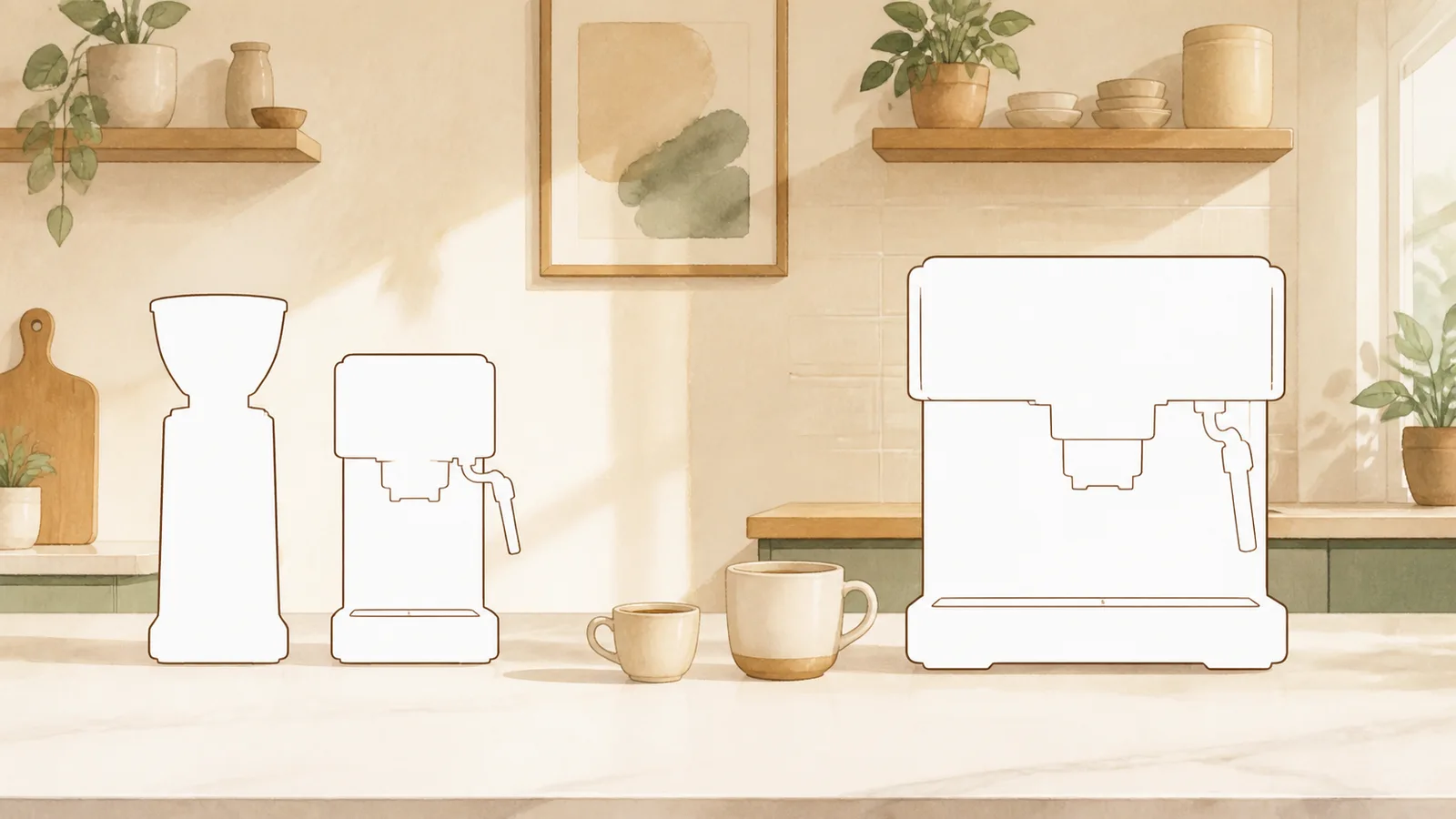
For a couple making one or two drinks at a time, a compact brewer plus a separate espresso-capable grinder can be the easier small-kitchen choice when you can give each piece a stable, dry place to work. A larger all-in-one machine can make sense when you want one fixed station and accept its deeper, wider footprint. This is a space-and-workflow decision, not a promise that either option makes better coffee.
Who This Guide Is For
- Two people sharing a small apartment kitchen and usually making one or two espresso-based drinks in a morning.
- Beginners deciding whether one integrated appliance feels simpler than two smaller pieces.
- Renters who need to preserve food-prep space, outlet access, and a realistic cleanup route.
Skip this guide if you regularly make three or more time-sensitive milk drinks in a row, need an appliance that fits a particular accessibility requirement, or cannot give a separate grinder a stable location. Start with the exact manuals and your own counter measurements instead.
What Usually Goes Wrong
A larger all-in-one machine can look like the tidy answer because the grinder and brewer share one body. But its total working area includes room to fill beans, lock in a portafilter, steam milk, empty the tray, and wipe down. A compact brewer can free visible counter width, yet it does not remove the need for a grinder; moving a grinder to an awkward shelf or a wet sink edge simply moves the problem.
Current beginner discussions still frame this as a real tradeoff: people compare a Bambino plus a separate espresso grinder with a Barista Express, while also weighing budget, learning, and counter space. Breville lists an integrated conical-burr grinder for the Barista Express; that is convenient, but it also means the grinder decision is tied to the brewer.
How to Choose
| Decision factor | Why it matters in a small space | What to verify |
|---|---|---|
| Total work zone | Two appliances may be more flexible, but they still need safe, dry landing space | Measure machine, grinder, portafilter swing, cup area, and wipe-down room |
| Shared routine | One fixed station can reduce handoffs; separate pieces can let you place each tool where it works best | Count normal weekday drinks and who prepares each step |
| Bean switching | An integrated hopper is one workflow; a separate grinder can make a staged setup possible | Confirm the exact grinder workflow and whether you switch coffees |
| Cleaning access | A compact base does not help if the tank, tray, grinder catch cup, or sink route is awkward | Read the exact manuals and check clearances before buying |
Shortlist and Tradeoffs
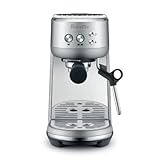
Breville Bambino — compact brewer
What it is: a compact brewer for a couple that already has, or is deliberately budgeting for, a separate espresso-capable grinder. Breville's current Bambino material describes a 54 mm portafilter workflow and a steam wand; it is not a grinder-inclusive purchase.
Best fit: a couple with a modest two-piece work zone, especially if one person wants to improve or replace the grinder later without replacing the brewer.
Tradeoff: the brewer body is compact, but the total setup is not one appliance. Measure both footprints and make sure the grinder is not squeezed beside a sink, stove, or food-prep area. Skip or buy later if there is no stable place for a separate grinder, or if the current Amazon listing, voltage, included parts, dimensions, seller, return terms, price, or availability do not suit you.
Breville Barista Express — larger all-in-one
What it is: a larger single-station machine with an integrated conical-burr grinder. Breville lists the all-in-one machine at 15.9 x 13.1 x 12.4 in; other Breville and Amazon listings put the 15.9 in figure as height, so measure for about 15.9 inches of height under your cabinets. It includes both single- and dual-wall filter baskets.
Best fit: a couple that wants grinder and brewer controls in one permanent location and has measured enough counter depth, top access, and cleanup room.
Tradeoff: one body can simplify placement, but it occupies one larger work area and ties the grinder and brewer together. It is not a universal upgrade and it does not make a cramped counter safer. Skip or buy later if your space only works when the machine is pushed against a wall, if bean changes are frequent, or if the current Amazon listing does not match the space you measured.
Small-Kitchen Workflow
- Tape the full working footprint on the counter, including the grinder, cup area, portafilter handle, and a dry cloth zone.
- Make one drink from start to finish without stacking wet tools near the grinder or power connection.
- Reset the station: dispose of grounds as appropriate for your household, follow the machine manual for rinsing, wipe the counter, and let removable parts dry where the manual permits.
- Repeat for the second drink. If the first person cannot reset before the second needs the counter, the issue is workflow space—not a reason to buy more accessories.
For a related space check, see how much counter space an espresso setup needs, how to fill a machine under cabinets, and whether simultaneous brewing and steaming matters for a couple.
What Not to Buy Yet
Do not add a second grinder, bottomless portafilter, or a large tamping station solely to make the counter look more complete. Add a second grinder only after you have a real shared-bean or speed problem and a measured place for it. Add accessories when they solve a repeatable problem, not before you can keep the basic brewer-and-grinder workflow clear and dry.
Before You Buy
- Confirm the exact model, seller, price, availability, return terms, voltage, and included accessories.
- Measure width, depth, height, tank or hopper access, portafilter movement, cup space, outlet reach, and a clear sink route.
- Read the current manufacturer manuals for both machine and grinder.
- Choose the compact setup only if the separate grinder has a stable, dry home; choose the all-in-one only if its complete work zone fits without blocking normal kitchen use.
Final Recommendation
For most couples with a tight but workable two-piece station, choose the compact brewer setup when flexibility and a smaller brewer footprint matter more than having one appliance. Choose the larger all-in-one only when you have measured a dedicated station and prefer a fixed integrated workflow. Either way, confirm the exact current listing and let counter access—not a product photo—make the final call.