

Quick Verdict
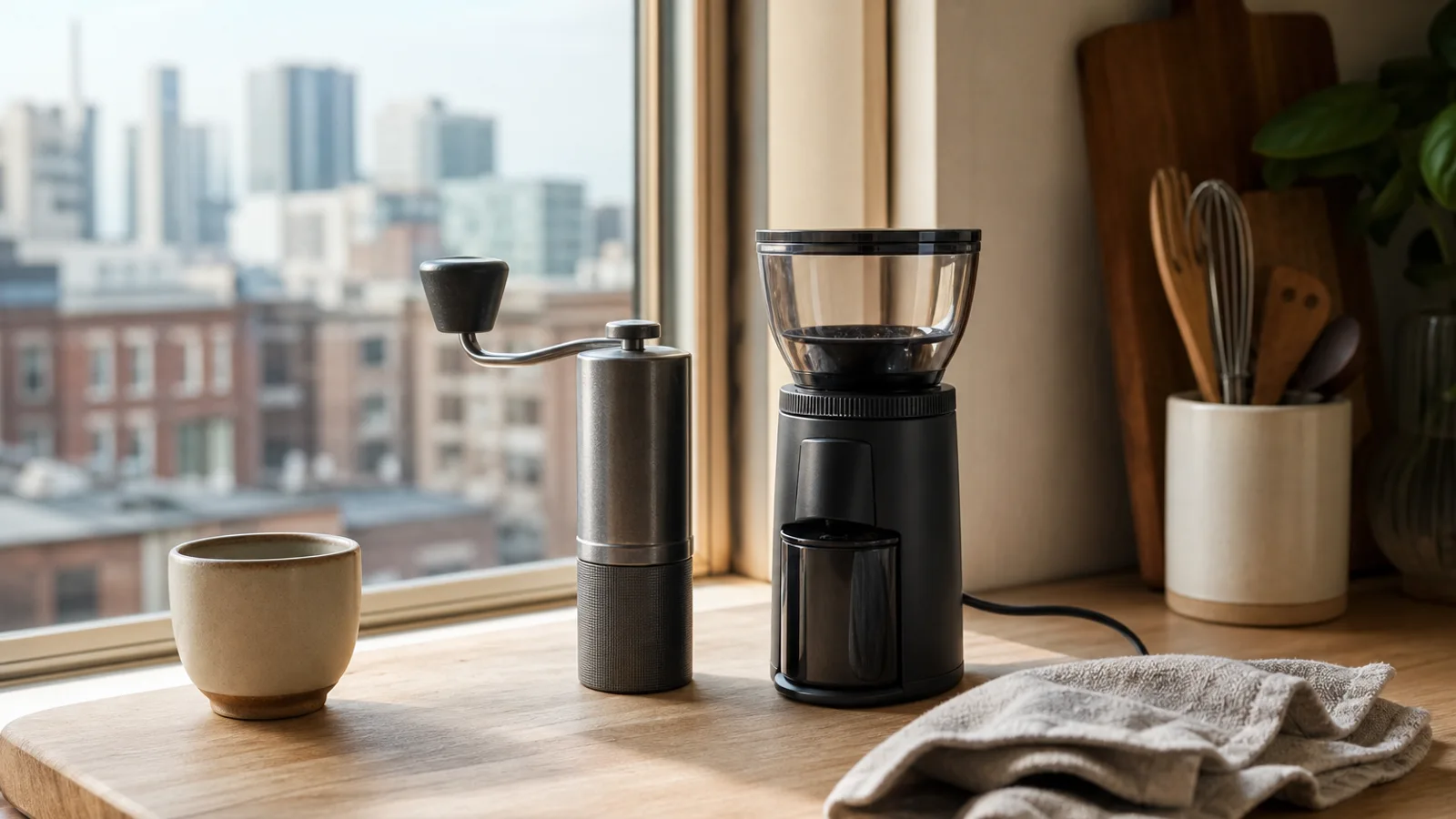
If you grind before someone wakes up, or you need the counter back, buy the TIMEMORE Chestnut C3 ESP. It is the cheaper brand-sold manual, and it is actually quiet because it has no motor. KINGrinder K6 is still a live listing (ASIN B0CY1XFXB8) if you specifically want that model; it is not the default here. C3 ESP stays the cheaper brand-sold default, not an out-of-stock swap.
If you grind during the day, you will use it most mornings, and you can live with a motor that is not quiet, buy the Baratza Encore ESP. Confirm a New offer from Amazon.com, not used resale. It is not a 6 a.m. pick.
Do not spend electric-grinder money on a premium manual and call it a budget quiet pick.
If you already know you will not hand grind, read Best First Espresso Setup If You Cannot Hand Grind and skip the C3 ESP path.
For the machine that sits next to these grinders, start with a compact Breville Bambino, not a larger Barista Express. Dedica, CASABREWS, and Bambino Plus live in Best Compact Espresso Machines for Small Kitchens. Pair the quiet path with Beginner Espresso Setup Under $500.
Who This Guide Is For
This guide is for:
- apartment renters with thin walls, roommates, or sleeping family nearby
- small-kitchen beginners choosing a first espresso grinder
- buyers who make one or two drinks and need a realistic weekday routine
- shoppers splitting a budget between machine, grinder, and a scale
This guide is not for:
- commercial cafe use
- high-end flat-burr comparisons
- anyone expecting an electric grinder to be silent
- plumbed-in or built-in espresso stations
What Usually Goes Wrong
The shopping question is not which burr is more even. It is: you rent, you cannot plumb a machine, you have a drawer or a sliver of counter, someone may be asleep, and you still need to grind tomorrow.
Two common mistakes:
- treating a Creators "currently unavailable" flag as retail out-of-stock, then swapping in the wrong grinder
- buying the Encore ESP because it is the familiar electric default, then grinding at 6 a.m. through a thin wall
How to Choose
| Decision factor | Why it matters in a small space | What to verify |
|---|---|---|
| Hour you grind | A motor is a different product at 6 a.m. than at 9 a.m. | Household sleep and shared walls |
| Drawer vs counter | Manual can disappear; electric usually stays out | Cabinet height and a landing spot |
| One drink vs several | Hand grinding espresso-fine is work | How many milk drinks before work |
| Espresso-capable grind | A drip preset is the wrong tool | Current model, not a lookalike listing |
| Seller and condition | New vs used changes the actual buy | Current Amazon offer, returns |
Shortlist and Tradeoffs
Product cards below use live Amazon data. Recheck seller, exact model, dimensions, return terms, price, and availability before buying.
TIMEMORE Chestnut C3 ESP (black, not Pro)
Best for quiet mornings, drawer storage, and an under-$500 setup.
Locked ASIN B0CC528S8D. Do not use C3 ESP Pro listings (B0C2CQBM3H or B0CC4ZB7XR).
Amazon lists this at 700 g. Brand spec is about 14.7 cm tall by 5.2 cm diameter; the Amazon dimensions row is often blank. Do not use 430–530 g figures from other sites.
Verified owners describe real hand effort at espresso-fine settings, but also a grind that is fine enough for espresso and a sturdy metal build.
Skip it if you already refused hand grinding, or you make a round of lattes before work.
Baratza Encore ESP
Best for a first daily electric espresso grinder, not for a quiet apartment.
Locked ASIN B0BW272XCV. Confirm the ESP model, not the older Encore. Confirm New from Amazon.com; used resale is a different product.
Baratza materials describe dual-range adjustment (espresso micro-steps, then brew steps) and an included dosing cup. Measure about 33.5 cm of height under cabinets. A verified owner comment on the current listing: it is definitely not a quiet machine.
Skip it if quiet is the actual constraint, or buying it would erase the scale and cleaning budget.
Not a pick: 1Zpresso J-Ultra sits at Encore money. Do not add Fellow Opus here.
KINGrinder K6 remains a real retail listing. This guide still locks C3 ESP because it is cheaper and brand-sold, not because K6 disappeared.
When Manual Wins
Choose the C3 ESP when you grind at 6 a.m. against a thin wall, you want the appliance off the counter, the total setup must stay under $500 with a scale, and you make one or two drinks.
When Electric Wins
Choose the Encore ESP when you will grind most days, daytime noise is acceptable, you want to press a button instead of being the motor, and you have measured cabinet height.
Small-Kitchen Workflow
6 a.m., thin walls: C3 ESP in a drawer, compact machine near the sink, scale stored flat. Grind one dose. Do not plan three lattes.
Daytime, daily espresso: Encore ESP on the counter beside a Bambino, dosing cup and cloth in the same zone. Grind after people are up.
What Not to Buy Yet
- C3 ESP Pro
- A premium manual at electric-grinder money
- Bambino plus Encore as an under-$500 kit. That pairing fills the budget before beans, a pitcher, or cleaner. See espresso machine vs grinder: how to split a beginner budget.
Before You Buy
- Confirm the exact ASIN and color. C3 ESP black is B0CC528S8D.
- Confirm New vs used, seller, returns, dimensions, included parts, price, and availability on Amazon.
- Measure the drawer or cabinet before the box arrives.
- Decide whether you will actually hand grind tomorrow.
Final Recommendation
Apartment grinder choice is noise, a drawer, and no plumbing. Quiet path: C3 ESP. Daily convenience path: Encore ESP, used after people are awake.