Quick Verdict
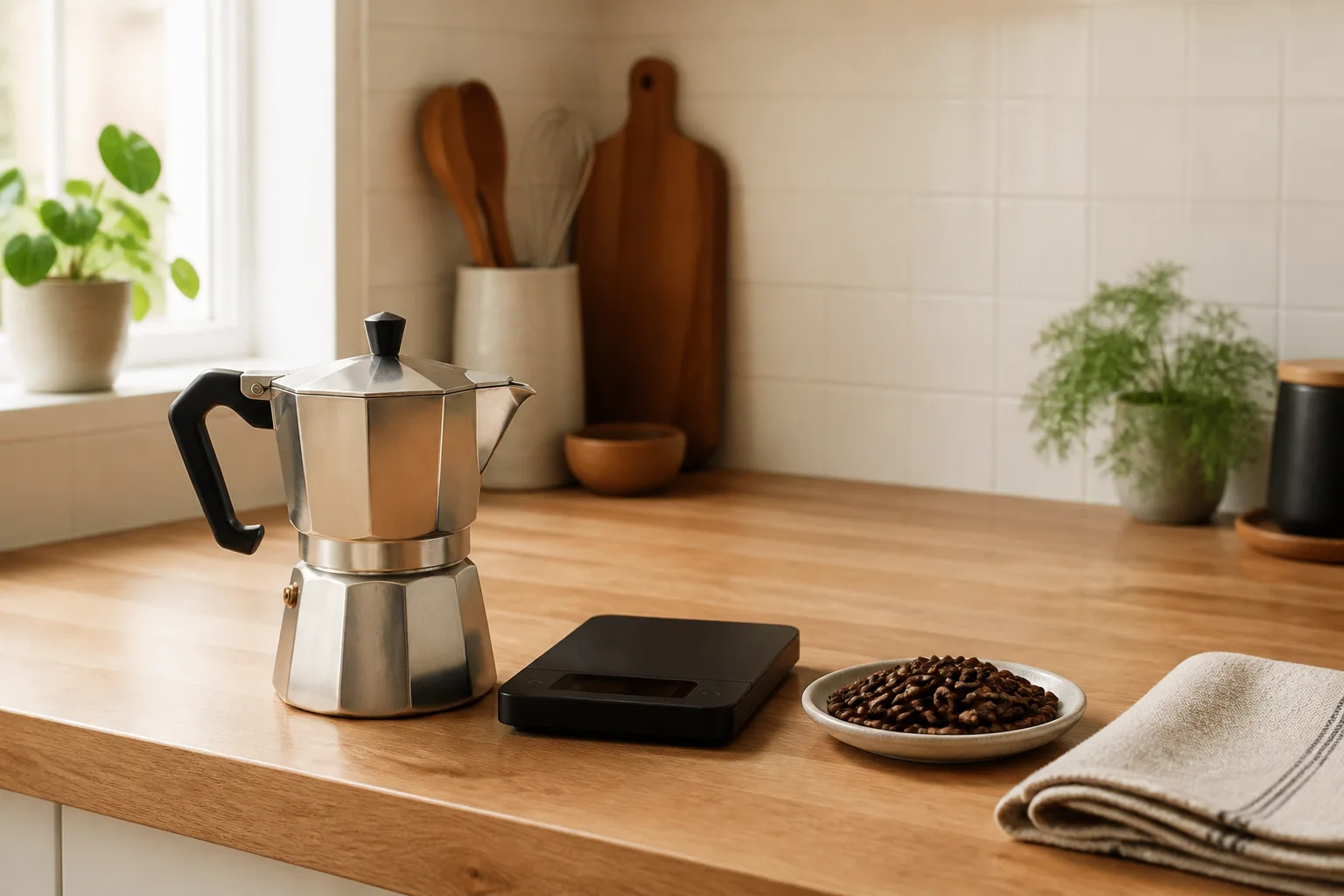
You do not need a coffee scale to start using a Moka pot. A simple pot-sized routine with Moka-ground coffee can be a sensible, low-clutter starting point. A scale becomes useful when your results vary and you want to repeat a dose that fits your basket without pressing grounds down or turning every morning into an experiment.
For a small apartment, the best reason to add one is repeatability, not perfection. It can live in a drawer, come out for beans or a filled basket, then go away before the stove and sink area get crowded.
Who This Guide Is For
- A Moka pot beginner who uses a compact kitchen or shared counter.
- Someone deciding whether a scale is a useful first accessory or another gadget to postpone.
- A coffee drinker who sometimes gets a weak, harsh, or inconsistent cup and wants one controlled variable.
Skip the scale for now if you enjoy your current pre-ground routine, have no wish to change beans or grind, and would rather keep the process simple. A scale cannot correct the wrong pot size, a damaged gasket, an overfilled water chamber, or an unsafe stove setup.
What Usually Goes Wrong
The word “cup” on a Moka pot is not a standard drinking-cup measurement, and the basket is filled by volume rather than by a universal gram recipe. Bean density, roast, and grind can change the weight that loosely fills the same basket. That is why copying another person's number can be less useful than recording the amount that worked in your own pot.
Bialetti's Moka Express guidance says to fill the funnel loosely with Moka-ground coffee and not press it down. Treat that instruction as the boundary: a scale is a way to observe and repeat a loose fill, not a reason to tamp, pack extra coffee in, or force a generic dose into the basket.
How to Decide
| Decision factor | Why it matters in a small space | What to verify |
|---|---|---|
| Your current routine | Pre-ground coffee can be a low-friction start | Are you actually unhappy with the repeatability? |
| Basket fit | A Moka basket is pot-specific | Does your normal loose fill sit below the rim without pressing? |
| Storage | The scale should not become permanent counter clutter | Can it fit in a dry drawer away from the sink? |
| Workflow | Weighing beans can be cleaner than correcting an overfilled basket | Can you weigh before the pot is on the stove? |
| Cleanup | Water and grounds build up around one small sink | Is there a dry landing spot before storing the scale? |
The One Product That Fits This Decision
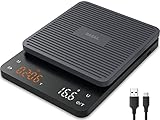
BAGAIL BASICS Coffee Scale with Timer
This is an optional repeatability tool, not a Moka pot requirement. It fits the article because a compact scale can help you record the amount of whole beans you grind, or the loose grounds that consistently fit a particular basket. The timer is not essential for Moka brewing, so do not buy it just to add another number to follow.
Good fit for: a beginner who changes beans, uses a grinder, or wants to write down one successful loose-fill amount for a specific Moka pot.
Skip or buy later if: you are content with a familiar pre-ground coffee and do not need more consistency, or you do not have a dry storage spot for a small electronic scale.
Tradeoff: a scale adds a small preparation step and needs protection from heat and splash. Before buying, confirm the current Amazon listing, seller, return terms, dimensions, charging details, price, and availability.
A Small-Kitchen Scale Workflow
- Keep the scale in a dry drawer or cabinet, not beside the sink.
- Put an empty dosing dish or the grinder catch cup on the scale before starting the stove.
- Weigh beans only if you want a repeatable starting point; otherwise, use your familiar Moka-ground coffee.
- Grind or transfer the coffee, then loosely fill the correct basket. Do not press the grounds down.
- Wipe loose grounds from the rim before assembly, following the pot maker's instructions.
- Move the scale away from the heat and water zone before brewing.
- If the cup works well, record the bean, pot size, and loose-fill weight. Change only one thing on the next brew.
This keeps the scale as a quiet note-taking tool rather than turning the counter into a laboratory. For more small-space decisions, see Moka Pot vs Espresso Machine for Small-Apartment Lattes and How to Choose Your First Espresso Beans for a Small Apartment.
What Not to Buy Yet
Do not add a precision scale, an expensive grinder, filters, funnels, and several storage containers all at once because one cup was disappointing. First confirm the pot's size, use the maker's water-fill and loose-coffee instructions, and repeat one calm routine.
A grinder can be a later upgrade if you want to explore whole beans and adjust grind size. It is not a requirement for making a safe, straightforward Moka pot coffee with a suitable pre-ground coffee.
Before You Buy
- Confirm that the scale fits in a dry storage spot and is not needed beside the hot pot.
- Confirm the exact Amazon model, seller, dimensions, charging method, return terms, price, and availability.
- Read the instructions for your exact Moka pot, especially water level, basket filling, heat source, and cleaning.
- Do not use a scale to override a pot's basket capacity or press coffee into the funnel.
Final Recommendation
Start without a scale if your Moka pot routine is simple and enjoyable. Add a compact scale when you want to repeat a loose-fill dose, compare beans more calmly, or reduce guesswork in a small kitchen. It is a modest workflow aid—not a prerequisite for good coffee and not a substitute for the instructions for your specific pot.