
Quick Verdict
If you finish one open bag of whole beans in a normal, short home routine, you may not need a special canister at all. Keep the bag closed, dry, shaded, and away from steam, then spend on storage only when the bag is awkward to close, the beans sit near a wet work zone, or you repeatedly lose track of what is open.
A coffee canister is a workflow tool, not a requirement for making good espresso. For a small apartment, the better purchase is the one that reduces a real storage problem without taking away working counter space.
Who This Guide Is For
- Apartment renters with one compact espresso setup and one open bag of whole beans.
- Beginners deciding between the original bag, a drawer, a countertop canister, or a freezer portioning routine.
- Readers who want fewer coffee items on the counter, not a more complicated storage ritual.
Skip this guide if you buy coffee pre-ground, have a roaster-specific storage instruction to follow, or need a food-storage decision beyond ordinary dry coffee beans.
What Usually Goes Wrong
The common mistake is buying a large storage system before checking the real problem. A canister cannot fix a bag that is being kept beside steam, a cluttered wet sink zone, or a routine that opens several coffees at once. It can also be an expensive use of precious counter space if the original bag already closes and fits a dry drawer.
Recent espresso discussions show that people use several workable routines: keeping a short-term bag in its original packaging, moving one active portion into a container, or freezing smaller sealed portions. Those are user experiences, not proof that one method suits every coffee or kitchen. The useful decision is how often you open the beans, where they sit, and whether the container makes your ordinary morning simpler.
How to Choose
| Decision factor | Why it matters in a small space | What to verify |
|---|---|---|
| Your open-bag rhythm | A container is less useful when one bag is finished before storage becomes annoying | How many drinks you make and how long one bag normally stays open |
| Dry location | Steam, splashes, and direct sun create a worse problem than the lack of a premium lid | Drawer, cabinet, or counter distance from the machine and sink |
| Counter footprint | A large canister can crowd the dosing and portafilter area | Actual diameter, height, cabinet clearance, and a clear working zone |
| Whole-bean compatibility | Some vacuum systems have their own instructions about contents and care | The manufacturer's current use and cleaning guidance |
| Freezer plan | Repeatedly opening a cold bulk container can complicate the routine | Whether you can portion coffee before freezing and use one active portion at a time |
Fellow's current Atmos guidance says its canister is intended for whole-bean coffee and advises re-twisting the manual lid every few days to maintain the vacuum. That is a product-specific care instruction, not a claim that every reader needs a vacuum canister.
One Storage Option and Its Tradeoffs
Fellow Atmos Electric Vacuum Coffee Canister 1.2L — ASIN B0D78MLCNX
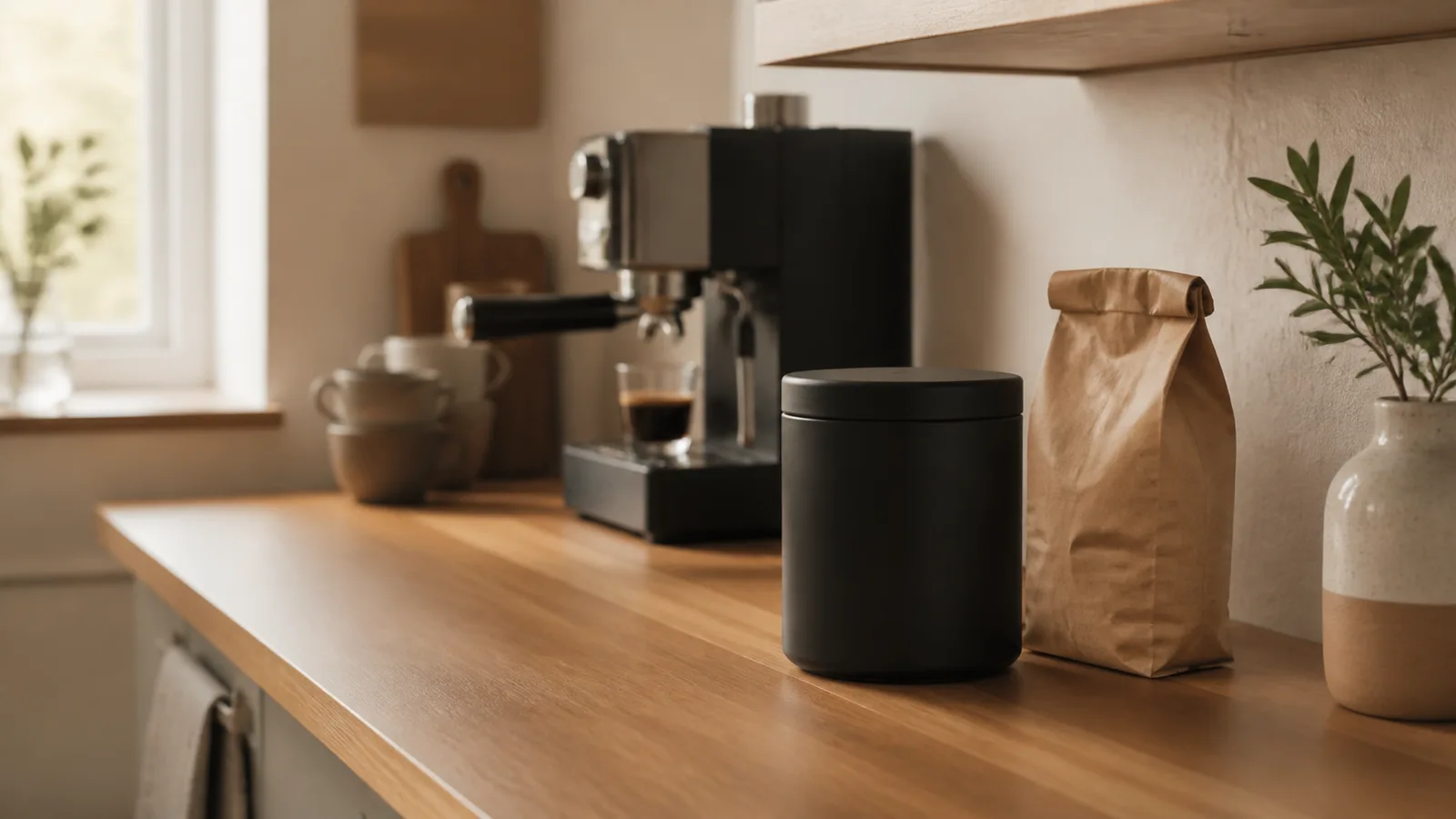
This is a research slot for a reader whose active whole-bean bag does not fit a dry drawer or close neatly and who wants a dedicated countertop or cabinet container. Fellow describes the 1.2-liter Atmos as holding whole beans and using an auto-maintained vacuum seal. That can be useful when a one-bag routine is otherwise messy.
The tradeoff is size, cost, and another item to clean and store. A 1.2-liter canister may be unnecessary for a small bag or a reader who already has a workable original-bag routine. Check the exact current Amazon variant, dimensions, seller, price, return terms, care instructions, and availability before buying. Skip it or buy later if the bag closes securely and your dry storage route already works.
A Small-Kitchen Storage Routine
- Open only one main espresso bag at a time while you are learning a grinder setting.
- Put that active bag or container in a cool, dry, shaded spot away from the steam wand, kettle, sink splashes, and direct sun.
- Keep the bean container out of the wet cleanup zone; reserve the counter near the machine for dosing and the portafilter.
- If you use a canister, follow its current manufacturer care instructions and do not put ground coffee into a system that says it is for whole beans only.
- If you buy more coffee than you will use soon, consider sealed smaller portions for freezer storage and move one portion into the active routine only when needed. Avoid turning repeated thawing and reopening of a bulk cold container into a daily chore.
For the broader drawer-versus-counter choice, see how to store coffee beans in a small kitchen. If you are still choosing your first bag, start with how to choose your first espresso beans for a small apartment.
What Not to Buy Yet
Do not buy several canisters, single-dose tubes, labels, or a decorative coffee station before you can describe the actual issue. Start with the original bag if it closes and has a dry home. Add one container only when it solves a repeatable problem such as a damaged closure, an awkward bag shape, or no tidy place for one active portion.
A canister also does not replace a scale, a grinder plan, or a safe dry-and-wet counter layout. Buy those tools only when they address the part of the espresso workflow that is genuinely getting in the way.
Before You Buy
- Measure the counter, drawer, or cabinet location, including height clearance for opening the lid.
- Confirm whether the original bag already closes and stays away from heat, light, steam, and splashes.
- Check the exact current Amazon model, seller, dimensions, care instructions, price, return terms, and availability.
- Read the manufacturer's current instructions for the specific canister; do not assume one lid works the same as another.
- Decide whether a short-term active bag plus a separate freezer portion is simpler than keeping a large bulk container on the counter.
Final Recommendation
For one open bag of espresso beans, begin with the simplest dry storage route that keeps the bag tidy and out of the wet work zone. Add one dedicated whole-bean canister only if it makes the bag easier to close, locate, and use in your actual apartment kitchen. If it does not solve a repeated problem, keep the counter clear and buy later.