
Quick Answer
Yes, you can start espresso with pre-ground coffee if you do it on purpose and keep your expectations realistic.
The easiest version of that path looks like this:
- a beginner machine with a pressurized or dual-wall basket
- small bags of coffee that were ground for espresso recently
- milk drinks or casual espresso, not perfection-chasing straight shots
- a plan to add a grinder later if you stick with the hobby
The harder version looks like this:
- supermarket pre-ground that has been sitting for a while
- a non-pressurized basket
- a beginner expecting cafe-style shot control immediately
That is why the real answer is not just "yes" or "no." It is "yes, but only with the right setup and the right expectations."
If you are still deciding on the full setup, read this with pressurized vs non-pressurized baskets for beginners, is a burr grinder necessary for espresso, and best beginner espresso setup under $500.
Apartment Barista uses Amazon affiliate links. As an Amazon Associate, this site earns from qualifying purchases. Prices, sellers, return terms, and availability can change at any time, so check Amazon before buying.
Who This Guide Is For
This guide is for:
- a beginner who wants espresso now but cannot buy a grinder yet
- a renter or small-kitchen user trying to keep the first setup simple
- a milk-drink buyer who wants a lower-pressure learning phase
- a budget-conscious shopper deciding whether to delay the grinder purchase
This guide is not for:
- someone chasing the best possible straight espresso from day one
- an advanced hobbyist already dialing in fresh beans daily
- a buyer who already knows they want a non-pressurized basket workflow
- anyone expecting pre-ground coffee to behave like a fresh-bean grinder setup forever
The Real Beginner Problem
Most beginners are not asking a coffee-forum question first.
They are asking a kitchen question:
"Can I get started without turning this into a bigger, noisier, more expensive setup immediately?"
That is a reasonable question. In a small apartment, a grinder is not just another coffee tool. It is another appliance, another cleanup source, another thing to fit under cabinets, and sometimes another source of morning noise.
Current public beginner discussions still show the same pattern:
- some people say pre-ground is fine if you use a pressurized basket
- some people say espresso without a grinder becomes frustrating fast
- both sides are often talking about different goals
If you mainly want to learn drink prep, milk steaming, and your morning routine, pre-ground can be a sensible bridge.
If your goal is to control shot flavor closely, a grinder becomes important much sooner.
Not All Pre-Ground Coffee Is The Same
One reason this topic gets confusing is that "pre-ground coffee" can mean very different things.
| Type | Can it work for beginner espresso? | Realistic expectation |
|---|---|---|
| Generic supermarket pre-ground | Sometimes, with a pressurized basket | Low-commitment starting path, not great control |
| Freshly ground coffee from a local roaster | Often better as a short-term bridge | More satisfying for the first days if the grind is close |
| Pre-ground coffee in a non-pressurized basket | Usually frustrating | Inconsistent flow and limited shot control |
The useful beginner question is not:
"Is pre-ground coffee allowed?"
It is:
"What kind of pre-ground coffee, in what basket, for what kind of drink, for how long?"
When Pre-Ground Usually Works Best
Pre-ground is most realistic when all of these are true:
- your machine has a pressurized or dual-wall basket
- you want to start simple and learn the routine first
- you mostly make milk drinks, not espresso-only tasting sessions
- you buy smaller amounts instead of expecting one bag to stay ideal forever
- you accept that this is a starter path, not the final form of the setup
This is why current Breville Bambino manuals still matter for beginners. Breville continues to describe dual-wall baskets as the right path for pre-ground coffee and older beans, which matches the way many first-time home users actually start.
That kind of guidance does not mean pre-ground is equal to fresh grinding. It means a forgiving basket can make the first setup more usable.
When Pre-Ground Usually Stops Working
Pre-ground becomes much more frustrating when:
- you switch to a non-pressurized basket
- you want sweeter, more repeatable straight shots
- the coffee has been sitting long enough that extraction gets inconsistent
- you keep changing beans but have no way to adjust the grind
- you start blaming the machine for problems that are really coffee-related
This is the turning point where many beginners feel confused. The machine may still heat up, pump, and steam correctly, but the shot quality stops improving because the coffee is no longer matched to the basket and machine.
That is why a lot of beginners think:
- the machine is bad
- espresso is too hard
- they personally are doing something wrong
Sometimes the real issue is simpler: the setup outgrew the pre-ground phase.
The Best Beginner Rule
If you want the plain-English version, use this rule:
Start With Pre-Ground If...
- you are using a pressurized basket on purpose
- you want to keep the first setup cheaper and simpler
- you mainly drink lattes, cappuccinos, or oat milk drinks
- you are still deciding whether espresso will become a real hobby
Skip The Pre-Ground Path If...
- you already know you care about shot flavor and control
- you are buying fresh beans regularly and want to dial them in
- you want a non-pressurized basket workflow immediately
- you will get frustrated by inconsistency more than you are helped by simplicity
Upgrade To A Grinder When...
- your drinks start tasting flat no matter what you try
- you want to move beyond the pressurized basket
- you want better straight shots, not just acceptable milk drinks
- you are ready to make room in the kitchen for another tool
Product Examples
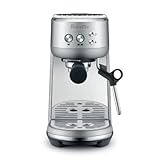
Breville Bambino
Best for: Compact machine with a forgiving basket path
Why it fits:
The Bambino is one of the clearest examples of a machine that gives beginners a real bridge. Current Breville materials still separate single-wall and dual-wall baskets, which makes the machine useful for both the "start simple" phase and the "upgrade later" phase.
Good fit if:
- you want to begin with dual-wall baskets and add a grinder later
- you want a compact machine that can stay on the counter
- you make milk drinks and want a realistic first espresso workflow
- you want one machine that does not force the grinder purchase on day one
Skip it if:
- you want the slimmest possible machine body
- you want automatic milk help instead of manual steaming
- you do not want a separate grinder in the future
Small-space notes:
The Bambino makes sense when you want to grow into better espresso without replacing the machine right away. Still check machine width, depth, water-tank access, and where a future grinder would go.
Tradeoff:
Its strength is flexibility, not a permanent shortcut. It gives you a gentler start, but eventually it will show you why fresh grinding matters.
Amazon check:
Check the current Amazon seller, exact model, included baskets, return policy, dimensions, price, and availability before buying.
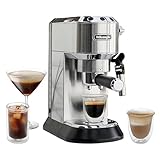
De'Longhi Dedica Deluxe
Best for: Slim starter machine path
Why it fits:
The Dedica is a strong example for readers who care even more about width than upgrade flexibility. Current De'Longhi support materials still show ground-coffee and E.S.E.-pod workflows directly in the Dedica setup path, which is exactly why it keeps appearing in beginner conversations.
Good fit if:
- your counter is very narrow
- you want a simpler no-grinder starting point
- you want a compact machine that can work with ground coffee while you learn
- you care more about getting started than building a long upgrade path immediately
Skip it if:
- you already want a more grinder-forward espresso path
- you want the easiest long-term accessory ecosystem
- you are only choosing by width and not thinking about the full workflow
Small-space notes:
The Dedica helps when width is the hardest limit, but a slim machine still needs room for the portafilter handle, water refill access, cups, and cleanup.
Tradeoff:
You gain counter-width savings, but you should be more careful about long-term workflow expectations, accessory compatibility, and seller quality on Amazon.
Amazon check:
Check the current Amazon seller, exact model, return policy, dimensions, included accessories, price, and availability before buying.
Baratza Encore ESP
Best for: First grinder when the pre-ground phase ends
Why it fits:
The Encore ESP belongs in this guide because the whole point is not to shame beginners for starting with pre-ground coffee. It is to show what the next step looks like when the bridge stops being enough. Current Baratza materials still position the Encore ESP as an espresso-focused grinder with simple hopper adjustment and an included dosing cup.
Good fit if:
- you are ready to leave the pre-ground phase
- you want a beginner-friendly electric grinder rather than a deep hobby purchase
- you want a stronger shot-control upgrade without changing machines first
- you have room for a compact upright grinder
Skip it if:
- you are still happy with casual pressurized-basket milk drinks
- you do not have space for another appliance yet
- you want the quietest possible morning routine
Small-space notes:
Even a compact grinder changes the setup. Measure cabinet clearance, bean-loading space, cleanup room, and where the grinder will live between drinks.
Tradeoff:
A grinder usually improves espresso more than another accessory, but it adds space, noise, and one more daily step. That tradeoff is worth it only when you are ready to use it.
Amazon check:
Check the current Amazon seller, exact ESP model, return policy, dimensions, dosing cup, price, and availability before buying.
Apartment Fit Checks Before You Buy Anything
If your kitchen is small, use this checklist before choosing the starter path:
- confirm whether the machine includes or supports a pressurized basket
- measure the counter width and the working space in front of the machine
- check whether the water tank can be removed without dragging the machine every time
- decide where coffee bags, cups, and cleaning cloths will live
- think about whether you will add a grinder later and where it would go
- confirm the current Amazon or brand page for seller, return terms, exact model, dimensions, included accessories, and availability
Pre-ground coffee can reduce complexity at the start, but it does not remove the need for a realistic counter plan.
What I Would Do First
If this were my beginner decision tree for a small apartment, I would keep it simple:
- pick a machine that gives you a forgiving basket path
- start with small amounts of pre-ground coffee instead of treating a big bag as a long-term solution
- use the setup for a few weeks and decide whether you actually enjoy making espresso at home
- buy a grinder only after you know you want better shot control, not because the internet made it sound mandatory on day one
That path is especially reasonable if you drink lattes, care about space, and do not want the first setup to become an expensive experiment.
Common Mistakes
Treating All Pre-Ground Coffee As Equal
Freshly ground coffee from a local roaster and a random bag that has been sitting for a while do not behave the same way. If you start with pre-ground, smaller and fresher is usually the safer bet.
Using Pre-Ground In A Non-Pressurized Basket And Judging The Machine
This is one of the fastest ways to create frustration. If the basket expects more precise grind control, the machine may seem worse than it really is.
Buying A Machine Without Thinking About The Next Step
If the machine is already tight under cabinets or squeezed into a narrow corner, a future grinder upgrade may be more annoying than expected.
Expecting Milk Drinks And Straight Espresso To Judge The Setup The Same Way
For many beginners, a pressurized-basket pre-ground setup can be perfectly acceptable for milk drinks while still feeling limited for straight shots.
FAQ
Can I make decent espresso with pre-ground coffee?
Yes, especially if you use a pressurized basket and keep expectations realistic. It is usually more convincing for milk drinks than for straight espresso.
Is pre-ground coffee okay for the Breville Bambino?
Yes, the Bambino is one of the clearer beginner examples because Breville still documents dual-wall baskets for pre-ground coffee and older beans. The better fresh-bean path still needs a grinder later.
Is the De'Longhi Dedica a good machine if I do not want a grinder yet?
It can be, especially if width is tight and you want a simpler start. Just remember that a slim machine still needs room to use comfortably, and current marketplace conditions can vary by seller.
When should I stop using pre-ground coffee for espresso?
Stop treating it as the main plan when you want better consistency, want to move past the pressurized basket, or feel like every shot has stopped improving. That is usually the moment a grinder becomes the better upgrade than another accessory.
Do I need to buy a grinder immediately?
Not always. If your goal is to start simply, learn milk drinks, and see whether home espresso fits your life, delaying the grinder can be a sensible choice. It becomes less sensible once you want more shot control.