
Quick Verdict
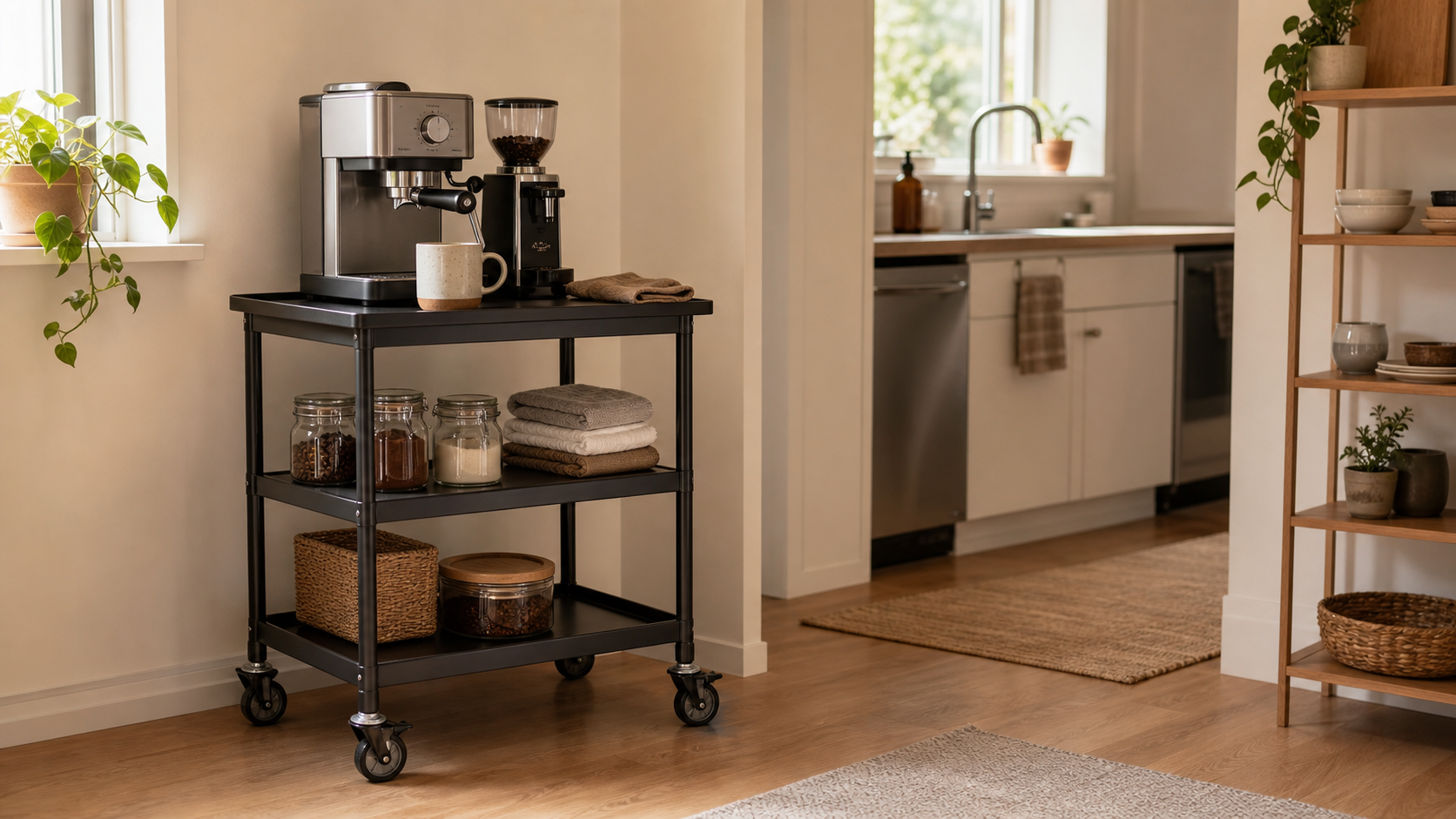
Yes, an espresso machine can live on a rolling cart in an apartment, but only when the cart is a stable parked workstation—not a piece of furniture you roll while brewing. The top must be deep and strong enough for the actual machine footprint, the wheels must lock, and the cart must sit level without rocking when you tamp or run the grinder.
For most beginners, a cart is safer as coffee overflow storage first: beans, cups, towels, scale, cleaning supplies, and backup tools on the lower shelves. Put the machine on it only after you have checked the cart maker's current load guidance, measured the entire setup, and tested a stable parking spot. Skip the cart-machine idea for a heavy machine, a lever machine, an uneven floor, or any setup that needs an extension lead or a long walk to rinse milk tools.
Apartment Barista uses Amazon affiliate links. As an Amazon Associate, this site earns from qualifying purchases. Prices, sellers, return terms, product details, and availability can change, so check the current Amazon page before buying.
For the wider layout decision, read coffee station outside the kitchen, renter-friendly espresso setups without plumbing or drilling, and best coffee station layouts for small apartments.
Who This Checklist Is For
This guide is for:
- renters whose kitchen counter is too narrow or too close to the stove
- beginners with a compact reservoir machine and a small grinder
- apartment users who need a station they can move for cleaning or guests
- coffee drinkers who want storage beneath the brewing surface
- people willing to measure, lock the wheels, and keep the cart parked while making drinks
This guide is not for:
- commercial coffee carts or serving events
- heavy, large, or lever-operated espresso machines unless the cart manufacturer expressly supports that load and use
- a cart that rocks, flexes, has damaged wheels, or sits on a sloped floor
- a setup that requires a loose extension cord, blocks a walkway, or puts water near electrical connections
- treating a cart as a substitute for following the machine manual's placement, ventilation, power, and water instructions
What Real Apartment Users Are Trying to Solve
Public coffee discussions show a real small-space pattern: people run out of counter space, see a compact cart, and imagine getting the machine, grinder, cups, and beans out of the cooking zone. That can be useful. The catch is that espresso is not a dry, decorative setup. It adds machine weight, tamping force, vibration, hot water, drip-tray liquid, loose grounds, and a cleanup trip to the sink.
The decision is therefore not "does a coffee cart look nice?" It is "can this specific cart stay level and boring during the whole routine?" A cart that feels fine holding mugs can feel very different when you lock in a portafilter, tamp coffee, pull a water tank forward, or put a scale beneath a cup.
The Five-Point Cart Test
Use this test before moving a machine.
| Check | A workable answer | Stop and rethink if |
|---|---|---|
| Load | The cart maker's current guidance covers the machine, grinder, water, and daily items with sensible margin | You only know it "looks sturdy," or the load guidance is missing |
| Top size | The machine sits fully on a flat top with room for its cord, water tank, drip tray, and ventilation | Feet hang over an edge, the tank cannot be removed, or the grinder crowds the machine |
| Stability | All wheels lock, the floor is level, and the cart does not rock when you press on each corner | It shifts, twists, rolls, or changes position while tamping |
| Workflow | You can refill water, empty the tray, dispose of pucks, and rinse milk tools without a long awkward walk | The cart becomes a wet mess far from the sink |
| Power | The appliance manual supports the outlet arrangement and the cord reaches without strain | You need an extension lead, a crowded power strip, or a cord across a walkway |
If one answer is no, use the cart for storage and keep the machine on a stable counter or cabinet instead.
Apartment Fit Checks Before Buying a Cart
- Measure the machine's width and depth, then add the space needed to remove its water tank and drip tray. Do not measure only the visible body.
- Measure the grinder, scale, tamper, cup, and the small clear zone where you will actually work. A cart needs prep space, not just a parking space for appliances.
- Read the cart maker's current assembly and load guidance. A total load number is not permission to put the heaviest item on any shelf or roll it over thresholds.
- Test every wheel lock on the floor where the cart will live. Locking wheels reduce rolling; they do not turn a flexing cart into a fixed counter.
- Press gently on all four top corners before placing appliances. Any rocking is a no-go until the floor and cart are made stable.
- Keep the machine far enough from the edge that the cord, portafilter handle, cup, and water tank are not constantly catching a wall or walkway.
- Plan the wet route: water refill, pitcher rinse, drip-tray emptying, and used-cloth drying should be simple enough to do after a weekday drink.
- Confirm current seller, exact dimensions, wheel style, return terms, load guidance, assembly instructions, price, and availability before buying any cart or organizer.
Useful Product Roles, Not a Fixed Cart Build
| Pick | Best for | Why it belongs in this guide |
|---|---|---|
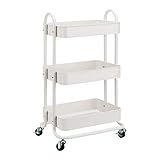
| Amazon Basics 3-Tier Rolling Utility Cart | Light coffee overflow storage | A movable vertical zone for beans, mugs, towels, filters, and backup supplies when you confirm its current dimensions and load guidance |
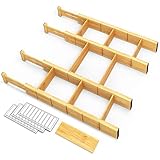
| SpaceAid Bamboo Drawer Dividers | Keeping small tools controlled | A nearby drawer can prevent a cart's open shelves from becoming a pile of WDT tools, cloths, and cleaning supplies |
| Amazon Basics Microfiber Cleaning Cloths | Fast spill reset | A dedicated cloth makes it easier to wipe grounds, drip-tray water, and milk splashes before they travel around the apartment |
Amazon Basics 3-Tier Rolling Utility Cart
Best for: a movable storage zone beside a confirmed stable machine surface
Why it fits:
This cart is a reasonable starting point for renters who need vertical storage without drilling or permanent shelves. Its three tiers can keep beans, mugs, filters, towels, and cleaning supplies together. For this article, it is deliberately not treated as an automatic espresso-machine platform: the current listing details, exact variant, dimensions, wheels, and load guidance must match your machine and routine.
Good fit if:
- you need coffee supplies off the kitchen counter
- the cart can park level with its wheels locked
- you have measured the top and can keep daily tools organized
- your espresso machine already has a confirmed stable top or the cart maker explicitly supports the complete setup
Skip it if:
- you want to put a heavy or lever machine on a light utility cart without checking guidance
- your floor is uneven or the cart moves when you tamp
- you need the cart to roll while the machine is hot or full of water
Tradeoff:
Mobility is useful for cleaning and reclaiming space, but wheels add another stability check. Open shelves are convenient, yet they need designated zones or they become visible clutter.
Amazon check: Confirm the current seller, selected color, dimensions, wheel style, assembly instructions, load guidance, return policy, price, and availability before buying.
SpaceAid Bamboo Drawer Dividers
Best for: a fixed home for small espresso tools near the cart
Why it fits:
A rolling cart works better when only daily items sit on top. Drawer dividers can keep the scale, tamper, WDT tool, spare baskets, cloths, and cleaning supplies in a nearby drawer instead of loose on a moving shelf.
Good fit if:
- you have one drawer close to the cart or machine
- you can measure the drawer interior first
- loose accessories are what make the cart look untidy
- you want to separate dry prep tools from cleaning items
Skip it if:
- the only storage is open cart shelving
- the drawer is shallow or too small for the dividers
- you need a travel case rather than everyday home organization
Tradeoff:
This solves small-tool clutter, not cart stability. It also needs a measured drawer; buying dividers before measuring can create another item with nowhere to go.
Amazon check: Confirm drawer interior measurements, current seller, selected size and color, return policy, price, and availability before buying.
Amazon Basics Microfiber Cleaning Cloths
Best for: keeping a cart setup from becoming a mobile mess
Why it fits:
The cheapest improvement to a cart routine is usually a dedicated dry-and-clean cloth. Put one in a defined drawer or lower shelf, use it for counter and drip-tray splashes, then give it a drying and laundry routine. It supports cleanup; it does not replace the cleaning process in the machine manual.
Good fit if:
- your cart is near a cooking or living area where drips are more visible
- you make milk drinks or frequently empty a drip tray
- you need a simple reset step before rolling the cart for cleaning
Skip it if:
- you expect one cloth to replace descaling, cleaning tablets, or machine-specific maintenance
- you have no place to dry and wash used cloths
Tradeoff:
Cloths reduce disposable towel clutter, but only when you rotate and wash them. A damp forgotten cloth on a lower shelf is not a clean storage solution.
Amazon check: Confirm the current seller, pack size, cloth dimensions, care guidance, return policy, price, and availability before buying.
A Safer Small-Apartment Workflow
- Park the cart at its everyday location and lock every wheel before adding water or coffee.
- Keep the top limited to the machine only if it has passed the five-point test. Otherwise, use the cart as adjacent storage.
- Store only daily dry items within one reach: beans, scale, cup, and one cloth. Keep backup supplies below or in a nearby drawer.
- Refill the water tank and empty the drip tray while the cart is parked. Do not move a hot machine or a full tray across the room.
- After milk drinks, take the pitcher and wet cloth to the sink immediately. A cart outside the kitchen needs a cleanup route, not just attractive shelves.
- Roll the empty, cooled, and tidied cart only when you need to clean beneath it or reclaim floor space.
Common Mistakes
- Choosing a cart because it matches the room instead of checking its current load guidance.
- Measuring only the machine body, then discovering the water tank, portafilter handle, or grinder lid has no working clearance.
- Assuming locked wheels mean the cart cannot flex or rock.
- Tamping hard on a cart that shifts against a wall or floor seam.
- Putting every tool on open shelves, which creates clutter and makes spills harder to notice.
- Running a cord across a walkway or improvising electrical connections instead of following the appliance manual and using a suitable outlet.
- Rolling the cart with a hot machine, full water tank, or full drip tray.
FAQ
Is a rolling cart stable enough for a Breville Bambino or similar compact machine?
It can be, but the machine model alone does not answer the question. Confirm the cart's current load guidance, full top footprint, locked wheels, level floor, water-tank access, and stability while you press gently on the work surface. If it rocks or shifts, use the cart for storage instead.
Should I lock the wheels every time I make espresso?
Yes. Treat the cart as parked before you add water, grind, tamp, or brew. Locking the wheels is only one check; the top also needs to stay level and firm.
Can I use a rolling cart for a heavy espresso machine?
Do not assume so. Heavy and lever machines add much more load and force than a compact beginner machine. Use the machine manual, the cart maker's current guidance, and a genuinely stable surface; when uncertain, choose a fixed counter or cabinet.
Where should I keep the grinder?
If the cart is confirmed stable and has enough top depth, the grinder can sit beside the machine only when there is clear room to work and open its hopper. Otherwise, keep it on a separate fixed surface or use the cart for beans and tools only.
Can I roll the cart to the sink to refill the machine?
It is usually simpler and less risky to carry water to a parked, cooled machine or remove a tank only as the machine manual allows. Do not roll a hot machine or a cart carrying a full drip tray just to make refilling easier.
Final Recommendation
Use a rolling cart when it solves a real apartment problem: a small, organized storage zone that can park firmly beside your coffee routine. Make the machine-on-cart choice only after the cart passes the load, footprint, stability, workflow, and power checks.
For many beginners, the best first version is modest: machine on the most stable available surface, cart for beans and tools, a drawer for small accessories, and a cloth for quick cleanup. You can move more equipment onto the cart later only if the daily routine proves stable and easy to clean.