
Quick Answer
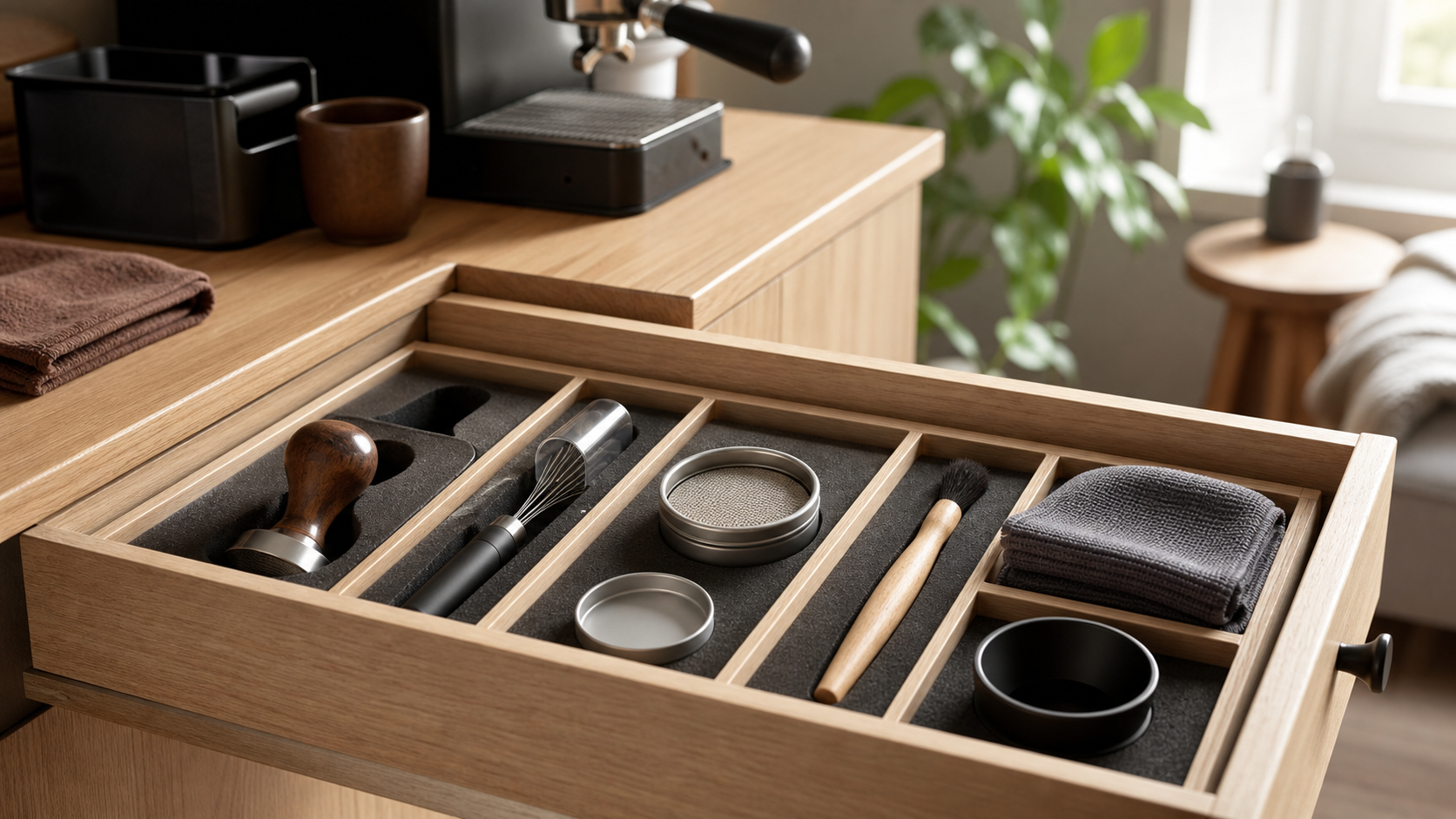
The safest small-drawer setup is not a pile of espresso accessories. Give every item one simple category: sharp, small and easy to lose, heavy, or cloth/cleanup. A WDT tool should have its cap, stand, or protected compartment; puck screens and funnels should sit in a small tray or lidded tin; a tamper should have a stable section; and used cloths should not share space with clean prep tools.
You do not need a dedicated coffee cabinet to do this. A single shallow drawer near the machine can work well when it opens fully, stays dry, and has enough room for tools to lie flat without being forced under one another. The goal is a calmer reset after each drink, not a larger accessory collection.
Apartment Barista uses Amazon affiliate links. As an Amazon Associate, this site earns from qualifying purchases. Prices, sellers, product details, return terms, and availability can change, so check the current Amazon page and your drawer measurements before buying an organizer.
Who This Guide Is For
This guide is for:
- apartment espresso users with one small kitchen drawer near the machine
- beginners using a WDT tool, puck screen, dosing funnel, tamper, brush, or scale
- people who want to clear daily tools off a narrow counter without hiding them so far away that they stop using them
- renters who want a removable organization solution rather than installed storage
This guide is not for:
- storing a hot portafilter, wet drip-tray parts, or a plugged-in appliance in a drawer
- leaving bare needles within reach of children, pets, or an open drawer edge
- using a drawer as a substitute for the machine maker's cleaning and safety guidance
- buying every accessory before a simple espresso routine is working
If a WDT tool has bent, loose, or exposed needles and you cannot protect it, stop storing it loose. Use the maker's cap or stand, a protected compartment, or leave it out of the routine until you can store it safely.
The Four-Zone Drawer
Think of a small espresso drawer as four small zones rather than one coffee junk drawer.
| Zone | Put here | Keep out |
|---|---|---|
| Sharp | capped or mounted WDT tool, needle tool, pointed brush | loose cloths and loose hands |
| Small parts | puck screen, dosing funnel, spare basket, dosing cup | large tamper or cleaning bottle |
| Heavy daily tool | tamper, distribution tool, scale in a dry sleeve | stacked screens and fragile needles |
| Cleanup | one clean cloth or a clearly separated clean-cloth supply | used wet cloths, food towels, chemicals |
This layout addresses a real small-space tradeoff. A tool can be easy to grab but unsafe if it rolls freely; it can be perfectly hidden but annoying if you must empty half a drawer to find it. Keep the tools you actually use in front, while still giving every sharp or tiny item a boundary.
For a low-mess dosing sequence before you decide where each tool goes, read dosing funnel and WDT workflow for small espresso counters. If the bigger issue is that you have bought too many accessories at once, espresso accessories beginners can skip is the better next read.
Set Up the Drawer Before You Buy Anything
Start with the drawer you already have. Empty it onto a dry towel, then sort only the espresso items you use in an ordinary week. Do not organize a collection of unused gadgets before you know whether they belong in your daily workflow.
- Measure the inside, not the drawer front. Measure width, depth, and the usable height when the drawer closes. Check for rails, plumbing, or a lip that reduces space.
- Remove wet and heat-sensitive items. A freshly rinsed puck screen, wet cloth, hot portafilter, or damp drip-tray part needs to dry elsewhere first.
- Protect the WDT tool first. Use its original cap or holder if it has one. If it does not, make a protected compartment where the needles cannot roll into a cloth or toward the drawer opening.
- Corral the tiny round parts. Put puck screens, funnels, spare baskets, and dosing rings in one small tray, cup, or lidded container. They are easy to lose beneath a tamper.
- Give the tamper a stable home. Put it flat in a section that does not crush delicate tools when the drawer closes.
- Keep cloths separate. Store a clean espresso cloth in a clean section. Put used cloths on a drying or laundry route, not back beside a WDT tool or dry coffee gear.
- Close the drawer slowly once. If anything shifts, catches, or stacks into the clearance, simplify the layout before using it every morning.
The exact arrangement is less important than the return path: after a shot, you should be able to wipe a tool if needed, put it back in its zone, and close the drawer without balancing or forcing anything.
What Deserves Protected Storage?
WDT tools and any needle-based tool
Treat a WDT tool as sharp even when the needles look thin. The practical rule is simple: never leave it bare under a towel, loose with a brush, or pointing upward at the front of a drawer. Use its supplied stand or cap where available. Otherwise, reserve a small compartment that keeps the handle from rolling and the needle end away from your hand.
This is also a reason not to buy WDT automatically. If you do not have a repeatable clumping or distribution problem, you may not need another sharp tool to store. The one-variable espresso troubleshooting guide explains how to decide whether a puck-prep accessory is solving a real issue.
Puck screens, funnels, and spare baskets
These small parts are not dangerous in the same way, but they are the easiest to misplace or bend under heavier tools. Give them a shallow tray, tin, or divider section. Keep machine-specific parts together only after confirming that they are compatible with your basket and portafilter; similar-looking 51 mm, 54 mm, and 58 mm parts are not automatically interchangeable.
Do not return a puck screen to a closed drawer while it is wet. Rinse and dry it according to the maker's directions, then return it to its small-parts zone. For basket and size checks, see Breville Bambino and DeLonghi Dedica accessory size guide.
Tampers and scales
The tamper is heavy enough to crush or pin small parts if it lands on them. Give it a section with a stable base rather than stacking it on a puck screen or funnel. A scale needs a dry spot; avoid placing it beside a damp cloth or cleaner bottle where a small spill can become a bigger problem.
If your scale normally stays beneath a compact machine, do not make the drawer its only home unless the machine is fully cool and the scale is clean and dry. The best storage routine is the one you can repeat without dragging tools across the counter.
Product Roles for a Small Espresso Drawer
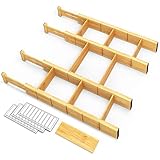
SpaceAid bamboo drawer dividers with inserts and labels
Best for: creating removable zones inside a drawer you have already measured
Why it fits:
SpaceAid bamboo drawer dividers are the organizer example in this guide because adjustable dividers can create a separate heavy-tool section, small-parts section, and clean-cloth section without permanently changing a rental kitchen. They are useful only when the drawer's interior measurements match the selected divider size and when the layout still lets the drawer close freely.
Good fit if:
- your drawer is deep enough for the divider and your daily tools
- you want a removable way to stop a tamper and puck screen from sharing one pile
- you can reserve a protected zone for a capped or mounted WDT tool
- the drawer is dry and close enough to the machine that tools will be returned
Skip it if:
- a small tray or existing utensil organizer already creates clear zones
- the drawer is too shallow, short, or crowded for a divider to sit securely
- you need a precise holder for bare needles rather than a general divider
- you have not measured the usable interior dimensions
Small-space note:
Dividers make boundaries; they do not make a shallow drawer taller. Do not stack a tamper, puck screen, and funnel in one compartment just because a divider made the pile look tidy.
Amazon check:
Confirm current seller, selected size, interior-drawer compatibility, insert and label details, return policy, price, and availability before buying.
Amazon Basics microfiber cleaning cloths
Best for: separating a clean espresso wipe-down cloth from used or food-prep towels
Why it fits:
Amazon Basics microfiber cleaning cloths are a simple support item for a drawer routine because a clean dedicated cloth makes it easier to reset grounds and drips without mixing coffee cleanup with a food-prep towel. The cloth does not need to stay in the drawer once used; its job is to start clean and then move to a defined drying or laundry place.
Good fit if:
- you want one designated cloth for the coffee area
- you can store clean cloths separately from used cloths and cleaning products
- you have a washing and drying routine
Skip it if:
- you already have a clean, washable, non-abrasive cloth system
- you need machine-specific descaling or tablet guidance instead of a surface cloth
- you expect a cloth to make a wet drawer safe for storage
Small-space note:
Keep only the next clean cloth in the espresso drawer. The rest can stay in a linen or utility area so the drawer remains a tool zone rather than bulk storage.
Amazon check:
Confirm current seller, pack size, cloth dimensions, care instructions, return policy, price, and availability before buying.
A Two-Minute Closing Routine
At the end of a drink, do not put every item away immediately if it is wet or hot. Use this short order instead:
- Turn off or finish with the machine according to its manual.
- Wipe away loose grounds with the clean cloth.
- Rinse and dry any part that requires it before it goes into the drawer.
- Return the tamper and dry small parts to their sections.
- Protect the WDT tool before closing the drawer.
- Move the used cloth to its drying or laundry spot.
- Close the drawer without forcing it.
This is deliberately modest. It prevents the common small-apartment pattern where the counter stays crowded because every tool is either wet, loose, or difficult to put back.
Common Mistakes
Treating a divider as a needle holder
A wide divider can separate zones, but it does not automatically protect exposed needles. Use the WDT tool's cap or mount when provided, or create a compartment that prevents contact and rolling.
Storing wet parts in the drawer
A closed drawer traps moisture and can transfer coffee residue to clean tools and cloths. Let rinsed screens, baskets, and cloths dry in their appropriate place first.
Mixing cleaning products with prep tools
Keep chemical cleaners upright in a separate cabinet according to their labels. A drawer for a tamper, puck screen, and cloth is not the place for an unprotected bottle.
Hiding every daily tool too far away
The drawer should make the routine easier, not turn it into a scavenger hunt. Keep only the tools that earn a regular place, and put the frequently used ones in the easy-to-return front section.
Buying organizers before checking the actual problem
If the drawer only holds one tamper, one cloth, and a protected WDT tool, you may only need a small tray. Start with the smallest organizing change that prevents a specific problem.
Before You Change Your Storage
Check these items first:
- usable interior width, depth, and closed-drawer clearance
- whether the drawer stays dry and fully opens near the espresso machine
- a cap, stand, or protected compartment for each sharp tool
- a small container for puck screens, funnels, and spare baskets
- a stable flat place for the tamper
- a separate route for used cloths and any chemical cleaner
- the exact machine and accessory compatibility for any basket-specific part
- current Amazon seller, dimensions, return terms, price, and availability for any organizer
FAQ
Can I keep a WDT tool in a drawer?
Yes, if it is protected from contact and rolling. A supplied cap or stand is the easiest answer. Do not bury exposed needles in a towel or leave them loose at the front edge of a drawer.
Should puck screens go in the drawer after rinsing?
Only after they are dry. Follow the screen maker's care guidance, then return it to a small-parts container so it does not sit under a tamper or disappear in the drawer.
Do I need a divider system for a small drawer?
Not always. A small tray, tin, or existing utensil organizer can be enough. Use dividers when your particular problem is larger tools and small parts sliding together.
Where should I keep used espresso cloths?
Move them to a defined drying or laundry spot after use. Do not put a damp cloth back with clean prep tools, dry coffee gear, or sharp accessories.
Is a drawer safer than leaving tools on the counter?
It can be, but only when sharp tools are protected, wet parts are kept out, and the drawer closes without shifting or crushing items. A hidden loose pile is still a loose pile.
Final Recommendation
Make one small drawer do one job well: protect sharp tools, contain small parts, stabilize the tamper, and keep a clean cloth ready. Start with the layout you already own, add an organizer only when it solves a measured drawer problem, and do not turn storage into another reason to buy espresso gear.