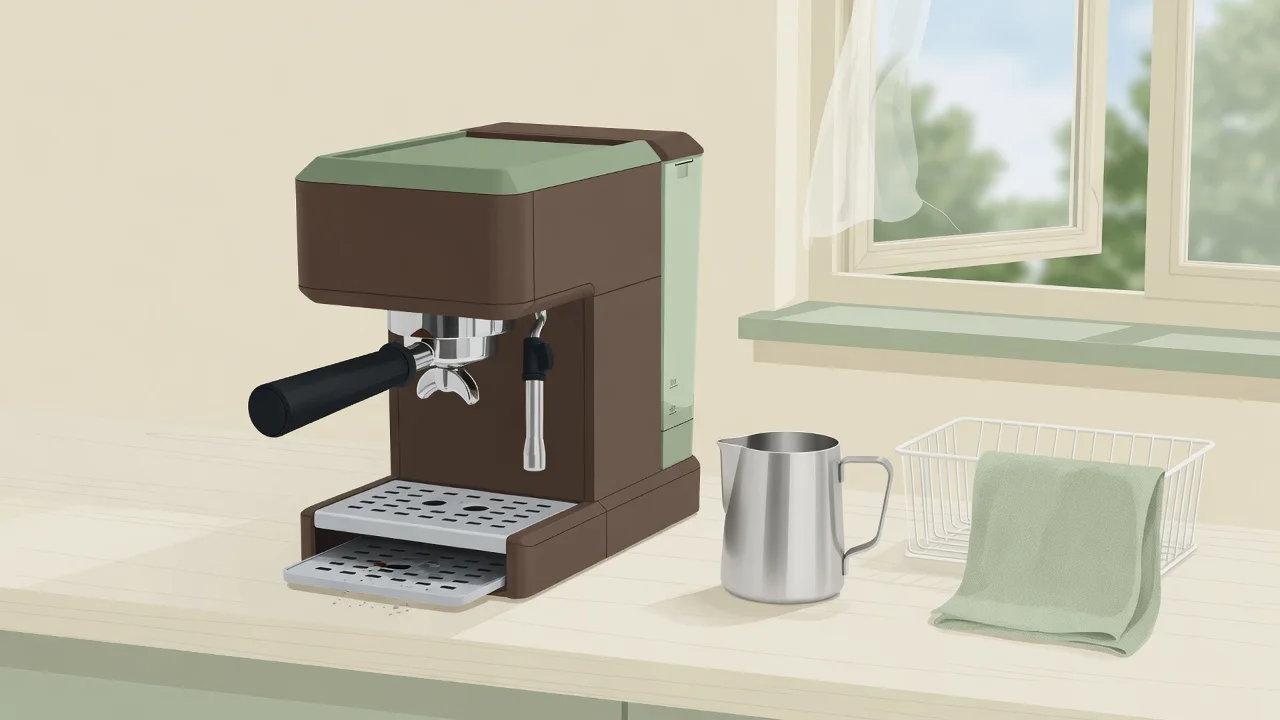

Quick Answer
A milk smell that keeps coming back usually comes from one part of the setup: milk left inside the steam wand, crusted tip holes, the milk pitcher, the drip tray or water pooled under it, the water tank or its filter, the cloth you wipe with, the milk itself, or old coffee grounds. Don't try to clean everything at once. Smell one part at a time, find the one that smells, and clean it the way your machine's manual describes.
Use only the cleaning methods your manual names. The De'Longhi manuals we checked say "Do not use solvents, abrasive detergents or alcohol to clean the coffee machine" (Stilosa US manual, page 11), and Breville's Barista Express manual says "Do not clean any of the parts or accessories in the dishwasher" (Barista Express BES870 manual, page 25). If the smell stays after every removable part is clean, or you ever smell burning, stop and contact the manufacturer's support. Don't open the housing.
Evidence in this guide: Manufacturer-researched (Breville and De'Longhi instruction manuals, checked October 29, 2026) and forum discussion (Reddit). Nothing here is Hands-on tested or a Measured mock-up. Where a step is our general advice rather than a manual instruction, we label it as general advice. This is a troubleshooting guide, not a ranking.
Apartment Barista uses Amazon affiliate links. As an Amazon Associate, this site earns from qualifying purchases. Prices and availability can change at any time and should be checked on Amazon before buying.
Who This Guide Is For
- Beginners making milk drinks on a compact machine, such as a Breville Bambino, Bambino Plus or Barista Express, or a De'Longhi Stilosa or Dedica, who notice a sour-milk or musty smell in a small kitchen.
- Anyone who already wipes and purges the wand and still smells milk.
This guide is about finding where a smell comes from. For the daily wipe-and-purge habit itself, see Steam Wand Cleaning Cloth Routine for Milk Drinks. For a full cleaning and descaling routine, see How to Clean an Espresso Machine in a Small Kitchen.
What Owners Ran Into (Forum Discussion)
These are individual owners' experiences, not a measurement of how often this happens or which machines smell more.
On March 23, 2026 (UTC), a Bambino Plus owner wrote: "the steam still smells faintly of sour milk. I really don’t know why since I clean the machine regularly and purge the steaming wand after every use." A commenter asked the next day: "Have you unscrewed the tip of the frother and soaked it?" The poster answered under that comment: "I just cleaned the tip and the wand but no change. The smell comes from the steam off the group head, not the steam wand." (Reddit, "Bambino Plus smells like sour milk")
On July 4, 2024 (UTC), an owner of a used Barista Express narrowed it the other way: "The steam smells sour, and with my current cleaning methods I haven't been able to make a dent on the smell. I don't notice the smell from the group head or the hot water outlet." (Reddit, "Steam from steam wand smells sour")
On October 20, 2026 (UTC), a Barista Express owner traced it to the tank: "i noticed the smell a couple of months ago when refilling the water tank. thoroughly washed the tank. the smell came back." A commenter replied the same day: "I imagine you replaced the charcoal filter? If not, I'd do that first." The poster answered under that reply the next day: "Replaced the filter today and will see how it goes." (Reddit, "Moldy smell from the water tank [breville barista express]")
On September 27, 2026 (UTC), a Dedica owner noticed it in standing water: "when I fill the tank, and let's say I don't use it for a day, the water smells, a musty smell to be exact." (Reddit, "Water Tank Smell? [Delonghi Dedica 885]")
On May 30, 2023 (UTC), an owner of a larger Breville machine wrote: "I accidentally left the steam wand going on full steam pressure for a good amount of time while I was away, and returned to find the machine was off but there was milk everywhere." Then: "The next day however, I went to make a coffee and it just tasted of rotten milk and the steam that was coming out had an awful smell." (Reddit, "The Dual Boiler steam wand rotten taste and smell") It's a different machine from the compact ones in this guide, but it shows that milk can end up inside a steam wand.
Put together, these owners found the smell in different places: the steam, the group head water, the tank. That's why it pays to smell one part at a time.
First, Smell One Outlet at a Time
With the machine on and the drip tray in place, run a little steam from the wand over the tray, then a little water from the group head with the empty portafilter in place, and smell each one. Then smell the tank water, the drip tray, the pitcher and your cloth. This is our general advice for narrowing it down; the fixes below come from the manuals.
Check Each Source
Inside the steam wand
Check: Purge the wand over the drip tray and smell the steam.
Manual fix: Wipe and purge right after steaming. The Barista Express manual says to point the tip over the drip tray and briefly turn on steam: "This will clear any remaining milk from inside the steam wand." (Barista Express BES870 manual, page 25). The Bambino Plus manual says its "Automatic purge removes residual milk from the steam wand when returned to the downward position." (Bambino Plus BES500 manual, page 9). The Dedica manual (EU edition, page 11) says a little steam after use "causes the cappuccino maker to discharge any milk left inside." For the full wipe-then-purge habit, see Steam Wand Cleaning Cloth Routine for Milk Drinks.
The tip holes
Check: Look at the holes in the tip. Crusted milk or weak, uneven steam points here.
Manual fix: Switch the machine off and let it cool first: "Press the POWER button to switch the machine off and allow to cool." Then "Use the pin on the end of the provided cleaning tool to unblock the hole(s)." If it's still blocked, "remove the tip using the integrated spanner in the cleaning tool and soak in hot water." (all Barista Express BES870 manual, page 25). The Bambino manual says to "unscrew the steam wand tip using the steam tip cleaning tool, then use the tool to unblock the holes" and then "Rinse the steam tip and wipe with a clean, dry cloth." (Bambino BES450 manual, page 16). On the Stilosa: "Remove the nozzle by pulling it downwards." and "Make sure the holes are not clogged. If necessary, clean them with a pin." (Stilosa US manual, page 10). The Dedica manual (EU edition, page 11) gives the same pin step. Only remove the parts your manual says to remove.
The milk pitcher
Check: Smell the empty, dry pitcher, especially the inside of the spout and the bottom seam.
Manual fix: The Barista Express manual lists the milk jug among the parts to clean "using warm water and a gentle dish washing liquid, then rinse and dry thoroughly." and says "All parts should be cleaned by hand using warm water and a gentle dish washing liquid." (Barista Express BES870 manual, page 10). It also says "Do not clean any of the parts or accessories in the dishwasher." The Dedica manual (EU edition, page 7) says "None of the components or accessories is dishwasher safe." As general advice, pour out leftover milk and rinse the pitcher right away rather than leaving it by the machine.
The drip tray and water pooled under it
Check: Pull the tray out, smell the water in it, and look underneath for standing water on the machine base or the counter.
Manual fix: The Bambino manual says the drip tray "should be removed, emptied and cleaned after each use or when the drip tray indicator rises through the drip tray grid" and to "wash both parts in warm soapy water." (Bambino BES450 manual, page 17). The Barista Express manual says "Wash all parts in warm soapy water with a soft cloth. Rinse and dry thoroughly." (Barista Express BES870 manual, page 25). The Stilosa US manual (page 11) says to "empty the water and clean the tray with a cloth", and the Dedica manual (EU edition, page 12) says the tray "must be emptied and cleaned" before its indicator shows. As general advice, wipe and dry the spot under the tray as well. If a small tray fills fast, see Tiny Drip Tray Workflow for Compact Espresso Machines. If water keeps turning up under the machine, see Why Is My Espresso Machine Leaking Water on the Counter? (Apartment Edition): Find the Source, Protect Your Rental, Know When to Stop.
The water tank or filter
Check: Smell the water in the tank, then smell the empty tank.
Manual fix: The Barista Express manual says "Always check the water level before use and replace water daily." (Barista Express BES870 manual, page 11). For its filter, it says "Replacing the water filter every two months will reduce the need to descale the machine." and "The water filter should be removed if using filtered or bottled water." (Barista Express BES870 manual, page 22). The Dedica manual (EU edition, page 12) says to "Clean the water tank regularly (about once a month)" "with a damp cloth and a little mild washing up liquid". The Bambino manual says "Do not use any other liquid apart from cold mains/tap water." (Bambino BES450 manual, page 5). Put nothing in the tank except the water your manual names: no cleaners, no tablets. If you descale a Dedica, its manual (EU edition, page 13) says "You should use De'Longhi descaler only." This section covers daily use; for a tank left full while you're away, see What to Do With Your Espresso Machine When You Travel (Apartment Edition): Drain, Dry, Unplug, and Restart.
The cloths
Check: Smell the cloth you wipe the wand with. A damp cloth that sat balled up on the counter can smell sour on its own.
Manual fix: The manuals only say to use a clean cloth: "Wipe the wand and tip with a clean damp cloth." (Bambino BES450 manual, page 13). They don't say how often to wash it. As general advice, use a fresh cloth for the wand, keep it apart from food-prep towels, and wash it often. See where to dry it in the apartment section below.
The milk itself
Check: Smell the milk in the fridge before you blame the machine.
Manual fix: "Start with fresh cold milk." (Bambino Plus BES500 manual, page 14). The Stilosa US manual (page 10) says "the milk must be at refrigerator temperature". As general advice, put the milk back in the fridge as soon as you've poured it.
The puck and knock box
Check: Look for a used puck still in the portafilter, or wet grounds sitting in a knock box or bin.
Manual fix: The Bambino manual's after-extraction step is "REMOVE USED GRINDS" (Bambino BES450 manual, page 14), and it says "The filter baskets and portafilter should be rinsed under hot water directly after use to remove all residual coffee oils." (Bambino BES450 manual, page 16). The manuals we checked don't cover knock boxes. As general advice, empty and rinse the knock box instead of leaving wet grounds in it overnight. For pucks and the tank when you'll be away, see What to Do With Your Espresso Machine When You Travel (Apartment Edition): Drain, Dry, Unplug, and Restart.
Milk Got Into the Water Tank by Mistake
On March 29, 2026 (UTC), one owner wrote that someone had "put milk into the DeLonghi" and "even after running water through it multiple times it smells like milk". (Reddit, "Milk smell doesn’t clear [De'Longhi ECP3630]") We didn't find guidance for this in the manuals we checked. The Dedica manual (EU edition, page 7) says "Use drinking water only to fill the tank". Don't experiment with cleaners in the tank. Contact the manufacturer's customer service and tell them exactly what went in.
In a Small Apartment
In a small or windowless kitchen, a sour smell has nowhere to go, so it can seem to come from everywhere. That's one more reason to smell one part at a time with your nose close to it. As general advice, air the room out, for example by opening a window or running the range hood fan while you check, so the room smell doesn't mask the part that's causing it.
Where the cloth dries matters too. As general advice, hang the wand cloth open to dry, away from the machine, the dish rack and food prep, instead of leaving it folded wet on the counter next to the machine, and swap it for a fresh one often. A small hook or a towel bar works.
When to Stop and Contact Support
If every removable part is clean and the steam or water still smells, stop and contact the manufacturer. The Barista Express manual says "For any maintenance other than cleaning, call Breville Consumer Support." (Barista Express BES870 manual, page 5). The Dedica manual (EU edition, page 7) says "If the appliance is faulty, do not attempt to repair. Turn it off, unplug from the mains socket and contact Customer Services." The Stilosa US manual (page 4) warns: "do not remove the exterior of the unit or the cover."
A burning or electrical smell is different from a milk smell. Stop using the machine, switch it off, unplug it if you can do that safely, and contact support. Don't open the housing.
Products Related to These Steps
This is not a ranking. Nothing listed here removes a smell on its own; the manual steps above do that.
- Amazon Basics Microfiber Cleaning Cloths are a pack of washable cloths, so you can keep one just for the steam wand and swap in a fresh one while the used one dries.
FAQ
Why does my steam smell like sour milk even though I purge after every use?
Milk can dry in the tip holes even when you purge. Switch the machine off, let it cool, and clear the holes with the tool or pin your manual names. On the Barista Express, the manual also says you can remove the tip and soak it in hot water. Then smell the group head water too, as the Bambino Plus owner above found the smell came from there.
Can I put cleaner, tablets or soap in the water tank to get rid of the smell?
Not unless your manual says so. The Bambino manual says "Do not use any other liquid apart from cold mains/tap water." (Bambino BES450 manual, page 5). The Dedica manual (EU edition, page 12) says to clean the tank itself with a damp cloth and mild washing-up liquid, then refill with fresh water.
Can the pitcher or steam tip go in the dishwasher?
Not on the Breville and De'Longhi machines we checked. The Barista Express manual says "Do not clean any of the parts or accessories in the dishwasher." (Barista Express BES870 manual, page 25), and the Dedica manual (EU edition, page 7) says none of its components or accessories is dishwasher safe.
Can I use alcohol or a strong cleaner on the steam wand?
The De'Longhi manuals say no: "Do not use solvents, abrasive detergents or alcohol to clean the coffee machine." (Stilosa US manual, page 11). Breville's manuals say not to use abrasive cleaners, pads or cloths.
Is my machine ruined if milk went into the tank?
We can't tell from here, and the manuals we checked don't cover it. Contact the manufacturer's customer service before you try anything else.
Sources
Manuals checked October 29, 2026. Page numbers are the page of the PDF file. Reddit dates are given in UTC.
- Breville, Bambino BES450 US instruction book
- Breville, Bambino Plus BES500 US instruction book
- Breville, Barista Express BES870 US instruction book
- De'Longhi, Stilosa US manual (EC260); see the De'Longhi Stilosa product page
- De'Longhi, Dedica EC685 instruction manual (EU edition, hosted by a retailer)
- Reddit posts and comments dated May 30, 2023, July 4, 2024, March 23, 2026, March 29, 2026, September 27, 2026 and October 20, 2026, linked above
Bottom Line
Don't chase a milk smell with stronger cleaners. Smell the steam, the group head water, the tank, the tray, the pitcher, the cloth, the milk and the grounds one at a time, then clean that part the way your manual says. Keep the wand cloth drying in the open, away from the machine. If the smell survives all of that, or it smells like burning, stop and contact the manufacturer.
Apartment Barista uses Amazon affiliate links. As an Amazon Associate, this site earns from qualifying purchases. Prices and availability can change at any time and should be checked on Amazon before buying.