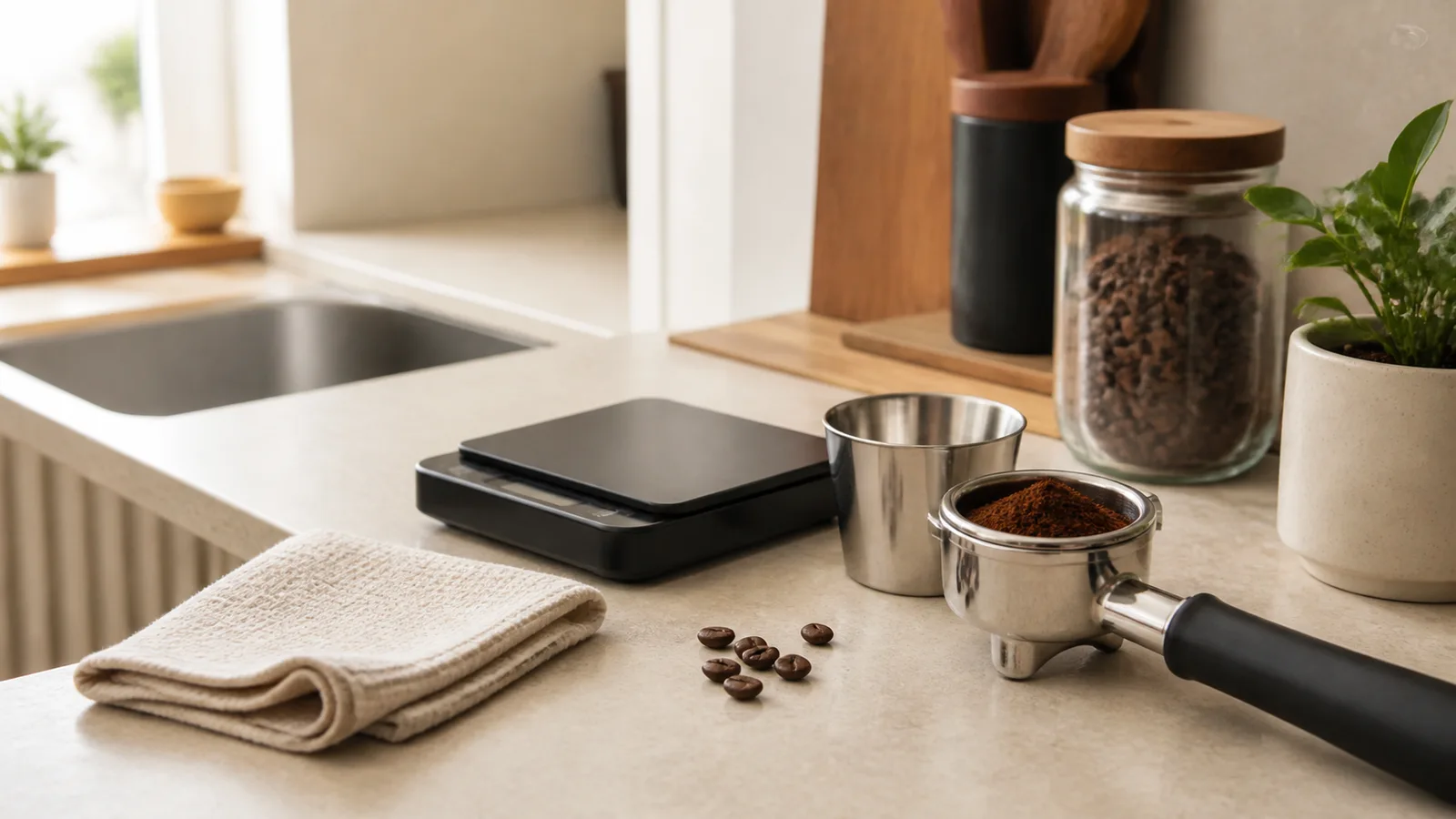

Quick Verdict
Most beginners do not need to buy a separate espresso dosing cup on day one. If your grinder includes a cup that transfers grounds cleanly into your basket, use it first. Add a separate cup only when your real routine has a repeatable problem: grounds spill during transfer, the included cup does not sit securely on the basket, or you need to weigh beans away from a cramped grinder.
A dosing cup is a workflow helper, not an extraction upgrade. It cannot replace an espresso-capable grinder, a scale, or a basket that fits your machine.
Who This Guide Is For
This guide is for an apartment beginner who has a separate grinder or is considering one, makes one or two drinks at a time, and wants to keep coffee grounds off a narrow counter. It is also for a Breville-style 54 mm portafilter owner who is unsure whether a cup, funnel, or both belongs on the first shopping list.
Skip this guide if you grind straight into a portafilter without spills and your current routine is already easy to repeat. You do not need an extra container just because it appears in espresso videos.
What Usually Goes Wrong
The common mistake is buying a cup, funnel, WDT tool, and new tamper before learning which part of the workflow is actually messy. A cup may make weighing and transferring calmer, but a poor fit can add another awkward pour. It also does not fix a grind setting, stale coffee, or a basket that is overfilled.
Recent beginner discussions show the practical distinction: a funnel can help keep grounds in the basket, while a separate cup is optional when an ordinary small cup or an included dosing cup already works. Treat that as a demand signal, not a guarantee for every grinder or portafilter.
How to Decide
| Decision factor | Why it matters in a small space | What to verify |
|---|---|---|
| Transfer fit | A cup that misses the basket rim can create more spills | Check the cup rim against your exact basket and portafilter |
| Grinder workflow | Some grinders include a dosing cup or a portafilter holder | Read the current manual and list of included parts |
| Counter route | One extra vessel needs a clean landing zone | Measure space for the grinder, scale, cup, and portafilter |
| Cleanup | Loose grounds travel quickly on a small counter | Decide whether a funnel, brush, or simple wipe-down solves the actual mess |
The Product Angle: A Grinder With an Included Dosing Cup
The Baratza Encore ESP is relevant here because its official operations manual describes an included espresso dosing cup and adapter ring for transferring coffee into 54 mm or 58 mm portafilters. That makes it a useful example of the first rule: check what your chosen grinder already includes before buying a second cup.
Best for: a beginner who needs an espresso-capable separate grinder and wants to try the included dosing-cup workflow before adding accessories.
Tradeoff: a separate grinder and cup take more counter height, add a transfer step, and can add noise. The included cup is not a universal fit promise for every basket, grinder, or aftermarket portafilter.
Skip or buy later: skip this grinder if pre-ground coffee in a machine-approved pressurized basket is intentional for now, or if the current bottleneck is machine fit rather than grind control. Buy a separate dosing cup later only if the included workflow repeatedly spills or does not fit your specific basket.
For the broader decision about a first grinder, see our beginner burr grinder guide. If the mess happens while filling a compact basket, our dosing funnel and WDT workflow guide is the better next read.
A Low-Clutter Test Before Buying Anything
- Put your empty portafilter, scale, and the cup you already own beside the grinder.
- Weigh beans in the cup or on the scale, then grind according to your grinder manual.
- Transfer slowly over a tray, towel, or clear counter section. Do not assume the cup must lock onto the basket.
- Make three normal drinks before deciding what fails: weighing, transfer, rim fit, static, or cleanup.
- If grounds only spill at the basket, test a correctly sized funnel before buying a different cup.
This keeps the decision specific. A cup is worthwhile when it removes a repeated, measured annoyance; it is clutter when it only duplicates a usable included part.
What Not to Buy Yet
Do not add a bottomless portafilter, puck screen, distribution tool, and replacement tamper all at once just to make a dosing cup feel useful. Change one variable at a time.
A dedicated cup can wait when:
- your grinder already includes one that fits your workflow;
- a clean, stable small cup transfers grounds without a problem;
- you still need to learn dose, yield, or grind adjustment; or
- a correctly sized funnel would solve the only spill point.
Before You Buy
- Confirm the exact grinder model, included cup, adapter, and portafilter compatibility in the current manual.
- Confirm your basket and portafilter diameter; 54 mm, 58 mm, and aftermarket parts are not interchangeable by name alone.
- Measure the counter route: grinder, scale, cup, portafilter, tamping area, and cleanup cloth.
- Check the current Amazon title, seller, return terms, dimensions, price, and availability before buying.
- Keep the original cup or packaging until you know the transfer is stable in your actual routine.
Final Recommendation
Start with the cup your espresso-capable grinder provides, if it has one. Buy a separate dosing cup only after you can name the repeatable problem it fixes. For a small apartment counter, fewer reliable steps are usually better than a larger collection of accessories.