

Quick Verdict
If you are building your first espresso setup, do not buy every accessory at once. Start with the things that make your routine more repeatable and easier to clean: a coffee scale, the right cleaning supply for your machine, and only then size-specific tools like a tamper or dosing funnel.
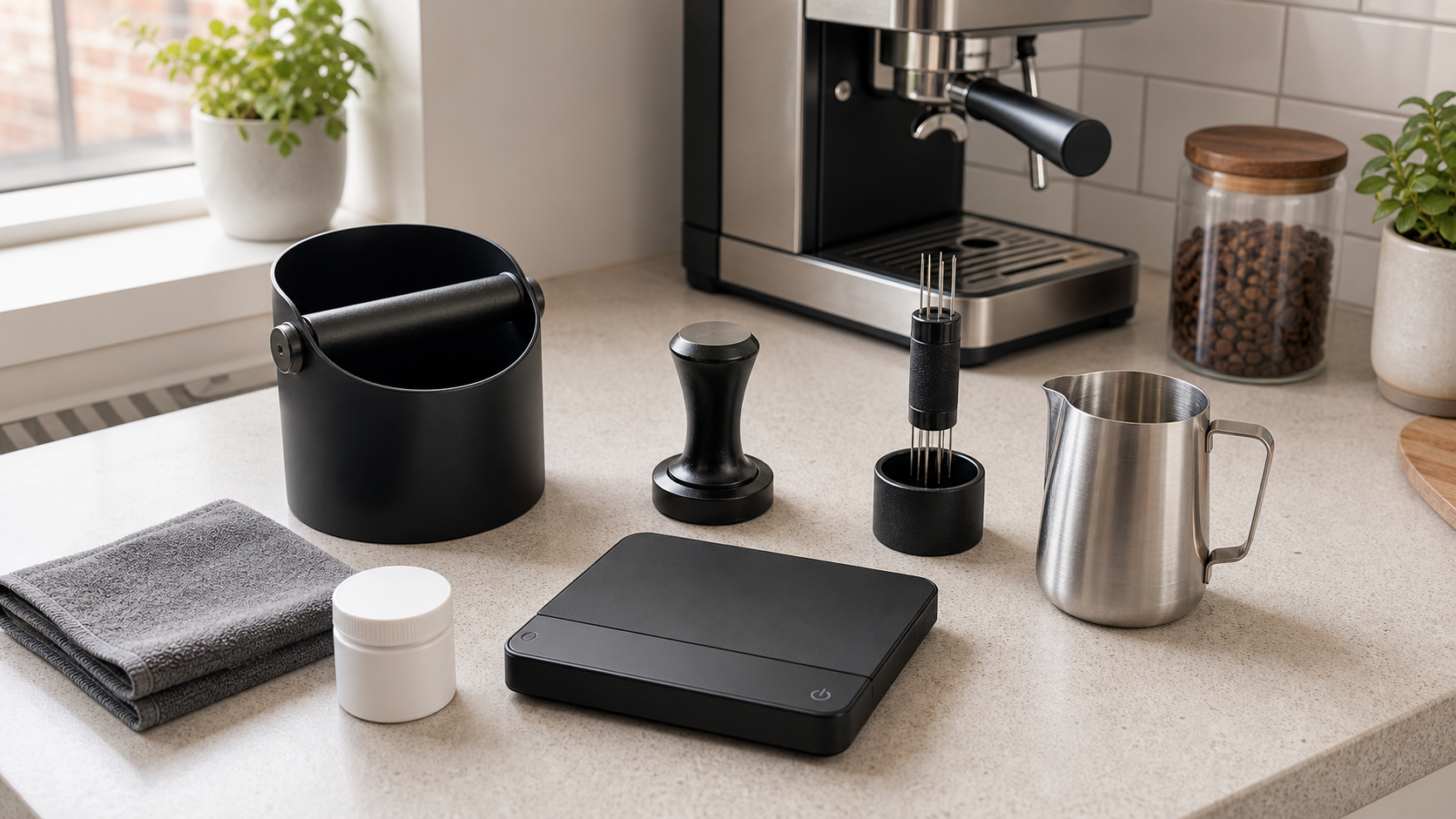
For most beginners, the BAGAIL BASICS Coffee Scale with Timer is the first accessory to buy because it helps you weigh coffee in and espresso out. The Normcore V4 53.3mm Spring-Loaded Tamper is the best fit here for many Breville 54mm basket users, but only if your machine uses that size. The Aieve WDT Tool is the small puck-prep tool that can help with clumpy grounds and channeling. The Amrules 12oz Milk Frothing Pitcher is the simple milk-drink pick for one latte at a time. The Breville Knock Box 10 is the convenience upgrade for a dedicated espresso corner. Urnex Cafiza Cleaning Tablets are the cleaning pick, but you should confirm your machine manual before using any tablet or backflush routine.
The big beginner rule is compatibility. A scale is broadly useful. Cleaning supplies depend on your machine manual. Tampers, dosing funnels, distributors, and baskets depend on portafilter size. Before buying any size-specific accessory, confirm whether your machine uses 51mm, 54mm, 58mm, or another basket size.
If you are still building the full setup, read this guide together with the beginner espresso setup under $500, best burr grinders for beginner espresso, and best compact espresso machines for small kitchens.
Who This Guide Is For
This guide is for:
- apartment renters with limited counter space
- beginners who bought or plan to buy a home espresso machine
- small-kitchen users trying to avoid accessory clutter
- latte and oat milk latte drinkers who need a simple milk pitcher
- buyers who want a practical first accessory list instead of a giant coffee bar wishlist
This guide is not for:
- commercial cafe use
- advanced espresso hobbyists building a large bench setup
- people who already know their exact basket, tamper, and puck-prep preferences
- buyers looking for decorative coffee station accessories before core workflow tools
The Need Behind This Guide
The real shopping problem is:
"I bought an espresso machine, and now Amazon is showing me tampers, distributors, funnels, mats, pitchers, knock boxes, scales, brushes, and cleaning tablets. Which ones do I actually need first?"
Current product and search-intent research points to a few repeated beginner problems:
- a scale matters more than most decorative accessories
- tampers and distribution tools can be useful, but only when they fit the machine
- beginners often buy a big accessory kit and use only two pieces
- small apartments need tools that store in one drawer or one small tray
- milk pitchers are simple, but the right size matters for one-drink routines
- cleaning tablets should match the machine manual, not a random internet routine
This guide is based on current Amazon product-page research and small-kitchen espresso workflow fit, not lab testing. Treat each pick as a buying shortlist, then confirm the current Amazon seller, return policy, exact size, current model, price, and availability before buying.
Quick Picks
| Pick | Best for | Why it fits |
|---|---|---|
| BAGAIL BASICS Coffee Scale with Timer | Coffee scale pick | Helps beginners weigh dose, yield, and time without taking much space |
| Normcore V4 53.3mm Spring-Loaded Tamper | Tamper pick | A more consistent tamping tool for many Breville 54mm basket users |
| Aieve WDT Tool Espresso Distribution Tool | WDT distribution pick | Small tool for breaking up clumps and improving puck prep habits |
| Amrules 12oz Milk Frothing Pitcher | Milk pitcher pick | Simple stainless pitcher size for one latte or cappuccino routine |
| Breville Knock Box 10 | Knock box pick | Compact puck disposal for a dedicated espresso corner |
| Urnex Cafiza Cleaning Tablets | Cleaning tablet pick | Practical cleaning supply for machines that call for espresso cleaning tablets |
What Matters Before Buying Espresso Accessories
A scale is usually the first real accessory. Espresso is hard to learn if you do not know how much coffee went into the basket or how much liquid came out. A timer helps you notice whether your shot is running much too fast or much too slow.
Compatibility matters more than brand matching. A 53.3mm tamper is not a general espresso tamper. It is meant for specific 54mm-style baskets, often in the Breville ecosystem. A 51mm DeLonghi basket, a 58mm machine, and a 54mm Breville machine need different accessories.
Puck prep tools should solve a real problem. A WDT tool can help if your grinder leaves clumps, your shots spray, or your puck prep feels uneven. It is not a replacement for a good grinder, fresh coffee, or a correct dose.
Milk tools should match your drink size. A huge pitcher can feel awkward when steaming one small latte. A 12oz pitcher is usually easier for one-drink beginner routines, while larger pitchers make more sense if you regularly make two drinks.
Cleaning is not optional. Some machines need cleaning tablets, some need descaling solution, and some beginner machines have different instructions depending on the model. Always follow the machine manual before using a tablet, detergent, or backflush routine.
Storage matters in apartments. A scale, tamper, WDT tool, pitcher, cleaning tablets, and knock box can already fill a small coffee corner. Skip large tamping stations, oversized knock boxes, and duplicate accessories until you know what you use every day.
Product Reviews
BAGAIL BASICS Coffee Scale with Timer
Best for: Coffee scale pick
Why it was selected:
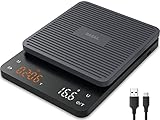
The BAGAIL BASICS Coffee Scale with Timer is the practical first accessory because it supports the whole espresso routine. It helps you weigh beans, weigh the portafilter dose, measure espresso yield, and time the shot. For a beginner, that feedback is more useful than buying several puck-prep tools before the basics are repeatable.
Good fit if:
- you want one scale for espresso and pour-over
- you need 0.1g-style measurement for beginner dose control
- you want a built-in timer instead of using a phone every time
- you have room for a small rectangular scale near the machine
Skip it if:
- your espresso machine has very little cup clearance
- you want a premium water-resistant espresso scale
- you need a very tiny scale for a cramped drip tray
- you dislike touch-style controls
Small-space notes:
Before buying, measure the space between your drip tray and portafilter spouts with your usual espresso cup. A scale can be compact on the counter but still too tall or too wide under a small machine.
Amazon check:
Check current Amazon seller, return policy, exact dimensions, charging cable, weight capacity, price, and availability before buying. Also confirm that it fits under your machine if you plan to weigh espresso output directly.
Normcore V4 53.3mm Spring-Loaded Tamper
Best for: Tamper pick
Why it was selected:
The Normcore V4 53.3mm tamper is the tamper pick because it helps remove one beginner variable: uneven pressure and tilt. The spring-loaded, self-leveling idea is useful when you are learning, especially if you use a Breville-style 54mm basket and want more consistency than the light tamper that often comes with entry machines.
Good fit if:
- your machine uses a compatible 54mm Breville-style basket
- you want a more repeatable tamp
- you struggle with crooked tamping
- you want a tamper that stores neatly on a small coffee tray
Skip it if:
- your machine uses a 51mm, 58mm, or nonstandard basket
- you are not sure what portafilter size you own
- you use pressurized baskets and are not ready to change puck prep yet
- you already have a tamper that fits well and feels consistent
Small-space notes:
This is a small accessory, but it is size-specific. Do not buy it just because it appears beside a Breville machine listing. Confirm the basket diameter first, then choose the matching tamper size.
Amazon check:
Check current Amazon seller, selected size, included springs, return policy, price, and availability before buying. The listing linked here is for the 53.3mm version, so check that the size option has not changed.
Aieve WDT Tool Espresso Distribution Tool
Best for: WDT distribution pick
Why it was selected:
The Aieve WDT tool is the distribution pick because it is small, inexpensive compared with machine upgrades, and useful for learning a better puck-prep routine. WDT stands for Weiss Distribution Technique. In simple terms, you use thin needles to stir the ground coffee in the basket before tamping, which can help break up clumps and spread the coffee more evenly.
Good fit if:
- your grinder leaves visible clumps
- your espresso sprays or channels often
- you want a small puck-prep tool instead of a large distributor
- you are learning to use a non-pressurized basket
Skip it if:
- you mostly use pre-ground coffee in a pressurized basket
- you want a tool that fixes grind size problems by itself
- you have young children around and cannot store needles safely
- you dislike slower, more careful prep steps
Small-space notes:
This tool is easy to store, but the needles need protection. Keep it in its stand or mount, not loose in a drawer where the needles can bend or poke other items.
Amazon check:
Check current Amazon seller, needle count, needle thickness, mount style, return policy, price, and availability before buying. Also confirm whether the mount works for your counter or machine layout.
Amrules 12oz Milk Frothing Pitcher
Best for: Milk pitcher pick
Why it was selected:
The Amrules 12oz milk pitcher is the simple milk-drink pick. A small stainless pitcher is useful if your machine has a steam wand, if you are practicing milk texture, or if you need a clean vessel for a handheld frother. The 12oz size makes sense for one latte or cappuccino routine in a small kitchen.
Good fit if:
- you make one milk drink at a time
- you use a compact espresso machine with a steam wand
- you want a basic stainless pitcher that rinses easily
- you drink lattes, cappuccinos, or oat milk drinks
Skip it if:
- you never make milk drinks
- you regularly steam milk for two large drinks at once
- you need a very specific pitcher shape for latte art practice
- you want a heavier premium pitcher
Small-space notes:
A 12oz pitcher is easier to store than a larger pitcher and usually easier to control for one drink. Rinse it right after steaming or frothing milk so residue does not dry inside.
Amazon check:
Check current Amazon seller, selected size, material notes, return policy, price, and availability before buying. Make sure you are buying the 12oz version if you want the one-drink size.
Breville Knock Box 10
Best for: Knock box pick
Why it was selected:
The Breville Knock Box 10 is the convenience pick for beginners who have a dedicated espresso corner. A knock box gives used pucks one predictable place to go, which keeps the sink and trash area cleaner during back-to-back shots.
Good fit if:
- you make espresso most days
- you have a small but permanent coffee station
- you want cleaner puck disposal than tapping into the trash
- you use a Breville machine and like matching accessories
Skip it if:
- your counter is extremely tight
- you only make espresso occasionally
- your trash can is close enough and works fine
- you do not want another item to empty and wash
Small-space notes:
A knock box is useful, but it is not mandatory on day one. If you have a tiny counter, start without one and add it only after you know your espresso routine is frequent enough to justify the space.
Amazon check:
Check current Amazon seller, exact dimensions, return policy, price, and availability before buying. Confirm that the footprint fits your coffee tray or counter area.
Urnex Cafiza Cleaning Tablets
Best for: Cleaning tablet pick
Why it was selected:
Urnex Cafiza tablets are the cleaning pick because espresso beginners often remember the machine and grinder but forget maintenance. Cleaning tablets can be useful for machines that call for espresso cleaning tablets or backflushing routines, but they should be used according to your machine manual.
Good fit if:
- your machine manual calls for espresso cleaning tablets
- you want a dedicated cleaning supply before the warning light appears
- you have a machine with a compatible cleaning cycle or backflush routine
- you prefer tablets over measuring powder
Skip it if:
- your machine manual says not to use cleaning tablets
- your machine needs descaler instead of detergent tablets for the task you are doing
- you are not sure whether your machine supports backflushing
- you want one cleaner for every part of every machine
Small-space notes:
Cleaning tablets are easy to store in a cabinet or small coffee drawer. Keep them away from food prep confusion, label the container clearly, and follow the machine instructions instead of improvising.
Amazon check:
Check current Amazon seller, tablet count, return policy, price, and availability before buying. Before use, confirm your exact espresso machine model's cleaning instructions.
Setup Advice for Small Kitchens
Buy accessories in stages. For most beginners, the first stage is a coffee scale and the correct cleaning supplies. These help you learn and protect the machine.
The second stage is compatibility-based. Once you know your machine and basket size, add the tamper, WDT tool, or dosing funnel that actually fits your workflow. This avoids the classic beginner mistake of buying a 58mm accessory for a 54mm or 51mm setup.
The third stage is convenience. Add a knock box, tamping mat, organizer, or extra pitcher only if you know you will use it often. These are nice to have, but they can quickly take over a small counter.
For a compact apartment coffee corner, one simple layout works well:
- keep the machine, scale, and milk pitcher within daily reach
- store the cleaning tablets away from the food prep area
- keep the tamper and WDT tool on a small tray beside the grinder
- skip large tamping stations until you have a permanent counter spot
- empty and rinse milk tools immediately so the sink does not become part of the coffee station
Common Mistakes
Buying the wrong tamper size. This is the big one. Always confirm the basket size before buying tampers, funnels, distributors, or puck screens.
Skipping the scale. A scale is less exciting than a shiny accessory kit, but it makes espresso easier to learn because it gives you numbers to repeat.
Buying a huge knock box too early. A knock box is convenient if you make espresso often, but a tiny apartment counter may not need one right away.
Using cleaning tablets incorrectly. Cleaning tablets are not the same thing as descaler. Follow the machine manual for what to use, where to use it, and how often.
Expecting WDT to fix everything. WDT can improve distribution, but it cannot fix stale beans, the wrong grind size, or a grinder that cannot grind fine enough for espresso.
Buying accessories before choosing the machine. If you do not know whether you will own a 51mm, 54mm, or 58mm setup, wait on size-specific tools.
FAQ
Which espresso accessory should a beginner buy first?
Start with a coffee scale. It helps you weigh your coffee dose, measure espresso output, and repeat a good shot. Cleaning supplies are also early essentials, but the exact cleaner depends on your machine manual.
Do I need a tamper?
Yes, most traditional espresso workflows need a tamper. Many machines include a basic one, but upgrading can make tamping more comfortable and consistent. The important part is buying the correct size for your basket.
What tamper size do I need?
Check your machine manual or basket size. Common home sizes include 51mm, 54mm, and 58mm, but there are variations. The Normcore pick in this guide is the 53.3mm version for many Breville 54mm baskets, not a universal size.
Is a WDT tool necessary for espresso?
It is helpful, not mandatory. A WDT tool can help break up clumps and distribute grounds more evenly before tamping, especially with non-pressurized baskets. Beginners using pressurized baskets and pre-ground coffee may not benefit as much at first.
Do I need a knock box?
Not on day one. A knock box is useful if you make espresso often and want a cleaner workflow, but you can wait until you know your routine. In a very small kitchen, space may matter more than convenience.
What milk pitcher size should I buy?
For one drink at a time, a 12oz pitcher is a practical beginner size. It is easier to store and usually easier to handle than a large pitcher. If you regularly make two milk drinks, consider a larger size later.
Can I use cleaning tablets in any espresso machine?
No. Use cleaning tablets only when your machine manual calls for them. Some maintenance tasks require descaler, some require detergent tablets, and some beginner machines have model-specific routines.
What accessories can wait?
Large tamping stations, puck screens, precision baskets, extra distribution tools, bean cellars, and decorative organizers can usually wait. Learn the machine, grinder, scale, and cleaning routine first.
Disclosure
Apartment Barista uses Amazon affiliate links. As an Amazon Associate, this site earns from qualifying purchases. Prices and availability can change at any time and should be checked on Amazon before buying.