


Quick Verdict
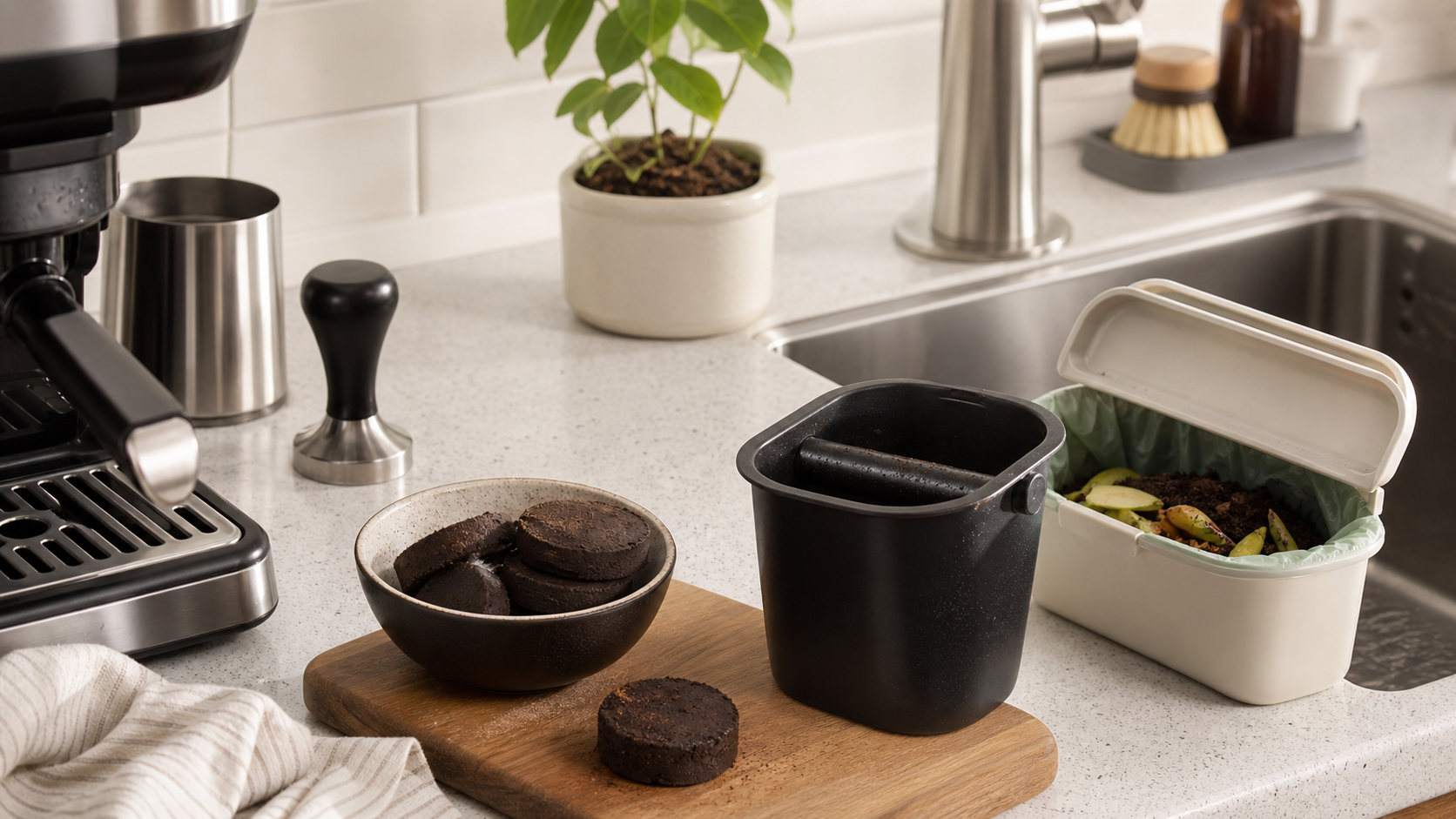
The simplest apartment routine is this: knock the puck into a small dedicated container, wipe the portafilter and counter, then move the puck to trash or compost before it smells. Do not build a daily habit of rinsing espresso pucks or loose grounds down the sink.
If you make espresso most days, the Breville Knock Box 10 is the easiest compact puck-disposal pick to check first. If smell or splatter is the main issue, the Ourokhome Espresso Knock Box with Lid is the better fit to compare. If your counter is already full, keep the disposal container small and use SpaceAid Bamboo Drawer Dividers to hide cloths, brushes, and backup tools. Amazon Basics Microfiber Cleaning Cloths are included because puck disposal usually leaves a wet cleanup step, not because a cloth replaces machine maintenance.
You do not need a giant knock box to be a good home barista. You need a repeatable route from portafilter to bin, a dry cloth, and a clear rule for when the pucks leave the kitchen.
If you are still planning the full coffee corner, read this with best knock boxes for small kitchens, best low-mess espresso setup for beginners, and how to clean an espresso machine.
Who This Guide Is For
This guide is for:
- apartment renters making espresso in a small kitchen
- beginners with a Bambino, Dedica, Gaggia, or similar compact machine
- people dealing with wet pucks, trash smell, or a tiny sink area
- latte drinkers who already have milk cleanup to manage
- anyone deciding whether a knock box is worth the space
This guide is not for:
- commercial cafe workflow
- people with outdoor compost access directly beside the machine
- buyers looking for a decorative coffee bar before solving the routine
- anyone who only makes espresso once in a while and can keep the setup simpler
What Real Users Are Trying to Solve
The real apartment question is not only "which knock box should I buy?"
It is closer to this:
"Where do these wet pucks go so my sink, trash, counter, and apartment do not smell?"
Current public user discussions show a few repeated patterns. Some people like a knock box because it keeps the portafilter near the machine instead of dripping across the kitchen. Some people skip the knock box and toss pucks into trash or compost. Others run into smell, mold, splatter, or a too-large container that steals counter space.
Public plumbing guidance is also consistent enough to be conservative: coffee grounds do not dissolve like a liquid. A few stray grounds during rinsing are not the same as dumping pucks down the sink every day.
The Short Disposal Rule
Use this order:
- Knock or loosen the puck into a dedicated container.
- Keep loose grounds out of the sink as much as practical.
- Wipe the basket, portafilter, and counter.
- Move pucks to trash, compost, or municipal organics before they smell.
- Rinse and dry the container often enough that it does not become the dirty part of the setup.
That rule matters more than the exact product. A small open knock box can work if you empty it daily. A lidded box can work if the lid does not make the routine annoying. A trash-only routine can work if the trash is close and you are not steaming the whole bin with hot wet pucks.
Quick Picks
| Pick | Best for | Why it fits |
|---|---|---|
| Breville Knock Box 10 | Compact knock box | Dedicated puck target with a small home workflow and removable bar |
| Ourokhome Espresso Knock Box with Lid | Lidded puck disposal | Better for smell, splatter, and apartment counters where pucks may sit briefly |
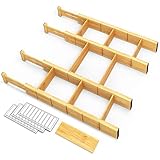
| SpaceAid Bamboo Drawer Dividers | Cleanup-tool storage | Keeps cloths, brushes, filters, and small espresso tools out of sight |
| Amazon Basics Microfiber Cleaning Cloths | Daily wipe-down | Gives the wet cleanup step a repeatable cloth routine |
Do not treat this table as a fixed-price cart. Check the current Amazon seller, dimensions, selected size or color, return policy, price, and availability before buying.
Apartment Fit Checks Before Buying Anything
Check the trash path. If the trash can is across the room, a knock box near the machine may prevent drips and grounds on the floor.
Check the sink path. If your sink is tiny or often full of dishes, do not rely on the sink as the puck landing zone.
Check smell timing. If your kitchen warms up quickly or the trash sits for several days, empty pucks sooner.
Check counter width. A knock box competes with the grinder, scale, towel, cup, milk pitcher, and drying area.
Check knocking noise. In a shared apartment, a loud morning knock can matter almost as much as grinder noise.
Check compost rules. If your building, city, or kitchen does not have an organics route, do not build a compost routine that you cannot actually keep.
Check the Amazon listing. Confirm the current seller, exact dimensions, capacity notes, selected color or size, return policy, price, and availability.
Best Picks
Breville Knock Box 10
Best for: Compact knock box
Why it fits this need:
The Breville Knock Box 10 is the simple dedicated-bin route. Current Amazon and Breville-facing materials position it around a 10-puck home capacity with a removable knock bar, which is enough for many one- or two-drink apartment routines if you empty it regularly.
Good fit if:
- you make espresso most days
- the trash can is not right beside the machine
- you want a stable target instead of knocking over the sink
- you have a small open counter spot or tray
Skip it if:
- you only make espresso occasionally
- you need a lid for smell control
- your counter is already too crowded
- you want the cheapest possible no-gear routine
Tradeoff:
A compact knock box makes the workflow cleaner, but it is still another wet container. It only stays helpful if you empty, rinse, and dry it often.
Check before buying:
Confirm the current Amazon seller, exact Breville model, dimensions, capacity notes, return policy, price, and availability.
Ourokhome Espresso Knock Box with Lid
Best for: Lidded puck disposal
Why it fits this need:
The Ourokhome lidded knock box is the better product angle when smell, splatter, and visible wet pucks are the main apartment problem. Current Amazon-facing materials show a lidded knock-box format with a removable bar and compact home-coffee positioning.
Good fit if:
- pucks may sit for part of the day before trash or compost
- you want used grounds covered between cleanouts
- splatter around the knock area bothers you
- your coffee setup is visible from the living area
Skip it if:
- you empty every puck immediately
- you dislike managing a lid during cleanup
- you need the smallest possible footprint
- you do not make espresso often enough to justify a dedicated bin
Tradeoff:
A lid can help contain the problem, but it does not erase it. Wet coffee still needs to leave the kitchen or be cleaned out before odor and mold become the bigger issue.
Check before buying:
Confirm the current Amazon seller, selected color, lid design, exact dimensions, return policy, price, and availability.
SpaceAid Bamboo Drawer Dividers
Best for: Cleanup-tool storage
Why it fits this need:
Puck disposal is easier when the cloth, brush, filters, and small tools have a predictable home. The SpaceAid divider set is not a puck container; it is the storage pick for keeping cleanup supplies near the machine without turning the counter into a tool display.
Good fit if:
- you have a drawer close to the espresso setup
- microfiber cloths and brushes keep migrating across the counter
- you want to separate cleaning items from prep tools
- you need a renter-friendly organization fix with no drilling
Skip it if:
- your drawers are shallow or already full
- you need a sealed food-waste container, not tool storage
- your coffee setup is on a cart with no drawer
- you have not measured the drawer interior
Tradeoff:
Hidden storage keeps the counter calmer, but it only works if the drawer is close enough to use. If the drawer is across the kitchen, the cloth will end up on the counter anyway.
Check before buying:
Confirm drawer interior dimensions, current Amazon seller, selected size and color, return policy, price, and availability.
Amazon Basics Microfiber Cleaning Cloths
Best for: Daily wipe-down
Why it fits this need:
Used pucks usually leave small wet steps: a drip near the portafilter, stray grounds on the counter, a wet drip tray, or milk cleanup after a latte. A dedicated washable cloth makes the routine easier than grabbing random kitchen towels.
Good fit if:
- you want one cloth near the machine every day
- your espresso setup shares space with food prep
- you make milk drinks and already need wipe-down habits
- you want a small reusable cleanup supply
Skip it if:
- you will not wash and dry used cloths regularly
- you need a machine cleaner, descaler, or cleaning tablet
- you prefer disposable towels for food-waste cleanup
- you do not have a clean place to dry the cloth
Tradeoff:
A microfiber cloth helps the daily wipe-down, but it also creates laundry. Keep coffee and milk cloths separate from food-prep towels.
Check before buying:
Confirm the current Amazon seller, pack size, cloth dimensions, washing guidance, return policy, price, and availability.
Trash, Compost, or Knock Box?
Use trash if it is the simplest reliable route
Trash is fine when compost is not available or when your building rules are unclear. The trick is not letting hot wet pucks sit in a small kitchen trash can for too long. If smell is a problem, let the puck cool in a small container first, then move it to trash soon after.
Use compost only if you have a real compost route
Coffee grounds can belong in compost, but an apartment compost plan has to be practical. If your city, building, or household already collects organics, pucks can fit that routine. If not, do not keep a wet mini compost bin just because it feels theoretically better.
If you garden, avoid treating espresso pucks like an automatic plant booster. Use local compost guidance and do not pile thick wet grounds directly around plants without understanding the soil and plant needs.
Use a knock box if it reduces daily friction
A knock box is worth considering if it keeps the portafilter near the machine, prevents drips across the room, and gives pucks one controlled landing spot. It is not worth it if the box itself becomes a smelly object you avoid cleaning.
What I Would Do First
If you make espresso once or twice a week, skip the knock box at first. Knock or loosen the puck into a small lined trash container, wipe the counter, and see whether the routine bothers you.
If you make espresso most mornings, add a compact knock box or lidded container near the machine. Empty it after the session or at least daily in a warm apartment.
If you have compost collection, keep the coffee station routine separate from the final compost bin. The knock box can be the short-term landing spot; the compost bin can be the final destination.
If your kitchen is tiny, prioritize the grinder, scale, and wipe-down routine before adding a large puck drawer. Used pucks need a path, but they do not need to own the counter.
Common Mistakes
Dumping pucks into the sink every day
Loose grounds and full pucks are not a good daily sink habit. Knock them into a container first, then rinse only the small residue that is left after the puck is removed.
Buying a large knock box before measuring
A large bin can solve capacity and create a new counter problem. Measure the portafilter swing, cup zone, towel spot, and grinder area first.
Letting wet pucks sit too long
Wet coffee in a small apartment can smell faster than you expect. A lid helps with visibility and odor, but it is not a substitute for emptying and rinsing.
Forgetting the cloth routine
The puck may be gone, but the workflow still leaves stray grounds and moisture. Keep one cloth nearby and give it a drying and laundry plan.
Treating compost as automatic
Compost is only useful if it matches your building, city, or garden routine. If you do not have a clear compost route, use trash and keep the bin clean.
Check Before Buying
- Confirm the current Amazon seller and return policy.
- Confirm exact dimensions, including width, depth, height, lid clearance, and drawer fit.
- Confirm whether the knock bar is removable.
- Confirm selected color or size; Amazon variants can change.
- Confirm where the container will sit during the shot.
- Confirm where pucks go after the session: trash, compost, municipal organics, or another allowed route.
- Confirm price and availability on Amazon instead of relying on this article.
FAQ
Do I need a knock box in an apartment?
Not always. You need a puck-disposal routine. A knock box helps if you make espresso often, the trash is not nearby, or you want fewer drips around the kitchen. If you make espresso occasionally, a small trash routine may be enough.
Can espresso pucks go down the sink?
Avoid making that your routine. Remove the puck first and keep most grounds out of the drain. A few stray grounds during rinsing are different from pushing wet pucks into the sink every day.
Can espresso pucks go in compost?
They can if your compost system accepts coffee grounds and your apartment has a practical organics route. Balance them with other compost materials and follow local guidance. Do not assume every building, city, or indoor bin handles wet grounds the same way.
How often should I empty a knock box?
For a small apartment, empty it after the session or daily. If the kitchen is warm, humid, or visible from the living area, empty it sooner.
What if my puck is soupy?
A wet puck can happen with some baskets, machines, grind settings, and dose levels. Do not overreact by buying more accessories immediately. Knock or scoop it into a container, wipe the basket, and focus first on a clean routine.
What should I buy first?
If you already have the machine and grinder, start with a simple cloth and a disposal route. Add a compact or lidded knock box only if the routine is messy enough to justify the counter space.
Final Recommendation
For most apartment beginners, the best puck plan is small and boring: one dedicated landing spot, one wipe-down cloth, and a daily emptying habit. Choose the Breville Knock Box 10 if you want the simplest compact bin, the Ourokhome lidded box if smell and visibility matter more, and drawer dividers plus microfiber cloths if the bigger problem is keeping cleanup tools out of the way.
The right solution is the one you will actually use after a rushed morning latte.
Disclosure
Apartment Barista uses Amazon affiliate links. As an Amazon Associate, this site earns from qualifying purchases. Prices, sellers, return terms, product details, and availability can change at any time and should be checked on Amazon before buying.